Up: On the use of data,
As was explained in Sect. 2.2, correlations exist between
abscissa
residuals on the same reference great circle, in particular for observations
with differences between the abscissa values of less than 4 degrees.
These correlations can only be fully accounted for through the use of the
abscissa data in combined solutions for the astrometric parameters of
groups of stars. Combined solutions are essential for solving mean parallax
and proper motion values in a relatively small area of the sky (density of
objects more than 0.2 per square degree). In addition, combined solutions
offer the best possibilities for incorporating constraints obtained from
other data.
 |
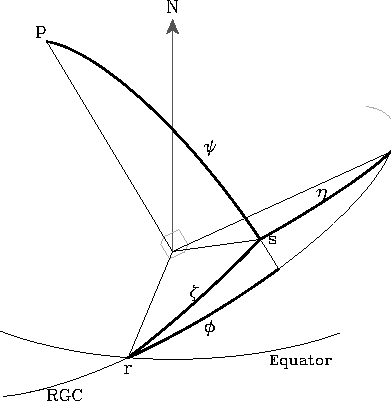
Figure 4:
Definition of the angles and directions used to calculate the
relative abscissae along the reference great circle |
In a combined solution one starts by collecting all the
abscissa data for the stars involved, and sort these on orbit number
(there is one reference great circle, or RGC, per orbit).
Covariance matrices are determined and applied per reference great circle.
The reference great circle data file (Table 2.8.1 in Vol. 1) provides
the pole positions for the NDAC and FAST RGCs, which are transformed to
unit vectors in the equatorial reference system,  and
and
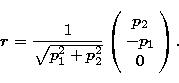
 . A unit length reference direction
  (Fig. 4) on each RGC can be obtained e.g. from its crossing with the Equatorial plane:
|  |
(15) |
from which:
|  |
(16) |
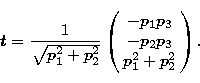
A vector  completes the triad
 :
:
|  |
(17) |
Given the unit vector  directed towards the reference position
of a star (the effect of aberration and other smaller effects have been
removed in the great-circle reduction process and would have been almost
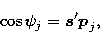
identical for neighbouring stars), we calculate the angles
directed towards the reference position
of a star (the effect of aberration and other smaller effects have been
removed in the great-circle reduction process and would have been almost
identical for neighbouring stars), we calculate the angles  and
and
 (see Fig. 4):
|  |
(18) |
| (19) |
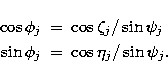
and  :
:
|  |
(20) |
where j equals N or F, depending on the origin of the observation.
The abscissa  for this star is then derived from:
|  |
|
| (21) |
Although for large distances between stars the difference between the
abscissae will be almost equal to the actual distance between those stars
on the sky, this is not necessarily the case for small distances
(less than a few degrees), where the correlations are the strongest.
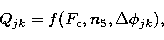
The abscissa separation between two stars,  , measured by the
same consortium on the same RGC, is translated into a correlation coefficient,
using the functions given in Table 1 (with n5 as defined in
Sect. 2.2 and
, measured by the
same consortium on the same RGC, is translated into a correlation coefficient,
using the functions given in Table 1 (with n5 as defined in
Sect. 2.2 and  a flag indicating the relevant
consortium):
a flag indicating the relevant
consortium):
|  |
(22) |
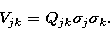
which produces a coefficient in the covariance matrix:
|  |
(23) |
Although no direct correlations exist between data for different stars on
the FAST and NDAC RGCs, secondary correlations or covariances do occur as
a result of the correlations between measurements of the same stars by NDAC
and FAST. One of the differences between a natural correlation and a covariance
due to a secondary correlation is that the first kind affects the total
amount of information (``total weight'') of the observations, while the
second kind does not.
The exact values of these covariances are difficult to estimate
due to possible small correlations between attitude errors, but their
approximate values can be derived as follows. Assume three sets of unit
weight residuals, 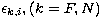 and
and  .
Say that there are natural correlations between
.
Say that there are natural correlations between  and
and
 (same observation, different reductions), such that
 .
Similarly, a natural correlation exist between and
.
Similarly, a natural correlation exist between and
 (same reference great circle, different stars), given by
QFF<552>ij. No natural correlation exist between and
, but due to the other correlations, a covariance will
occur, which can be approximated by substituting
(same reference great circle, different stars), given by
QFF<552>ij. No natural correlation exist between and
, but due to the other correlations, a covariance will
occur, which can be approximated by substituting  , which results from the first correlation. Thus,
as and
, which results from the first correlation. Thus,
as and  are uncorrelated, we find for the
covariance
are uncorrelated, we find for the
covariance  ,giving the following element in the covariance matrix:
|  |
(24) |
This covariance is only an approximation; in fact a slightly different value
can be obtained by using a different link between the variables:
|  |
(25) |
The effect of introducing these covariances in the covariance matrix is
to preserve the proper weight reduction caused by the natural correlations:
they cancel out when inverting the covariance matrix, leaving at the diagonal
elements only the effects of the natural correlations. In the example given
above the covariance matrix looks like:
| 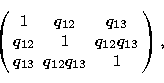 |
(26) |
where we substituted QFF<594>ij=q12, QFN<596>ii=q13, and assumed all
variances to be equal to 1.
A Gauss elimination produces:
| 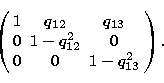 |
(27) |
The inverted, variance matrix then reads as follows:
| 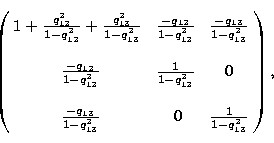 |
(28) |
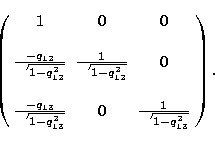
from which is obtained the Cholesky square root, as defined by
Eq. (5), and by means of which the observations are
weighted:
|  |
(29) |
Thus, in the final weighting of the observations, the covariances as
produced by the secondary correlations (products of q12 and q13)
have disappeared, and only the influences of the natural correlations remain.
After inverting  and taking its Cholesky square root, it can be
applied to the original observations to obtain a set of uncorrelated and
properly weighted observation equations. This is done for the data in each
RGC, covering the observations of both consortia (when available). These
de-correlated observations can then be incorporated in a classical
least-squares solution.
and taking its Cholesky square root, it can be
applied to the original observations to obtain a set of uncorrelated and
properly weighted observation equations. This is done for the data in each
RGC, covering the observations of both consortia (when available). These
de-correlated observations can then be incorporated in a classical
least-squares solution.
The observational equations used for each star can either be the original
equations, in which case corrections to the individual parameters are
found, and a set of uncorrelated parameters is determined, or they
can contain common parameters such as a common proper motion and/or a
common parallax. When solving for a common parameter, it is essential that
all abscissa residuals are corrected to represent a reference solution
referring the abscissa residuals for all stars involved in the combined
solution to the same parallax and/or proper motion values. These corrections
are obtained using Eq. (10). Thus, for the LMC-stars example,
the residuals are corrected to reference values of zero proper motion and
a parallax of 0.02 mas, and then solved together
for a common proper motion. The combined solution provides corrections to
the reference values. It is also possible to use all observations, ignoring
rejections from the standard processing, and determine new rejections
under the new conditions, based on the residuals relative to the
combined solution. When determining the mean proper motion of
a star cluster, it is possible to incorporate precise differential
proper motions obtained on the ground as constraints for the solution.
In all cases, the degrees of freedom available will be strongly reduced,
thus improving the reliability of the solution.
In the solutions for a star cluster the space velocity rather than the proper
motion should be considered constant. Without the presence of internal
motions this condition can be used to determine individual distances and
radial velocities of cluster members, as was shown for the Hyades cluster
by Dravins et al. (1997). For a cluster like the Pleiades,
however, with a higher internal velocity dispersion but a larger distance
and a small radial velocity, the differential distance variations and the
projection of the radial velocity can be ignored, and the shared space
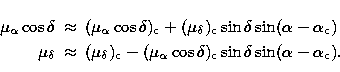
velocity of cluster members can be expressed as a function of the proper
motion of the centre of the cluster (indicated by the subscript ``c'') and
the position of each object on the sky, relative to the cluster centre (see
VL98 for a derivation):
|  |
|
| (30) |
The effects are, as one would expect, most noticeable close to the equatorial
poles ( and relatively large variations in
  for relatively small angular separations) and for clusters covering large
parts of the sky.
There are different ways to solve for (
for relatively small angular separations) and for clusters covering large
parts of the sky.
There are different ways to solve for ( ,
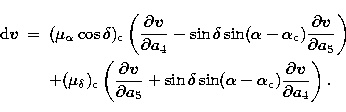
, ). One way is to first transform all abscissae
residuals back to zero proper motion, and then implement
Eqs. (30) in the solution for each star. This then gives, as
the proper motion part of the solution, the following equation (where
). One way is to first transform all abscissae
residuals back to zero proper motion, and then implement
Eqs. (30) in the solution for each star. This then gives, as
the proper motion part of the solution, the following equation (where
 and
and  ):
):
|  |
|
| (31) |
Alternatively, a first-order approximation is made for the cluster
proper motion, from which the local projection corrections are calculated.
In a subsequent iteration, further adjustments of the cluster proper motion
will have negligible influence on these projection corrections. Only when
the cluster is spread out over a large part of the sky, like the Hyades,
must these and other corrections be fully taken into account.
Other possibilities of combined and constrained solutions may not involve
small fields, and can be simpler to apply as they would not require
de-correlating observations of different stars. Accidental correlations
that could occur because of two stars appearing on the same reference great
circle will be small and rather rare, and therefore of very little influence.
Correlations between the FAST and NDAC reductions of the same observations
are removed using Eq. (9). This kind of solution can be used
for luminosity calibrations.
As an example, consider determining the mean absolute magnitudes of RR Lyrae
stars in a single solution, using the parallax information contained in the
abscissa residuals and the reddening-corrected apparent mean magnitudes.
The procedure goes as follows. First assume a reasonable value
for the absolute magnitude  , related in a well defined manner
(passband) to the reddening corrected mean apparent magnitude <mv> of each
star. Translate the difference into a predicted parallax:
, related in a well defined manner
(passband) to the reddening corrected mean apparent magnitude <mv> of each
star. Translate the difference into a predicted parallax:
|  |
(32) |
where  is measured in mas. All abscissae are corrected for the
difference
is measured in mas. All abscissae are corrected for the
difference  between the published
(
between the published
( ) and the calculated predicted parallax (Eq. 10).
The estimated absolute magnitude will differ by a small
amount from the best estimated value indicated by the observations:
) and the calculated predicted parallax (Eq. 10).
The estimated absolute magnitude will differ by a small
amount from the best estimated value indicated by the observations:
|  |
(33) |
This correction to the absolute magnitude will in the first approximation result
in a scaling correction of the assumed parallaxes:
|  |
(34) |
giving corrections to the assumed individual parallaxes of  ,where is the estimated parallax of an individual RR Lyrae star, and
 a correction factor which is the same for all RR Lyrae, if
our basic assumption that the absolute magnitudes of these stars are
equal is indeed correct. Thus, we can now create one solution for all
RR Lyrae, solving for each star the position and proper motion corrections,
and solving for one overall parallax correction factor .The solution provides an accuracy of the estimated value
a correction factor which is the same for all RR Lyrae, if
our basic assumption that the absolute magnitudes of these stars are
equal is indeed correct. Thus, we can now create one solution for all
RR Lyrae, solving for each star the position and proper motion corrections,
and solving for one overall parallax correction factor .The solution provides an accuracy of the estimated value  and
thus for
and
thus for  , and will tell how good the model is (at the available
accuracy of the observations) through its
, and will tell how good the model is (at the available
accuracy of the observations) through its  value. By using this
method rather than the direct interpretation of the published parallaxes,
a more reliable and better to interpret solution is obtained, involving
fewer degrees of freedom and deriving the critical quantity of the distance
scale correction directly from the actual observations: the abscissa data.
However, as the correction factor is multiplied by the estimated
parallax, most of the weight in the solution will still come from the nearest
stars. As long as the accuracy of the corrected apparent magnitudes is high,
any bias on the derived parallaxes will be very small, and no bias
is expected from the solution. This was confirmed by a simple simulation.
A more general description of luminosity calibrations using this
method can be found in VL98. A different method for obtaining unbiased
luminosity estimates has been presented by Luri et al.
(1996), and is based on a maximum likelihood estimate for a set of
probability distributions.
value. By using this
method rather than the direct interpretation of the published parallaxes,
a more reliable and better to interpret solution is obtained, involving
fewer degrees of freedom and deriving the critical quantity of the distance
scale correction directly from the actual observations: the abscissa data.
However, as the correction factor is multiplied by the estimated
parallax, most of the weight in the solution will still come from the nearest
stars. As long as the accuracy of the corrected apparent magnitudes is high,
any bias on the derived parallaxes will be very small, and no bias
is expected from the solution. This was confirmed by a simple simulation.
A more general description of luminosity calibrations using this
method can be found in VL98. A different method for obtaining unbiased
luminosity estimates has been presented by Luri et al.
(1996), and is based on a maximum likelihood estimate for a set of
probability distributions.
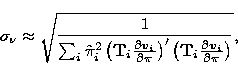
An estimate of the expected accuracy of can be obtained from:
|  |
(35) |
where the index i represents the different stars, and  is the
Cholesky square root of the variance matrix for star i. This can be
approximated with the following simplification to:
is the
Cholesky square root of the variance matrix for star i. This can be
approximated with the following simplification to:
| 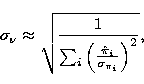 |
(36) |
where  is the parallax accuracy given in the final catalogue,
but
is the parallax accuracy given in the final catalogue,
but  is the estimated parallax value as defined above, and NOT
the value given in the catalogue.
is the estimated parallax value as defined above, and NOT
the value given in the catalogue.
Up: On the use of data,
Copyright The European Southern Observatory (ESO)