A very important aspect of the Hipparcos data reductions was the use of two independent data reduction consortia, NDAC and FAST (see Perryman et al. 1997), each providing what they considered their best final results. The results from the two consortia were merged to form the final catalogue.
There were two kinds of errors affecting the consortia results: errors due to photon noise on the original measurements, and errors due to inadequacies in the calibration methods (instrument modelling) applied by the two groups. The first of these was the same for both sets of consortia results and showed as a correlation between residuals with respect to the accepted solution. Errors resulting from instrument modelling were considered largely uncorrelated due to the different reduction methods used by the two groups. However, some correlation may be expected for these errors too. By combining the results from the two consortia the influence of the uncorrelated (instrument modelling) errors was reduced. This was clearly observed from the parallax results obtained in the merged solution, which showed an improvement relative to the individual consortia results.
Another important aspect of the Hipparcos instrument was the scanning law and the two entrance pupils, projecting images on the same focal plane, observing only objects selected from the pre-defined Hipparcos Input Catalogue (ESA 1992). These provisions made it possible to measure very precisely large angular distances on the sky and allowed for the determination of a rigid optical reference frame and the measurement of absolute parallaxes. This all-sky rigidity and reliability makes it possible to combine the intermediate astrometric data from all parts of the sky in a single solution into an essentially distortion free all sky (or small field) solution. The two entrance pupils did imply, however, that occasionally observations were disturbed by an image from the other field of view.
The mean signal
level and modulation amplitude were processed in the photometric reductions
and provided the data for the H and H
and H magnitudes
respectively. The reduced photometric data were combined in field transit
magnitudes, which are presented in the Hipparcos Epoch Photometry Annex
(HEPA) and the Hipparcos Epoch Photometry Annex Extension (HEPAE).
magnitudes
respectively. The reduced photometric data were combined in field transit
magnitudes, which are presented in the Hipparcos Epoch Photometry Annex
(HEPA) and the Hipparcos Epoch Photometry Annex Extension (HEPAE).
The modulated signal could be affected by images close enough to the target image to be visible at the same time by the IDT. Such images could be either due to duplicity of the star or to accidental superimposition of an image from the other field of view. The composite image would still fit the same modulation model, but the relations between the mean intensity level and the modulation parameters were altered. The modulation phases were no longer directly linked to the transit time of an image, and special processing was required to handle observations of the double and multiple stars, while data associated with accidental superimpositions had to be discarded. A related source of signal disturbance was caused by stray light, resulting from very bright stars at larger distances (up to a few hundred arcsec). These effects were corrected for approximately. Exact corrections were impossible due to the very limited knowledge of the sensitivity of the IDT instantaneous field of view at larger distances from its centre.
Information on recognized accidental superimpositions by one or more images from the other field of view is provided in the Hipparcos Epoch Photometry Annex Extension file, HEPAE. This information can be related to the data in the Intermediate Astrometric Data file through a comparison of epochs: the astrometric reference epoch 1991.25 corresponds to photometric epoch JD 2448349.0625. It has to be realized, however, that in combining field transit data to abscissae individual data points that were affected by spurious images from the other field of view were in many cases rejected.
A further source of signal disturbance, although for only a very small number of objects, was due to the presence of planetary nebulae around some stellar images. These could disturb the signal depending on the scan direction in a way that is difficult to reconstruct or interpret. The average effect was a relative decrease of the modulation amplitudes of the signal, which can be recognized from the HEPA/HEPAE files by comparing the magnitudes derived from the zero-level intensities (dc-magnitudes in the HEPA file) with the simultaneously derived magnitudes from the modulation amplitude (ac-magnitudes in the HEPAE file). Disturbance by a planetary nebula leads to too bright dc-magnitudes in comparison with the ac-magnitudes. Deviations from circular symmetry led to distortions on the phase estimates, and few of these objects have reliable astrometric solutions.
Detailed analysis of the first and second harmonics (phases and amplitudes) in the modulated signal led to the discovery of several thousands of double stars. Signals for double stars were processed separately by both NDAC and FAST, but only FAST carried all these signals along into the great-circle reductions. For this reason, only FAST abscissae are available for most of the double stars. It should be realized, however, that, depending on the magnitude difference and the separation, the interpretation of these double star abscissae can often be ambiguous due to the complexity of the signal. The Transit Data file (Vol. 1, Sect. 2.9) has preserved the case history files for 35535 known or suspected double or multiple stars as obtained by NDAC, permitting a revised interpretation of these data too (Vol. 1, Sect. 2.9).
 |
(1) |
 is the along-scan
attitude correction and
is the along-scan
attitude correction and  is the vector of instrument parameters.
The very smooth motions of the satellite (except at times of thruster
firings) allowed for the use of cubic splines to fit locally the
corrections
is the vector of instrument parameters.
The very smooth motions of the satellite (except at times of thruster
firings) allowed for the use of cubic splines to fit locally the
corrections  to the original star-mapper-based attitude
reconstruction, and thus to reconstruct very precisely the abscissae along
the great circle. However, the attitude corrections used the same abscissa
data, and as a result there are correlations between the errors on the
final abscissae and the attitude corrections.
This propagated into correlations of abscissae errors for stars affected by
the same attitude errors. Due to the two fields of view, abscissae errors for
stars very close together on the sky, as well as for stars separated by
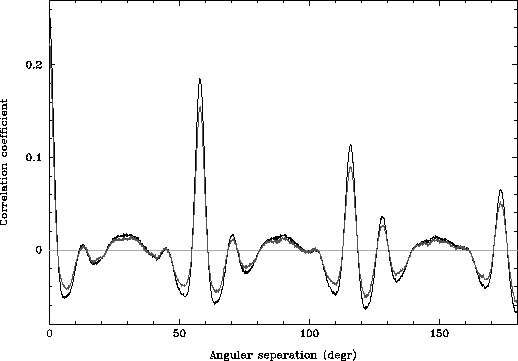
58 degrees (the basic angle) and multiples thereof, are found to be correlated
(see Fig. 1). A preliminary study of these correlations was
presented in Volume 3, Chapter 17. The correlations were re-investigated at a
higher spatial resolution and taking into account the projection of the stellar
separation to an abscissa difference. Also investigated was the influence
of the length of the time interval covered by the data included in each
great-circle reduction run. It was expected that correlations would be much
stronger for short sets that for long sets. As the actual length of the data
stretches was not available, the number of stars per great circle was used
instead as an indicator of long and short sets. There were other aspects too,
that affected the quality of the great-circle results, but these are difficult
to reconstruct from the published data. They concern gaps in the data due
to occultations (a major problem for great circles with small inclinations
with respect to the ecliptic), and problems with the attitude reconstruction
due to high background levels. Most of these problems reflect in individual
abscissa accuracies.
to the original star-mapper-based attitude
reconstruction, and thus to reconstruct very precisely the abscissae along
the great circle. However, the attitude corrections used the same abscissa
data, and as a result there are correlations between the errors on the
final abscissae and the attitude corrections.
This propagated into correlations of abscissae errors for stars affected by
the same attitude errors. Due to the two fields of view, abscissae errors for
stars very close together on the sky, as well as for stars separated by
58 degrees (the basic angle) and multiples thereof, are found to be correlated
(see Fig. 1). A preliminary study of these correlations was
presented in Volume 3, Chapter 17. The correlations were re-investigated at a
higher spatial resolution and taking into account the projection of the stellar
separation to an abscissa difference. Also investigated was the influence
of the length of the time interval covered by the data included in each
great-circle reduction run. It was expected that correlations would be much
stronger for short sets that for long sets. As the actual length of the data
stretches was not available, the number of stars per great circle was used
instead as an indicator of long and short sets. There were other aspects too,
that affected the quality of the great-circle results, but these are difficult
to reconstruct from the published data. They concern gaps in the data due
to occultations (a major problem for great circles with small inclinations
with respect to the ecliptic), and problems with the attitude reconstruction
due to high background levels. Most of these problems reflect in individual
abscissa accuracies.
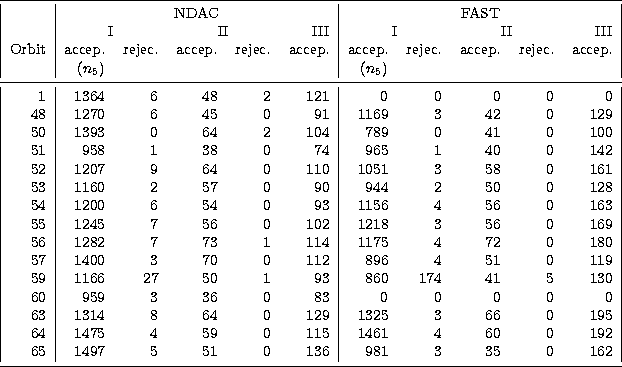
Only stars with a standard 5-parameter solution were used in the determination
of the correlations. On each great circle there are mostly between 900 and
2000 such stars (extremes run from 27 to 2110 stars for NDAC, and 295 to 2027
stars for FAST). Only in one situation were these correlations both
significant and able to accumulate and affect a discussion of Hipparcos
astrometric data: for stars in a small field (a few degrees diameter, like
an open cluster or the Magellanic Clouds). For any other separation the
correlation between measurements for a pair of stars seldom repeated
themselves over the mission, and the cumulative effect was very small (stars
at a separation of 180 also accumulated a correlation, but at that
separation the correlations were rather small).
also accumulated a correlation, but at that
separation the correlations were rather small).
 |
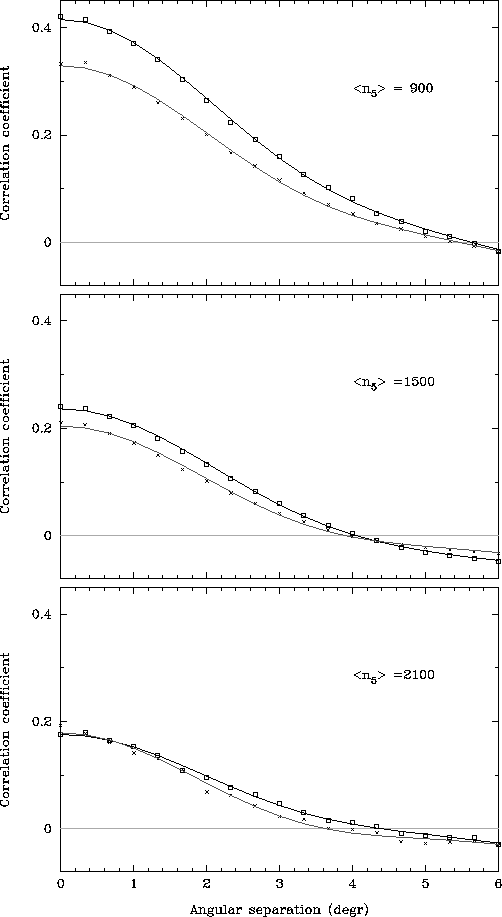 |
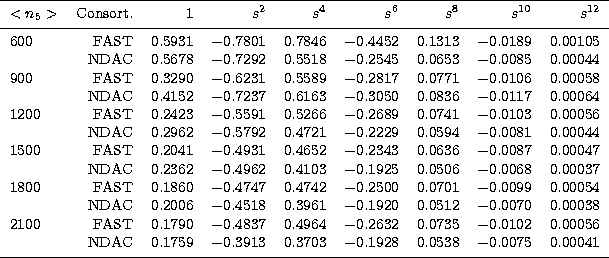
Figure 2: The abscissa residuals correlation coefficient for small separations in data sets of different lengths. Top: short datasets; middle: medium length data sets; bottom: long datasets, as defined in Table 1. Crosses represent FAST data, open squares represent NDAC data. Also shown are the fits as given in Table 1 |
The result of the great-circle reductions was a set of 2341 great circles. They cover a time-span of 2768 orbits or 1230 days. Not every great circle was reduced by both consortia. Due to a tape delivery problem that was detected too late, the NDAC reductions are not available for 4 RGCs towards the end of the mission, while in a few cases an RGC is missing in the FAST reductions due to problems with the data reductions. In most cases this concerned RGCs with small numbers of stars. Instrument parameters were not solved for when numbers of stars were low. They were interpolated from neighbouring, better determined solutions. For 2247 RGCs data is available from both consortia; for 15 RGCs data is only available from the FAST consortium; while for 79 RGCs data is only available from the NDAC consortium.
A comparison between the final Hipparcos and Tycho results seems to indicate
the presence of grid-step ambiguities for 57 stars in the final catalogue
(Vol. 4, Chap. 11).
These stars can be solved for again by using the Tycho data as starting points
and allowing corrections of multiples of  arcsec on some or all
of the abscissae.
arcsec on some or all
of the abscissae.
Finally, all results were transformed to the International Celestial Reference System (ICRS). This transformation was based mainly on very high accuracy radio positions and proper motions for a small set of radio stars (see Vol. 3, Chap. 18 and Kovalevsky et al. 1997).
Copyright The European Southern Observatory (ESO)