

Up: On the use of data,
Subsections
The details of the intermediate astrometric data file are described in
Volume 1, Sect. 2.8, the file itself is available on disc 5 of the ASCII
CD-ROM set.
The file contains the data from which the astrometric parameters for single
stars, as presented in the main catalogue, were derived through the fitting of
one of the models described in Sect. 2.4. The model used is
indicated for each star, both in the main catalogue and the intermediate
astrometric data file.
A model fitted to the abscissae is described in the form of the expected
changes in the abscissa positions, vi, as a result of changes in each
of the model parameters aj. Collecting all abscissa residuals in a vector
 , the following relation is obtained:
|  |
(2) |
which is solved through minimizing the  , the sum of the squares of
the residuals:
, the sum of the squares of
the residuals:
|  |
(3) |
as a function of the parameter corrections  .
. is the covariance matrix of the abscissa
residuals. In the Hipparcos Catalogue the standard errors on the
parameters have been calculated assuming the predicted value, i.e. using an assumed standard error for the solution of 1.0 rather than the
observed value, which may be larger or smaller than 1.0.
In the presence of the variance matrix
is the covariance matrix of the abscissa
residuals. In the Hipparcos Catalogue the standard errors on the
parameters have been calculated assuming the predicted value, i.e. using an assumed standard error for the solution of 1.0 rather than the
observed value, which may be larger or smaller than 1.0.
In the presence of the variance matrix  , the
minimization of results in k=1, n equations of the type:
, the
minimization of results in k=1, n equations of the type:
|  |
(4) |
which constitute the so-called normal equations.
The matrix  is symmetric and can be factorized as:
|  |
(5) |
where  is a lower triangular matrix (see e.g. Bierman 1977).
The matrix is called the square root of , and can be obtained
using e.g. the Cholesky decomposition algorithm, as described by Bierman.
After replacing by
is a lower triangular matrix (see e.g. Bierman 1977).
The matrix is called the square root of , and can be obtained
using e.g. the Cholesky decomposition algorithm, as described by Bierman.
After replacing by  and some reorganization
the following equations are obtained (k=1,n):
and some reorganization
the following equations are obtained (k=1,n):
|  |
(6) |
Thus, by multiplying the left- and right-hand sides of the observation
equations, as defined by Eq. (2), by the matrix ,
which is the Cholesky square root of the inverse of the covariance
matrix , a set of de-correlated and properly weighted observation
equations is obtained, ready to be incorporated in the traditional
least-squares solution. Note that the square root of a matrix is not unique,
and therefore different ways exist to de-correlate the same set of observation
equations. Also, when the covariance matrix is diagonal, the square root is
too, and the multiplication of the observation equations reduces to a
straight forward weighting by the inverse of its standard error for
each observation.
The observation equations for a single star consist in fact of two sets of
correlated observation equations, one set from each consortium. Data obtained
for observations on reference great circle k by FAST will be indicated by
Fk, and for NDAC by Nk. The counter i (or j) refers to an observation
equation independent of its origin.
The covariance matrix for a single star solution is built up as
follows. The diagonal elements are given by:
| 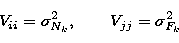 |
(7) |
for observation i obtained by NDAC and observation j obtained by FAST.
If two observations i and j originate from NDAC and FAST reductions on
the same reference great circle k, additional off-diagonal elements
have to be added to the covariance matrix, representing the correlation
between these observations:
|  |
(8) |
where qNFk is the correlation coefficient between the FAST and NDAC
reduction results for orbit number k. The values of qNFk have been
determined empirically from the FAST and NDAC abscissa residuals
as function of magnitude, time and the estimated standard errors on the
abscissa by FAST and NDAC and are provided in the abscissa records.
When only these consortia correlations
are considered, the correlations between observations can be incorporated
in the observation equations by multiplying pairs of correlated observations
equations with the Cholesky square root of the inverse of their covariance
matrix:
|  |
(9) |
where the first equation is assumed to originate from FAST, and the
second from NDAC.
The resulting pair of observations are uncorrelated and properly weighted,
and can be treated as any other observation equations in a least squares
solution. It is clear that, if the correlation coefficient qNFk
is equal to zero, Eq. (9) reduces to a simple scaling of each
equation by the inverse of the square root of the variance of the standard
error on the observation it represents.
The abscissa file provides  for the solution
of the five astrometric parameters: corrections to the mean position
(
for the solution
of the five astrometric parameters: corrections to the mean position
( ,
,  ), the assumed parallax
(
), the assumed parallax
( ) and the assumed linear proper motions
(
) and the assumed linear proper motions
( ,
,  ).
Provisions have also been made for variable proper motions, the so-called
7- and 9-parameter solutions (see Sect. 2.4 and Vol. 1,
Sect. 2.8).
The information for the construction of the covariance matrix
(standard errors and correlation coefficients) is included in the
abscissa records (fields IA9 and IA10 in Table 2.8.3 of Vol. 1).
).
Provisions have also been made for variable proper motions, the so-called
7- and 9-parameter solutions (see Sect. 2.4 and Vol. 1,
Sect. 2.8).
The information for the construction of the covariance matrix
(standard errors and correlation coefficients) is included in the
abscissa records (fields IA9 and IA10 in Table 2.8.3 of Vol. 1).
The abscissa residuals presented in the intermediate astrometric data file
are given relative to an implementation of the five astrometric parameters
given in the header records. These five parameters may be
part of a more complicated solution, such as a 7- or 9-parameter solution
or an orbital motion solution. In these cases the abscissa residuals
were obtained through implementing only the first five parameters of the
solution, as given in each header record. In the 7- and 9-parameter
solutions the first- and second-order time dependence of the proper motion
were referred to a reference time such that the effect of these parameters on
the basic 5-parameter model would be very small. This leads to the following
results:
- In case the original solution was a 5-parameter solution, the proper
application of a 5-parameter solution to the residuals must give negligible
corrections to the astrometric parameters (only rounding-off errors),
and reproduce the standard errors on those parameters and their covariances
as given in the main catalogue;
- In the case of 7- or 9-parameter or orbital motion solutions,
the application of the original solution must produce negligible corrections
for the first 5-parameters, and reproduce the remaining parameters, together
with all standard errors and the full covariance matrix. When applying a
5-parameter solution to the residuals of the partially implemented 7- or
9-parameter solution, the expected results are small corrections to the
5-parameters and an increase in the standard error of the solution.
- In the case of a stochastic solution (``X" in field H59 of the main
catalogue, and in field IH8 in the header records of the intermediate
astrometric data), the original solution can
be recovered by adding in quadrature a ``cosmic noise'' to the standard
errors of the abscissae, and applying the standard 5-parameter solution to
the result. The level of the ``cosmic noise'' was adjusted such as to give
the expected for the solution.
In the case of double star solutions (types ``C'' and ``V'') the abscissa
residuals (often only given for the FAST data) are mostly of little meaning,
and should not be used. For these stars the Transit Data (Vol. 1,
Sect. 2.9) should be used instead.
Up: On the use of data,
Copyright The European Southern Observatory (ESO)