

 |
(10) |
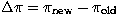 . The new set of residuals are then
solved using the mechanism described in Sect. 3 for only
four parameters ai: position and proper motion.
. The new set of residuals are then
solved using the mechanism described in Sect. 3 for only
four parameters ai: position and proper motion.
The situation is much more complicated when a very precise proper motion is available from an external source. The problem is that before such a constraint can be incorporated, it needs to be represented in exactly the same reference frame as the Hipparcos data. The same applies when positions are obtained on photographic plates at a different epoch than the Hipparcos data. The transformation to the Hipparcos reference frame can only be obtained if a sufficiently large number of objects is available for the determination of the transformation parameters, e.g. when the measurement has been obtained in a sufficiently well determined reference frame, and has been corrected for any systematic differences between that reference frame and the Hipparcos reference frame, both in positions and in proper motions. In general, the uncertainty of the systematic errors will inhibit incorporation of proper motion data. Here, however, the Tycho catalogue can be of assistance in some cases. With a much higher density of stars than the Hipparcos catalogue, the Tycho positions can provide a sufficient number of reference points to determine accurate plate transformations if plates were obtained at an epoch close to the mean Tycho epoch. For clusters like the Pleiades and Praesepe one can use the fact that the internal proper motions of the cluster members are very small, and that by using only cluster members, larger epoch differences can be allowed.
Another possible application is for stars with orbital motions, where prolonged observations can provide additional measurements. It is likely that some of the 7- and 9-parameter solutions refer to orbital motions over a time-span much longer than the 3.5 years of the Hipparcos mission. The same applies to some stochastic solutions, where the orbital motion time-scale could be shorter than 3.5 years. Further observations may constrain the possibilities of non-linear proper motion fits. It will be difficult, however, to obtain positional measurements with accuracies comparable with the Hipparcos data. In such cases, the addition of radial velocity data may sometimes help resolve the solution of the Hipparcos data.
Important in the construction of orbital parameter solutions is the definition
of the parameters ai and their derivatives. This problem is very similar to
that of the solar system objects, described in the next section, except that
the angle  (Fig. 3), defining the local direction to
the equatorial pole, still needs to be calculated. Although it can be
derived from the positions of the star and the pole of the reference great
circle, it is far easier to obtain the angle directly
from fields IA3 and IA4 (Vol. 1, Table 2.8.3) in the intermediate
astrometric data file:
(Fig. 3), defining the local direction to
the equatorial pole, still needs to be calculated. Although it can be
derived from the positions of the star and the pole of the reference great
circle, it is far easier to obtain the angle directly
from fields IA3 and IA4 (Vol. 1, Table 2.8.3) in the intermediate
astrometric data file:
 |
(11) |
 |
(12) |
Copyright The European Southern Observatory (ESO)