

Up: On the use of data,
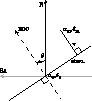 |
Figure 3:
Definition of the abscissa offset  for a predicted position
( for a predicted position
( , ,  ), with respect to the catalogue position
( ), with respect to the catalogue position
( , ,  ) and RGC orientation ) and RGC orientation  |
The solar system objects observed by Hipparcos (48 minor planets, two of
Jupiter's moons, Callisto and Europa, and one of Saturn's moons, Titan),
do not lend themselves for a simple parametrized
representation. They could only be presented in the form of the abscissa
results, with one observation per field of view crossing. Although an
actual position is given, the only value of this position is to serve as a
reference point for the abscissa measurement. The actual data-point could be
found anywhere close to this line. Figure 3 shows how from the
published data (described in Vol. 1, Sect. 2.7) and
a predicted position (, ) the abscissa residual
v can be derived. Assuming that the distances between the published
and the predicted positions are small (generally less than 1 arcsec),
the Euclidian approximations can be made:
|  |
(13) |
The handling of these measurements is very similar to the handling of the star
abscissae: a model predicts abscissa positions and their dependence on the
model parameters. We take e.g. the best available ephemerides of an object to
calculate predicted positions ( ,
,  ). The abscissa
residuals vi for these predicted positions (Eq. 13)
can be represented in various ways: either as a function of some critical
parameters in the model, or simply as observed offsets in coordinates as a
function of time:
). The abscissa
residuals vi for these predicted positions (Eq. 13)
can be represented in various ways: either as a function of some critical
parameters in the model, or simply as observed offsets in coordinates as a
function of time:
|  |
(14) |
with  .By representing
  and
and  as functions of parameters
ai, such as time or orbital elements, Eqs. (14) are solved
through minimizing
as functions of parameters
ai, such as time or orbital elements, Eqs. (14) are solved
through minimizing  .Here, as in all other similar solutions, no correlations are assumed to exist
between data on different reference great circles.
.Here, as in all other similar solutions, no correlations are assumed to exist
between data on different reference great circles.
It should be realized, however, that
for the determination of both and , measurements
are required from different reference great circles, providing the different
angles needed to remove their correlation.
Up: On the use of data,
Copyright The European Southern Observatory (ESO)
