

 was obtained. This is
not significantly different from kinematically derived parallax estimates by
Fernley et al. (1997), who note, however, that some of the
stars in the selection used here are not confirmed independently as RR Lyrae
stars. The unit weight standard deviation of the solution is 1.021, which,
given the number of observations, is close to significantly different from
the expected value of 1.00.
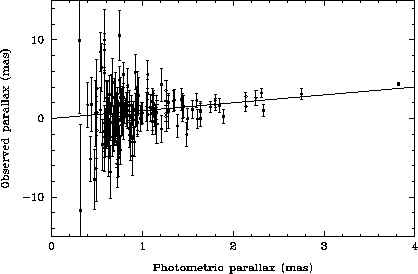
The consistency between the magnitude based parallaxes and the parallaxes
obtained from the individual solutions is shown in Fig. 5.
was obtained. This is
not significantly different from kinematically derived parallax estimates by
Fernley et al. (1997), who note, however, that some of the
stars in the selection used here are not confirmed independently as RR Lyrae
stars. The unit weight standard deviation of the solution is 1.021, which,
given the number of observations, is close to significantly different from
the expected value of 1.00.
The consistency between the magnitude based parallaxes and the parallaxes
obtained from the individual solutions is shown in Fig. 5.
The Mira stars in the Magellanic Clouds show in the K band a period luminosity relation. The slope of this relation was used by van Leeuwen et al. (1997b) in combination with Hipparcos parallaxes to derive a zero point for this relation. A major problem with the Mira stars is the effect of the very large brightness and colour variations on the astrometric measurements. Most of the brighter Miras received so-called ``V'' type solutions, implementing a brightness related correction to the abscissae residuals.
We started off with the same selection of 16 stars as used by van Leeuwen et al. (1997b),
and removed from this list two stars suspected of being fundamental
mode pulsators, a symbiotic, a C-type and a double mode Mira, and tested all
solutions for a standard 5-parameter solution. Three stars showed very bad fits
according to the unit weight variances of their residuals, and were removed.
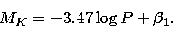
There remained 8 stars, for which the reddening corrected ``K'' magnitudes were
fitted using:
 |
(37) |
 .Corrections to this assumed value reflected in a scaling parameter for the
parallaxes, which was solved for all 8 stars simultaneously using their
465 abscissae records. No corrections for brightness variations were
introduced. The value thus obtained is
.Corrections to this assumed value reflected in a scaling parameter for the
parallaxes, which was solved for all 8 stars simultaneously using their
465 abscissae records. No corrections for brightness variations were
introduced. The value thus obtained is 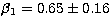 , slightly
smaller than what was given by van Leeuwen et al. (1997b), but this may be related
to ignoring the above mentioned corrections. The need for these corrections
was reflected in the unit weight standard error, which measured 1.35.
, slightly
smaller than what was given by van Leeuwen et al. (1997b), but this may be related
to ignoring the above mentioned corrections. The need for these corrections
was reflected in the unit weight standard error, which measured 1.35.
A preliminary calculation of the proper motions of the Large and Small Magellanic Clouds was carried out for the paper by Kroupa & Bastian (1997). The covariance values have since been recalculated in more detail (see Sect. 2.2), and were in most cases found to be smaller than shown in Figs. 17.11 and 17.12 of Volume 3, Chapter 17.
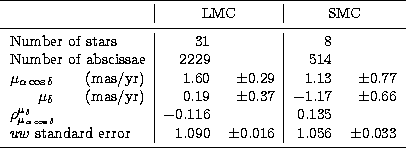
The situation for the LMC and SMC is simple. The Hipparcos Catalogue contains
31 members of the LMC and 8 members of the SMC for which a single star
solution of type ``5'' or ``7'' was obtained. Given the distances of the Magellanic
Cloud stars, it was assumed that solutions of type ``7'' were spurious.
The astrometric solutions for these
stars were obtained from in total 2229 abscissa measurements in the LMC and
514 in the SMC. Each star had a parallax and proper motion
derived in its individual solution. The first task was to remove the parallax
and proper motions and to obtain abscissae relative to a zero proper motion
and parallax (using Eq. 10). The abscissae were sorted on orbit
number and for every orbit a set of de-correlated observation equations was
obtained (corrected for the consortia correlations and the correlations
described in Sect. 2.2). The observation equations described
corrections to individual star positions and to a common LMC or SMC proper
motion, but did not allow for a parallax solution. These de-correlated
observation equations were accumulated in a single least squares solution,
(using Eq. (31) for the proper motions)
providing the results shown in Table 3. From the unit weight
standard errors it is clear that the condition of a single common proper
motion over the LMC may not be entirely satisfied, producing a  significantly above the expected value. The situation is better for the SMC.
The differences between the values presented here and those presented
earlier by Kroupa & Bastian have no significant effect on the
discussions presented in that paper.
significantly above the expected value. The situation is better for the SMC.
The differences between the values presented here and those presented
earlier by Kroupa & Bastian have no significant effect on the
discussions presented in that paper.
 |
The determination of the Pleiades parallax and proper motion will be dealt with in detail by van Leeuwen and Hansen (in preparation). Here we present the preliminary results of that study and a similar application to stars in the Praesepe cluster.
The Hipparcos catalogue contains 60 members of the Pleiades
cluster. Of these, 54 were selected as single stars with solution type ``5'',
providing a total of 2182 abscissae (see van Leeuwen & Hansen-Ruiz 1997).
All abscissae were incorporated, including
those rejected in the individual star solutions. In an iteration over the
combined solution a total of 4 abscissa residuals were rejected. All abscissae
were corrected to a reference parallax and proper motion, and sorted on
orbit number. For each orbit a set of de-correlated observation equations
was created, which were combined in one least-squares solution. The observation
equations described positional corrections for all 54 stars and one parallax
and proper motion for the cluster centre, using Eq. (31).
Thus, the degrees of freedom were reduced
from  to
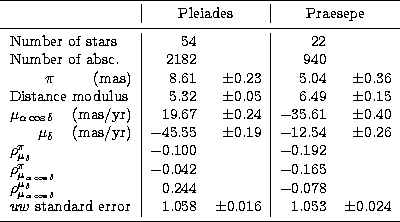
to 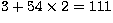 . The results are summarized
in Table 4. From the unit weight standard error and its uncertainty
it appears that there remained unmodelled effects in the parallax and proper
motion. This is most likely the internal proper motion dispersion in the
cluster, which has a dispersion in the projected centre of the cluster of
around 1 mas s-1.
The correlation coefficient of
. The results are summarized
in Table 4. From the unit weight standard error and its uncertainty
it appears that there remained unmodelled effects in the parallax and proper
motion. This is most likely the internal proper motion dispersion in the
cluster, which has a dispersion in the projected centre of the cluster of
around 1 mas s-1.
The correlation coefficient of 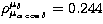 reflects the proximity of the Pleiades to the ecliptic and limited
range of scan-directions resulting from this situation.
reflects the proximity of the Pleiades to the ecliptic and limited
range of scan-directions resulting from this situation.
Table 4 also provides similar results for the Praesepe cluster.
Here there is no significant contribution from an internal proper motion
dispersion.
 |
Copyright The European Southern Observatory (ESO)
 between the proper motion in declination and right ascension are also given