

 , and for the
variables
, and for the
variables
 and
and  in place of R and L,
one seeks exponents
in place of R and L,
one seeks exponents  ,
,  and
and  in such a way
that the gradients of pressure, radius and luminosity
are O(1) in a neighborhood of the center, M=0.
The gradients are written:
in such a way
that the gradients of pressure, radius and luminosity
are O(1) in a neighborhood of the center, M=0.
The gradients are written:

 , is
, is  ,
therefore R=O(M1/3) and
,
therefore R=O(M1/3) and  ; similarly,
L=O(M) and
; similarly,
L=O(M) and  and, at the limit
  :
:
 ,
and
, deduced from the previous set of equations, are given for the values
0, 1 and 2, for p, r and l.
,
and
, deduced from the previous set of equations, are given for the values
0, 1 and 2, for p, r and l.
| | | | ||||||||
| p | r=0 | r=1 | r=2 | l=0 | l=1 | l=2 | ||||
| 0 | 2/3 | 2 | 4 | 6 | 2/3 | 4/3 | 2 | |||
| 1 | 1/3 | 1 | 2 | 3 | 1/3 | 2/3 | 1 | |||
| 2 | 2/9 | 2/3 | 4/3 | 2 | 2/9 | 4/9 | 2/3 | |||
From Table 3 (click here), with the exponents
 ,
,  and
and  , i.e., with the variables M2/3,
R2 and
L2/3, one ensures p=0, r=0 and l=0, therefore
, i.e., with the variables M2/3,
R2 and
L2/3, one ensures p=0, r=0 and l=0, therefore  ,
,
 and
and  as expected.
Obviously other sets of exponents can be employed, the best of them is
chosen according to the following numerical criterion:
working with a scheme of, let say, third order, between two grid
points the dependent variables are quadratic polynomials
in  ; any of them,
  for example, is written:
 . In a neighbourhood of ,
the gradient are
. In a neighbourhood of ,
the gradient are  ; with p=0 one has:

while, if p=1:

The last approximation only uses the term in  , therefore
information is lost. Hence the set of exponents
, and , i.e., the variables M2/3, R2
and L2/3, are optimal.
, therefore
information is lost. Hence the set of exponents
, and , i.e., the variables M2/3, R2
and L2/3, are optimal.
| | | | ||||||||
| p | r=0 | r=1 | r=2 | l=0 | l=1 | l=2 | ||||
| 0 | 2 | 2/3 | 4/3 | 2 | 2/3 | 4/3 | 2 | |||
| 1 | 1 | 1/3 | 2/3 | 1 | 1/3 | 2/3 | 1 | |||
| 2 | 2/3 | 2/9 | 4/9 | 2/3 | 2/9 | 4/9 | 2/3 | |||
From table 4 (click here), where the exponents for eulerian variables are given, one sees that the highest accuracy cannot be obtained with the set of variables of Eq. (26 (click here)).
 and
and  known within a factor
 ,
,
 , which was, up to now,
implicitly assumed to be the unity for each mesh, but it could be
adjusted (iteratively)
in order to set each LMR on the closest grid point; in other words, locally, for
both sides of each LMR, instead of using the constant value C(t)
the repartition constant is adjusted to the amounts just needed
for fitting a grid point right on the LMR.
Doing that, instead of Q(q), for
, which was, up to now,
implicitly assumed to be the unity for each mesh, but it could be
adjusted (iteratively)
in order to set each LMR on the closest grid point; in other words, locally, for
both sides of each LMR, instead of using the constant value C(t)
the repartition constant is adjusted to the amounts just needed
for fitting a grid point right on the LMR.
Doing that, instead of Q(q), for  ,
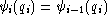
one uses a "weighted distribution function", defined by pieces, as:
,
one uses a "weighted distribution function", defined by pieces, as:

The pieces of the function  being connected by continuity:
 ,
,  .
Therefore, instead of Eq. (20 (click here)), one uses:
.
Therefore, instead of Eq. (20 (click here)), one uses:

Note that and  are step functions.
Due the facts (see Appendix B.5 (click here)), that at grid points first, the
differential equations are not written and, second, discontinuous derivatives
are allowed for, the discontinuities of
are step functions.
Due the facts (see Appendix B.5 (click here)), that at grid points first, the
differential equations are not written and, second, discontinuous derivatives
are allowed for, the discontinuities of  are implicitly managed.
Let, at time t, a solution of Eq. (21 (click here)) be known and Qi(0)(q) be
the weighted distribution function defined by Eq. (A1 (click here)) with
are implicitly managed.
Let, at time t, a solution of Eq. (21 (click here)) be known and Qi(0)(q) be
the weighted distribution function defined by Eq. (A1 (click here)) with
 . Here each quantity with a "(j)'' superscript is
related to the j-th iterated model,
. Here each quantity with a "(j)'' superscript is
related to the j-th iterated model,  At the location
 , where the discontinuity occurs, the distribution function,
calculated with Eq. (22 (click here)), amounts to
, where the discontinuity occurs, the distribution function,
calculated with Eq. (22 (click here)), amounts to  ; let l be the index
of the nearest mesh point from the discontinuity (
; let l be the index
of the nearest mesh point from the discontinuity ( ) (in this
discussion
one simplifies by assuming that the index l does not change as it does,
sometimes, in the calculations); since
Q(j)(q) is a strictly monotonous function, there is only a
unique value such that
) (in this
discussion
one simplifies by assuming that the index l does not change as it does,
sometimes, in the calculations); since
Q(j)(q) is a strictly monotonous function, there is only a
unique value such that 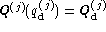 ,
therefore, for , , the weights
,
therefore, for , , the weights
 can be defined by:
  and, for
  :
:

Hence, at the iteration , the LMR will be
closer, than previously, to the grid point with the index l.
After convergence ( ),
),  ,
,
 .
The jump of the distribution function, between ql-1 and
.
The jump of the distribution function, between ql-1 and
 will satisfy:

just that is needed.
For j=0 the weights are initialized to unity and
updated between each Newton-Raphson iteration of the quasi-static equilibrium
problem with Q(j)(q) and q(j)D derived from the locations of the
LMR at the (j-1)-th iteration, for j>0.
Figure 7 (click here) shows a typical displacement of a grid point
toward a LMR (see also Fig. 5 (click here)). In this simplified case only
three iterations have been necessary to set a grid point on the LMR.

Figure 7: Automatic adjustment of a grid point on the limit between a radiative
and a convective zone.
Two iterations have been needed to push a grid point towards the LMR; during
the process the radiative gradient  slightly decreases and
the LMR moves
right. The adiabatic gradient
slightly decreases and
the LMR moves
right. The adiabatic gradient  , full line, remains unchanged.
The initial
locations of the grid points (empty squares), are moved to the right at the
first iteration (empty circles) and slightly right again at the second on
(full circles)
, full line, remains unchanged.
The initial
locations of the grid points (empty squares), are moved to the right at the
first iteration (empty circles) and slightly right again at the second on
(full circles)
This iterative process is only of first order. It will converge only if the functions considered are sufficiently smooth and, moreover, if the LMR is sufficiently well defined, as in the case illustrated in Fig. 7 (click here); it is the case for the external LMR of the Sun and for the convective core of stars of intermediate mass. On the other hand, for semi-convective zones or convective cores with diffuse LMR, as for the convective core of the young Sun, the closest index l, from the LMR, is not well fixed and the algorithm may not converge; fortunately, in such cases, the jump of the slope of the gradient is almost zero, therefore a mislabelling of a small jump in the slope of the gradient has almost no consequence.
 ,
,  and
and  ;
recall that, at
;
recall that, at  , defined by Eq. (10 (click here)), there is a
open
inner limit. In the numerical solution of Eq. (11 (click here)), one assigns, among the
, defined by Eq. (10 (click here)), there is a
open
inner limit. In the numerical solution of Eq. (11 (click here)), one assigns, among the
 grid points allowed for the atmosphere, a fixed index
 to the moving limit
  ; that is done by the piecewise
logarithmic linear mapping:
; that is done by the piecewise
logarithmic linear mapping:  of
of  in
in  defined by:

 and
and  are defined by:

 , at the bottom of the atmosphere where
  ,
,
 , at the inner limit where
  ,
,
 , at the upper
limit of the atmosphere where
, at the upper
limit of the atmosphere where  ;
;
is a open parameter; with  ,
,
 will lie in the vicinity of the middle of the interval
 . From
this mapping results a constant mesh size, it is an advantage of the algorithm.
For the numerical solution it is convenient to add one more unknown: the
temperature T, which fulfills the scalar equation
. From
this mapping results a constant mesh size, it is an advantage of the algorithm.
For the numerical solution it is convenient to add one more unknown: the
temperature T, which fulfills the scalar equation  , and the boundary condition
 . With the following
variables, employed for the reconstitution of the atmosphere:
. With the following
variables, employed for the reconstitution of the atmosphere:
 ,
,  ,
,  ,
,
 ,
,
 and
and  , Eq. (11 (click here))
are written:
, Eq. (11 (click here))
are written:

where  (respt. ) if
 (respt.
  ). The boundary
conditions are:
). The boundary
conditions are:
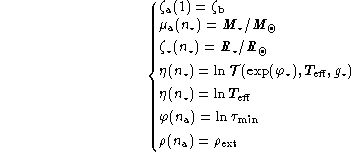
here:

The numerical solution of the non-linear differential problem
Eq. (A4 (click here)), with its boundary conditions at three different
levels, is solved using the B-spline collocation method
(see Appendix B.5 (click here)). The iterative process is initialized either,
with an approximate model of the solar atmosphere for PMS or ZAMS initial
models or, along the evolution, with the atmosphere of the previous model .
The solution gives  ,
,
 ,
,
 and their derivatives with respect
to
and their derivatives with respect
to  and
and  .
Typically, one uses from
.
Typically, one uses from  to
to  grid points for
the interval .
With B-splines of order 3, there are from 59 to 99 points where
Eqs. (A4 (click here)) are fulfilled; due to the
superconvergence (see Sect. B.5 (click here)), the order of the scheme is 4.
grid points for
the interval .
With B-splines of order 3, there are from 59 to 99 points where
Eqs. (A4 (click here)) are fulfilled; due to the
superconvergence (see Sect. B.5 (click here)), the order of the scheme is 4.

Table 5: Coefficients in Eq. (A5 (click here)) for the IRK formulas Lobatto IIIC
(see text) of order p=1,2,4 with s=1,2,3 steps.
As usual, the  are in the first column, the bi
in the last row, the remainder entries are the coefficient aij
of the IRK matrix
are in the first column, the bi
in the last row, the remainder entries are the coefficient aij
of the IRK matrix 
 ).
With the coefficients reproduced in Table 5 (click here), the IRK scheme is written:
).
With the coefficients reproduced in Table 5 (click here), the IRK scheme is written:

 and yj are, respectively,
the temperature, density and abundance at intermediate times
and yj are, respectively,
the temperature, density and abundance at intermediate times
 ,
,  ; s is the number of steps of the IRK
formulae.
This standard formulation for IRK schemes does not give satisfactory
results for the evolution of the chemical composition: negative values for
the abundances are observed; that is
due to the amplification of the errors by large Lipschitz constants.
The round-off errors are reduced
if the first Eq. (A5 (click here)) is rewritten
for the smaller quantities zi=yi-y0 (Hairer & Wanner, loc. cit., Sect. IV.8) as:
; s is the number of steps of the IRK
formulae.
This standard formulation for IRK schemes does not give satisfactory
results for the evolution of the chemical composition: negative values for
the abundances are observed; that is
due to the amplification of the errors by large Lipschitz constants.
The round-off errors are reduced
if the first Eq. (A5 (click here)) is rewritten
for the smaller quantities zi=yi-y0 (Hairer & Wanner, loc. cit., Sect. IV.8) as:

 of any IRK Lobatto IIIC
formulas is invertible therefore, with
of any IRK Lobatto IIIC
formulas is invertible therefore, with
 ,
one has
,
one has dj=0 if
  and ds=1;
then the second Eq. (A5 (click here)) is simply written:
and ds=1;
then the second Eq. (A5 (click here)) is simply written:

In MZ the abundances have constant values as described Sect. 3.3.2 (click here);
for the chemical species y, let  be this mean. At time
  , the mean,
  , is approximated using the mid-point rule:

here the sum involves all the meshes inside the MZ; y0,k+1/2
is the abundance at the mid-point,  and:
and:

Therefore Eq. (A6 (click here)) is written:
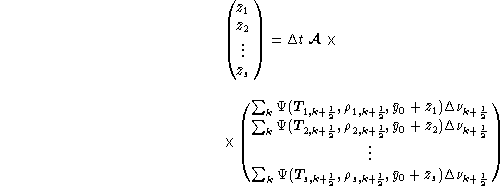
where  (respt.
  ) is the temperature
(respt. the density) at the intermediate point at time ;
then is written:
) is the temperature
(respt. the density) at the intermediate point at time ;
then is written:

The extension to several chemical elements of Eq. (A6 (click here)) to
Eq. (A10 (click here)) is straightforward. Note that, with the use of the
mid-point rule, Eq. (A8 (click here)) for
the numerical approximation the integral of Eq. (28 (click here))
over the MZ, is only of second order; a two-points Gaussian formula
(i.e. third order accuracy) will be more appropriate. The error is not
important in the solar case since the thermonuclear
reactions are not really efficient in MZ.
In CESAM, Eq. (A6 (click here)) to Eq. (A10 (click here)) are solved iteratively using
Newton-Raphson scheme with an analytical jacobian updated at each iteration;
the initial values of the zi are fixed to zero; the quadratic iterative
process is halted as soon as the corrections on the zj are less
than 10-8 in relative values; most of the time, the
convergence is reached in less than five iterations.
 , let at time t:

 , e.g. conservation of baryon and charge
numbers are relationships of that form, then:
, e.g. conservation of baryon and charge
numbers are relationships of that form, then:

Owing to the linearity of Eq. (A6 (click here)) and Eq. (A9 (click here)), for  elements, with obvious notations:

and:

therefore, with IRK formulae, the number of baryons and the number of
charges
are exactly conserved up to the accuracy of the closure of the Newton-Raphson
scheme.
 with discontinuous first derivative at each LMR,
i.e.,
with discontinuous first derivative at each LMR,
i.e.,  . For the calculations it is
convenient to project them on their normalized B-spline basis,
. For the calculations it is
convenient to project them on their normalized B-spline basis,
 (see App. B (click here)),
  ,
,  is the
dimension of the basis; therefore
is the
dimension of the basis; therefore  is written:
 (Schatzman et al. ; Marchouk & Agochkov,
; Quarteroni & Valli, ):
Let
(Schatzman et al. ; Marchouk & Agochkov,
; Quarteroni & Valli, ):
Let 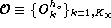 be
the B-spline basis without discontinuity, i.e.,
be
the B-spline basis without discontinuity, i.e.,  , constructed on the grid of
 - schematic representations of nodal
vectors of and
- schematic representations of nodal
vectors of and  can be found App. B.5.2 (click here);
for
can be found App. B.5.2 (click here);
for  , multiply both sides of Eq. (30 (click here)) with
 , and integrate over the whole star:

 for the
inner product of two functions f and g.
Due to the continuity of the fluxes Fi, the standard integration by
parts gives:
for the
inner product of two functions f and g.
Due to the continuity of the fluxes Fi, the standard integration by
parts gives:

 at the center
  ,
,  at the outer limit
 of the envelope and to the continuity of Xi and Fi,
the set of Eq. (A12 (click here)) is written:
of the envelope and to the continuity of Xi and Fi,
the set of Eq. (A12 (click here)) is written:
 except
Xi(t) taken at time t.
This fully implicit scheme is of order
except
Xi(t) taken at time t.
This fully implicit scheme is of order  in space and of first order
in time.
in space and of first order
in time.
One emphasizes the following three facts: (i) in Eq. (A12 (click here)) the discontinuities of the first derivatives of the Xi are implicitly taken into account by the integral formulation, (ii) the use of the B-spline basis is convenient because the algorithms remain simple even if the locations of the LMR change with time, (iii) the Petrov-Galerkin formulation only involves first order derivatives, (iv) the fully implicit scheme has no restrictive time step condition (Richmyer & Morton 1967).

 , i.e., with the variables used in . (