![\begin{figure}
\centering
\includegraphics[width=8.8cm]{ds7458f10.eps}\end{figure}](/articles/aas/full/1998/14/ds7458/img74.gif) |
Figure 10:
Vector point diagram for the whole set
of relative proper motions in the master plate
reference system. The arrow signs the direction of the
antiapex of the solar motion.
The axes alignment is 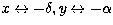 |
The final catalogue (Table 6, available only in electronic form) contains a total number of 51846 stars, all of them having positional information. 39762 stars have standard photographic photometry too (Sect. 3.1). A total number of 12029 stars do not have standard photometry, because they were not detected in the blue photometric plate, and no colour term could be applied. For these stars, the raw R magnitude (Sect. 3.3) computed from the master plate was included in the catalogue as brightness indicator. 55 stars do not have standard nor raw photometry, for being too bright: they are labelled with R=0 in the catalogue. Proper motions were computed for 45036 stars, 37129 of them using three or more different plates (31257 stars having complete standard photographic photometry). As said in Sect. 4.2, proper motions were computed provided plates span a minimum of 30 years. The catalogue contains, for each star, the following data: an identification number (that assigned in MAMA original files to the objects in the master plate), the coordinates in the master plate reference system, the proper motions with their standard errors, and the BVR photographic photometry. Cross-identifications with the most widespread star catalogues and with previous studies of the zone (Cuffey 1937; Straizys et al. 1992, Paper I) are given in notes to Table 6. Figure 10 represents the vector point diagram (VPD) of the whole set of relative proper motions. The elongation in the VPD due to the solar motion is evident.
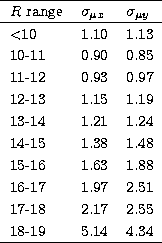
The least squares fits described in Sect. 4.2 provide a
standard error on the coefficients when they are computed using more
than two plates. These errors show a strong dependence
with apparent magnitude. Figure 11 displays this behaviour,
and Table 7 shows the mean error in R magnitude
intervals, computed applying a 3 clipping.
![\begin{figure}
\centering
\includegraphics[width=8.6cm]{ds7458f11.eps}\end{figure}](/articles/aas/full/1998/14/ds7458/img75.gif) |
Figure 11:
Internal error of the proper motions as a function of R
photographic magnitude. The line traces the mean error computed
in half magnitude bins, applying a 3 clipping.
The axes alignment is |
 and
and  (mas yr-1)
averaged in R magnitude intervals, applying a 3 clipping.
The axes alignment is
(mas yr-1)
averaged in R magnitude intervals, applying a 3 clipping.
The axes alignment is
 |
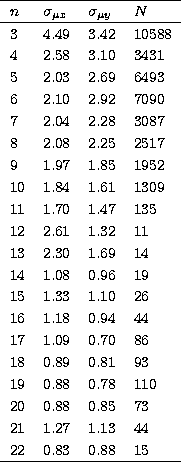
As could be expected, the internal errors are strongly dependent on the number of plates used for the calculation. Table 8 displays the average error of proper motions as a function of the number of plates. There is no clear tendency of the errors as a function of the distance to the master plate center, nor for the whole sample, nor for the brightest stars (R<16 mag). Figure 12 displays the histogram of the error distribution for the whole sample, and for the stars brighter than R=16 mag.
The mode of the proper motion errors is below 1 mas yr-1.
The achieved precision is good, considering the diversity of our
plate material and the short focal length of several telescopes used;
the careful treatment allowed the removal of systematic effects.
and (mas yr-1)
as a function of the number of plates (n).
N is the number of stars.
The axes alignment is
 |
![\begin{figure}
\centering
\includegraphics[width=8.6cm]{ds7458f12.eps}\end{figure}](/articles/aas/full/1998/14/ds7458/img80.gif) |
Figure 12:
Histograms of the proper motion error distribution for the whole
sample (solid lines) and for the stars brighter than
R=16 mag (dotted lines). Error bins are of 0.1 mas yr-1.
Number of stars in each bin is expressed as percentage of the total
number of stars.
The axes alignment is |
The astrometric catalogue was transformed into FK5 and ICRS
reference systems through comparison with the following catalogues:
Positions and Proper Motions Catalogue (PPM; Röser & Bastian 1989),
Tycho and Hipparcos (TYC and HIP; ESA 1997). Equatorial coordinates
from these catalogues were transformed to the master plate epoch by
taking into account the proper motions and, after that, were converted to standard
coordinates through the usual gnomonic projection (see, for instance,
Van de Kamp 1967). The resulting virtual plates were cross-identified with
our astrometric catalogue, and transformation equations were computed by
means of a procedure similar to the transformation-crossing loop
described in Sect. 4.1. The models applied were
third degree (PPM and TYC) or second degree (HIP) complete 2-D
polynomials without magnitude-dependent terms.
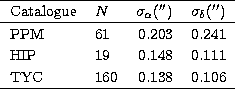
The resulting coefficients evidenced a very good alignment of our x
coordinate with  , and y with
  . Table
9 shows the number of stars in common with the catalogues,
and the standard deviation of the residuals of the fits.
. Table
9 shows the number of stars in common with the catalogues,
and the standard deviation of the residuals of the fits.
 and
and  ) for the reference
catalogues PPM, HIP and TYC
) for the reference
catalogues PPM, HIP and TYC|
|
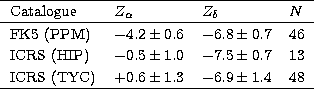
 and
and  (mas yr-1)
to be added to our
proper motions, to convert them to FK5 and ICRS,
after aligning them with the coordinate axes of these reference systems.
N is the number of stars used to compute the parameters
(mas yr-1)
to be added to our
proper motions, to convert them to FK5 and ICRS,
after aligning them with the coordinate axes of these reference systems.
N is the number of stars used to compute the parameters
 |
The transformation coefficients obtained allowed us to compute
equatorial coordinates for the master plate epoch and J2000.0 equinox,
referred to FK5 and to
ICRS, for all stars in our astrometric catalogue. After that, the
(x,y) coordinates from our catalogue were modified by adding their
centennial proper motions, and the resulting positions
( ) were converted again into the equatorial system by
means of the same transformation coefficients. The comparison of the
equatorial positions in the master plate epoch and in the master plate
epoch+100 yr allowed an easy conversion of our (
) were converted again into the equatorial system by
means of the same transformation coefficients. The comparison of the
equatorial positions in the master plate epoch and in the master plate
epoch+100 yr allowed an easy conversion of our ( ) proper
motions into (
) proper
motions into ( ) in the FK5 and ICRS
reference systems, except for a zero point shift. The zero point
shifts (Table 10) were determined comparing the just
obtained () with the proper motions quoted
in the reference catalogues.
The calculation of the zero point shifts to ICRS is affected
by lack of a good number of reference stars in the case of HIP, and
by lack of accuracy of proper motions in the case of TYC.
) in the FK5 and ICRS
reference systems, except for a zero point shift. The zero point
shifts (Table 10) were determined comparing the just
obtained () with the proper motions quoted
in the reference catalogues.
The calculation of the zero point shifts to ICRS is affected
by lack of a good number of reference stars in the case of HIP, and
by lack of accuracy of proper motions in the case of TYC.
Table 11 (available only in electronic form) contains, for each star in our catalogue: the identification number, the astrometric position and the proper motions in the ICRS and FK5 systems. For the transformation of proper motions to ICRS, the zero points computed from comparison with HIP catalogue were applied.
Copyright The European Southern Observatory (ESO)