

 for NGC 1750; and a diameter of 8' centered at
  for NGC 1758.
Stars in the zone where the two circles overlap, were assigned
to NGC 1758. Figure
13 shows the proper motion histogram and the
colour-magnitude diagram for the stars assigned to NGC 1758,
to NGC 1750 and to the remaining zone (assumed to represent the field),
using only the stars with R<16 mag and with proper motion
errors smaller than 2.5 mas yr-1.
for NGC 1758.
Stars in the zone where the two circles overlap, were assigned
to NGC 1758. Figure
13 shows the proper motion histogram and the
colour-magnitude diagram for the stars assigned to NGC 1758,
to NGC 1750 and to the remaining zone (assumed to represent the field),
using only the stars with R<16 mag and with proper motion
errors smaller than 2.5 mas yr-1.
![\begin{figure}
\centering
\includegraphics[width=16cm]{ds7458f13.eps}\end{figure}](/articles/aas/full/1998/14/ds7458/img94.gif) |
Figure 13:
Proper motion histograms and photographic colour-magnitude
diagrams for the stars assumed to belong to the field (top),
NGC 1750 (center) and NGC 1758 (bottom). The sample has been limited
to R<16 mag and to stars with proper motion errors smaller than
2.5 mas yr-1. Note the different vertical scales of the
proper motion histograms.
The axes alignment is 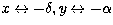 |
Although this raw spatial classification implies contamination due to field stars in the clusters zones as well as to the strong overlap of the two possible clusters, the histograms and colour-magnitude diagrams allow to draw some very interesting conclusions.
The field population shows a disperse colour-magnitude diagram, without any well defined main sequence. The field proper motion distributions, in x as well as in y, are smooth in shape, clearly skewed as expected from the inspection of Fig. 10. The colour-magnitude diagrams corresponding to the cluster areas show clearly defined main sequences, with characteristics in agreement with the conclusions pointed out in Paper I: this spatial classification of photographic photometric data does not allow us to distinguish clear differences among the sequences of NGC 1750 and NGC 1758, except for the known fact that the second cluster lacks bright stars.
The kinematical information adds new insights to the photometric data.
An overdensity of stars is
apparent in the proper motion histograms
for the x coordinate, when comparing the clusters areas with the field
population. This overdensity is found close to zero proper motion, but
shows a slightly positive trend in the NGC 1758 area, and a negative
tendency in NGC 1750. This feature of the  histograms could be
attributed to the presence of one or possibly two clusters in the zones.
The
histograms could be
attributed to the presence of one or possibly two clusters in the zones.
The  histograms clarify the situation.
The stellar overdensity has different behaviour in the two zones,
being the maximum overdensities in NGC 1750 and NGC 1758 separated by
histograms clarify the situation.
The stellar overdensity has different behaviour in the two zones,
being the maximum overdensities in NGC 1750 and NGC 1758 separated by
 5 mas yr-1 in . In the NGC 1758 area a clear contribution
of stars sharing NGC 1750's proper motion indicates the contamination
due to the overlap.
5 mas yr-1 in . In the NGC 1758 area a clear contribution
of stars sharing NGC 1750's proper motion indicates the contamination
due to the overlap.
The presence of two kinematically different groups, with spatial distributions coincident with those assigned to the clusters from visual (spatial stellar density) as well as from photometric criteria, moves us to assert the reality of two separated open clusters in the zone. These clusters can be identified without ambiguity with the objects NGC 1750 and NGC 1758 of Dreyer's (1888) catalogue. No astrometric nor photometric indication of the existence of NGC 1746 was found. This signature of the objects moves us to perform a deeper analysis of the astrometric and photometric data presented in this article and in Paper I, with the aim of assigning individual membership probabilities to the stars and determining the fundamental physical parameters of the two clusters. The strong spatial overlap of the two clusters and their sparseness requires a careful segregation procedure. The third and last article of this series will be devoted to this goal.
Copyright The European Southern Observatory (ESO)