

As described in Sect. 6.2, for the determination and correction of inter-plate magnitude equations, plates were averaged in groups of equal epoch. Three modern Schmidt plates were transformed into the master plate magnitude equation system and averaged with it (Sect. 6.2.1). When computing the relative magnitude equation from each of these source plates to the master one, the dispersion around the magnitude equation was evaluated as a function of magnitude. The functions describing these dispersions, transformed to the master plate scale, were used for assigning magnitude-dependent weights to the stars in each modern epoch source plate. The master plate was individually compared to the CCD pseudo-plate, and the dispersion around this transformation was used for weighting purposes. For the CCD pseudo-plate, weights were assigned considering the dispersion of the positions in the zones overlapped among different CCD fields, in the master plate scale, as a function of magnitude.
Old epoch plates were averaged in groups before transforming them into the average modern plate for computing their magnitude equation (Sect. 6.2.3). The dispersion of the transformation inside each old epoch group, transformed to the master plate scale, was used for assigning magnitude-dependent weights to the star positions from these plates.
Five iterations of the ICOA (Sect. 4) were enough for
stabilizing the final proper motions. The transformation-crossing
loop (Sect. 4.1) was, by far, the most time-consuming step of
the whole procedure. Only two internal iterations of the
transformation-crossing loop (three at most, in some cases) were needed
for all plates in all the ICOA iterations.
 |
When performing the fits of Eqs. (6) and (7)
for computing the proper motions, some star positions were rejected by
the 3 clipping criterion. The different quality of
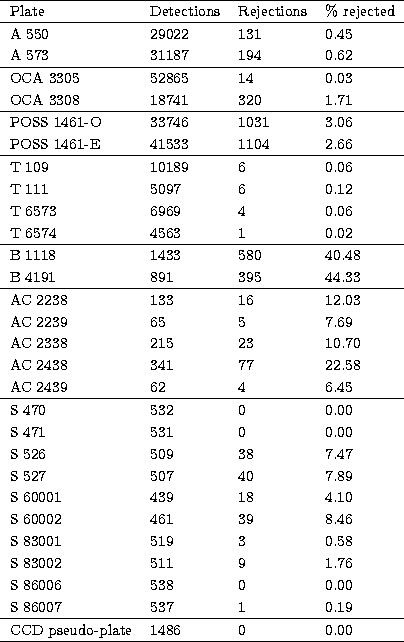
the plates lead to clear tendencies in this rejection. Table
5 displays the statistics of detected and rejected points
for each astrometric plate in this calculation step for the last ICOA
iteration. As can be seen, the Heidelberg and several of the
Astrographic Catalog plates are the less accurate from the astrometric point of view.
clipping criterion. The different quality of
the plates lead to clear tendencies in this rejection. Table
5 displays the statistics of detected and rejected points
for each astrometric plate in this calculation step for the last ICOA
iteration. As can be seen, the Heidelberg and several of the
Astrographic Catalog plates are the less accurate from the astrometric point of view.
Copyright The European Southern Observatory (ESO)