

 20' around
  : NGC 1746, NGC 1750 and NGC 1758. The
IAU official designations for these objects are C 0500+237, C 0500+235
and C 0501+237, respectively. Their position is very close to the
galactic anticenter (
: NGC 1746, NGC 1750 and NGC 1758. The
IAU official designations for these objects are C 0500+237, C 0500+235
and C 0501+237, respectively. Their position is very close to the
galactic anticenter (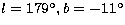 ), in the direction
of the Taurus dark cloud complex. The existence and nature of these
clusters has not been definitively clarified, due to the lack of
specific studies. The main analyses of this zone up to now have been
the photographic photometric survey by Cuffey (1937)
and the Vilnius
photoelectric study by Straizys et al. (1992).
), in the direction
of the Taurus dark cloud complex. The existence and nature of these
clusters has not been definitively clarified, due to the lack of
specific studies. The main analyses of this zone up to now have been
the photographic photometric survey by Cuffey (1937)
and the Vilnius
photoelectric study by Straizys et al. (1992).
This paper is the second of a series of three devoted to a comprehensive astrometric and photometric analysis of this zone, with the aim of determining the existence of these objects and clarifying whether the possible clusters constitute a bounded, multiple system. A previous article (Galadí-Enríquez et al. 1998, from now on referred to as Paper I) was mainly devoted to the description of a UBVRI-CCD photometric survey in a radius of about 15' around the center of NGC 1750. Paper I contains also a brief introduction to the observational history of the area, and we refer to it for the search of literature about the clusters. The photometric data from Paper I indicated that NGC 1746 probably does not exist, and showed the presence of at least one real open cluster in the zone. This object is coincident with the position and description assigned by Dreyer (1888) and other authors to NGC 1750 and NGC 1758. It was not possible to decide the single or double nature of the cluster relying only on the positional and photometric information from Paper I.
In this article we provide additional observational material:
photographic photometry, positions and proper motions in an area of
 around the cluster centers. The joint
analysis of the CCD (Paper I) and photographic data (this paper) will
lead to the clusters-field segregation and the conclusions about NGC
1746, NGC 1750 and NGC 1758 discussed in the third article of this
series.
around the cluster centers. The joint
analysis of the CCD (Paper I) and photographic data (this paper) will
lead to the clusters-field segregation and the conclusions about NGC
1746, NGC 1750 and NGC 1758 discussed in the third article of this
series.
The present photographic study is based on astrograph and Schmidt plates from very different origins, spanning a large time baseline. In our effort to push the material to its limit of precision, we have done a careful treatment of the plate-to-plate geometric transformations, including a rigorous correction of magnitude effects. To this end, the joining of photographic and CCD data has been extremely useful. For the determination of proper motions, we implemented a version of the iterative central overlap algorithm (ICOA).
Our photographic photometry is derived from a set of modern epoch Schmidt plates, obtained with filter/emulsion combinations specifically designed to match Johnson's B, V and R bands. The density of stellar images on the plates was transformed into magnitude using the CCD photometry from Paper I as standard, and including colour terms in the transformation equations. This provided us with a complete and homogeneous deep photometric survey in the whole studied area.
This paper is organized into 10 main sections. In Sect. 2 we describe the plate material and its measurement. Section 3 is devoted to the photometric calibration of the plates, and includes a brief discussion of the resulting standard BVR photographic photometry. The iterative central overlap algorithm is described in Sect. 4. Section 5 discusses some details on the plate-to-plate transformations. Section 6 is dedicated to our treatment of magnitude effects. The proper motion calculations are described in Sect. 7. The resulting photometric and astrometric photographic catalogue is presented and discussed in Sect. 8. A preliminary analysis of the data applying spatial distribution criteria is presented in Sect. 9. The conclusions are summarized in Sect. 10.
Copyright The European Southern Observatory (ESO)