

The equipment of the FAI AS RK observatories was also used to perform CCD position observations of Saturnian satellites.
These observations were made with the same telescopes described above, only the focal length of the Assy telescope was set equal to 12909 mm.
During observations the CCD field always contained two or more satellites thereby allowing determination of their mutual positions.
We used standard ST-6V software to determine the angular separations between the satellites. After pointing the cross cursor on the maximum-brightness pixel interpolation is performed between the neighboring pixels in order to refine the position of maximum-brightness point (zero point). After pointing the cursor on the other satellite the program displays the angular separation between the satellites and the position angle.
The dates and times of observations were chosen so as to determine the mutual distances between the satellites during their approaches.
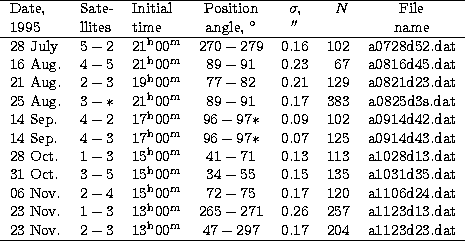
We performed a total of 11 observing sets to determine mutual
apparent separations between Saturnian satellites. The duration
of each such set was several tens of minutes. Table 1 gives the
characteristics of these observing sets.
 |
Angular separations between the satellites are measured directly with the CCD software. The scale of the observed field is determined from the images of binary stars.
The results are presented without correction for differential refraction. These corrections would be negligible since the angular altitude of the satellites was significant and the apparent separations between the satellites were very small.
To our regret the orientation of the CCD was set only approximately. Because of this and the fact that the angular separations between the satellites were very small the position angle was not a subject of our observations and we did not write the position angles in the files. To furnish the results with satellites configurations we only give in Table 1 the range of position angle values for each observing set. The position angles are determined for the first satellite in each pair (i.e., the one whose number is goes the first). The second number refers to the satellite with respect to which the position angles were determined. In the cases where we did not measure position angle at all the value in Table 1 is based on the ephemeris and is marked by an asterisk.
The results of observations can be found in files listed in Table 1. The data in these files are written in the following format. Each line contains the results of a single measurement. The first column gives the time of observation (the midtime of exposure) measured in minutes from the initial time given in the Table 1. The time is in the UTC scale. The second column gives the measured angular separation between the satellites in arcseconds.
The observing sets of 28 July and 14 September were performed at the Assy observatory and the remaining ones, at the Almaty observatory.
During one of the observing sets (August, 25) we measured the angular separation between the Tethys and an unidentified star. In Table 1 in this case an asterisk is used instead of the number of the second satellite. The magnitude of the star is of about 9.9. We hope this star could be identified with the precise ephemerides of Saturn and its satellite. Subsequently the measured angular separation between the satellite and the star could be used as one of measured values to refine the planet and satellite theories.
During the last observing set (November, 23) the satellites were observed both before their approach and during their separation. To distinguish the distances measured before and after the approach the latter are given as negative numbers. This allows us to fit a linear function to the observed data points over the entire observing set.
The results of observations described in this paper are shown
graphically in Figs. 7-17. The observation time measured in
minutes from the starting time is laid off along the x-axis and
the mutual separation between the satellites in arcseconds, along
the y-axis.
The line is a linear least squares fit to the observed
data points. The rms scatter of the observed separations about
this linear fit ( ) is given in Table 1.
The starting time used in Figs. 7-17 differs from the initial
time used in the files and Table 1.
) is given in Table 1.
The starting time used in Figs. 7-17 differs from the initial
time used in the files and Table 1.
Substantial sigmas determined from these results concern the scale of the observed field and the pixel dimension. The discrete values in Figs. 7-17 confirm these conditions which could not be improved with the available telescope.
![\begin{figure}
\includegraphics [width=8.8cm,clip]{pict07d.eps}\end{figure}](/articles/aas/full/1999/16/ds1626/img33.gif) |
Figure 7:
The observed apparent distances D between the satellites. Observatory -
Assy, Satellites - Rhea(5), Enceladus(2). Date - July 28, 1995, the starting time
(UTC) -  , ,  |
![\begin{figure}
\includegraphics [width=8.8cm,clip]{pict08d.eps}\end{figure}](/articles/aas/full/1999/16/ds1626/img36.gif) |
Figure 8:
The observed apparent distances D between the satellites.
Observatory - Almaty, Satellites - Dione(4), Rhea(5). Date -
August 16, 1995, the starting time (UTC) -  , ,  |
![\begin{figure}
\includegraphics [width=8.8cm,clip]{pict09d.eps}\end{figure}](/articles/aas/full/1999/16/ds1626/img39.gif) |
Figure 9:
The observed apparent distances D between the satellites.
Observatory - Almaty, Satellites - Enceladus(2), Tethys (3).
Date - August 21, 1995, the starting time (UTC) -  , , |
![\begin{figure}
\includegraphics [width=8.8cm,clip]{pict10d.eps}\end{figure}](/articles/aas/full/1999/16/ds1626/img41.gif) |
Figure 10:
The observed apparent distances D between the satellite Tethys(3) and some
unidentified star. Observatory - Almaty, Date - August 25, 1995, the starting time
(UTC) - ,  |
![\begin{figure}
\includegraphics [width=8.8cm,clip]{pict11d.eps}\end{figure}](/articles/aas/full/1999/16/ds1626/img44.gif) |
Figure 11:
The observed apparent distances D between the satellites. Observatory -
Assy, Satellites - Dione(4), Enceladus(2). Date - September 14, 1995, the starting
time (UTC) -  , ,  |
![\begin{figure}
\includegraphics [width=8.8cm,clip]{pict12d.eps}\end{figure}](/articles/aas/full/1999/16/ds1626/img46.gif) |
Figure 12:
The observed apparent distances D between the satellites. Observatory -
Assy, Satellites - Dione(4), Tethys(3). Date - September 14, 1995, the starting
time (UTC) - ,  |
![\begin{figure}
\includegraphics [width=8.8cm,clip]{pict13d.eps}\end{figure}](/articles/aas/full/1999/16/ds1626/img49.gif) |
Figure 13:
The observed apparent distances D between the satellites. Observatory -
Almaty, Satellites - Mimas(1), Tethys(3). Date - October 28, 1995, the starting
time (UTC) -  , ,  |
![\begin{figure}
\includegraphics [width=8.8cm,clip]{pict14d.eps}\end{figure}](/articles/aas/full/1999/16/ds1626/img52.gif) |
Figure 14:
The observed apparent distances D between the satellites. Observatory -
Almaty, Satellites - Tethys(3), Rhea(5). Date - October 31, 1995, the starting time
(UTC) -  , ,  |
![\begin{figure}
\includegraphics [width=8.8Cm,clip]{pict15d.eps}\end{figure}](/articles/aas/full/1999/16/ds1626/img54.gif) |
Figure 15:
The observed apparent distances D between the satellites. Observatory -
Almaty, Satellites - Enceladus(2), Dione(4). Date - November 06, 1995, the starting
time (UTC) -  , , |
![\begin{figure}
\includegraphics [width=8.8cm,clip]{pict16d.eps}\end{figure}](/articles/aas/full/1999/16/ds1626/img57.gif) |
Figure 16:
The observed apparent distances D between the satellites.
Observatory - Almaty, Satellites - Mimas(1), Tethys(3). Date
- November 23, 1995, the starting time (UTC) -  , , |
![\begin{figure}
\includegraphics [width=8.8cm,clip]{pict17d.eps}\end{figure}](/articles/aas/full/1999/16/ds1626/img59.gif) |
Figure 17:
The observed apparent distances D between the satellites.
Observatory - Almaty, Satellites - Enceladus(2), Tethys(3).
Date - November 23, 1995, the starting time (UTC) -  , , |
Copyright The European Southern Observatory (ESO)