

At FAI AS RK the observations were performed at two
observatories. The Assy observatory is located at an altitude of
2750 m at east longitude  , north latitude
 . The Almaty
observatory (Kamenskoe Plato) has an altitude of 1450 m and is
located at east longitude
. The Almaty
observatory (Kamenskoe Plato) has an altitude of 1450 m and is
located at east longitude  , north latitude
 .
.
At the Assy observatory the observations were made with a 1-meter Zeiss telescope and at the Almaty observatory, with a 0.6-meter Zeiss telescope. On both telescopes photometric observations were made using cameras with image-magnification resulting in focal lengths of 12381 and 21474 mm for Zeiss-600 and Zeiss-1000, respectively.
The images were projected onto a ST-6V CCD
thermoelectrically cooled to  C. The exposure times
were always equal to 10 s and no filters were used. To avoid the
scattered-light halo of the planet (which was not always
possible), only a small CCD area containing the satellites to be
observed was measured. The CCD was operated in the
automatic image-file recording mode. The combined brightness
of the two satellites was computed as the
average over
C. The exposure times
were always equal to 10 s and no filters were used. To avoid the
scattered-light halo of the planet (which was not always
possible), only a small CCD area containing the satellites to be
observed was measured. The CCD was operated in the
automatic image-file recording mode. The combined brightness
of the two satellites was computed as the
average over  pixels
square region using standard
CCD OPS software for CCD operation and reduction
of frames.
pixels
square region using standard
CCD OPS software for CCD operation and reduction
of frames.
A total of 15 mutual events of Saturnian satellites were observed and photometric data were secured for two of them.
The results of the first observing set can be found in file a0914e32.pmr. Each line in this file corresponds to one measurement and consists of four numbers. The first three numbers (hours, minutes, and seconds) give the time of observation - the average exposure midtime in the UTC scale. The last, fourth number gives the combined brightness (flux) of the two satellites in arbitrary relative units.
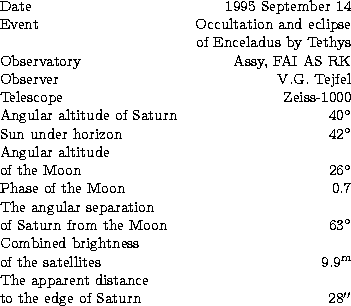
Figure 3 shows the resulting light curve (the flux is in arbitrary units). Here are the characteristics of the first event:
This observing set was also analyzed in [12, (Emel'yanov et al.
1997]). The reduction procedure was similar to that
employed in the previous case. We obtained the apparent angular
coordinate differences for satellites at a certain instant of time
within the observing period. The accuracy of the satellite
coordinate difference turned out to be  and
and  in the right ascension and declination, respectively. The
values of the refined parameters are given in [12, (Emel'yanov et al.
1997]). In Fig. 4 we compare observations with the
theoretical light curve computed after refining the parameters.
The flux is normalized to the total light of the two satellites
outside the event.
in the right ascension and declination, respectively. The
values of the refined parameters are given in [12, (Emel'yanov et al.
1997]). In Fig. 4 we compare observations with the
theoretical light curve computed after refining the parameters.
The flux is normalized to the total light of the two satellites
outside the event.
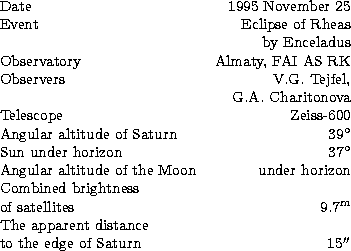
The second successful photometric observing set had the following characteristics:
 and
and  in
the right ascension and declination, respectively. The values of
the parameters are given in [12, (Emel'yanov et al. 1997]).
in
the right ascension and declination, respectively. The values of
the parameters are given in [12, (Emel'yanov et al. 1997]).
![\begin{figure}
\includegraphics [width=8.8cm,clip]{pict05d.eps}\end{figure}](/articles/aas/full/1999/16/ds1626/img27.gif) |
Figure 5: Photometric observations of eclipse of Rhea by Enceladus performed from Almaty on November 25, 1995. The Rhea' flux, S, is given in relative units. The line is a preliminary ephemeris |
![\begin{figure}
\includegraphics [width=8.8cm,clip]{pict06d.eps}\end{figure}](/articles/aas/full/1999/16/ds1626/img28.gif) |
Figure 6: The calculated (line) and observed (dots) brightness curves of Rhea for the eclipse of Rhea by Enceladus performed from Almaty on November 25, 1995. The calculated curve is based on adjusted event parameters. The observations have been corrected for scale, zero point and secular trend effects |
Copyright The European Southern Observatory (ESO)