

The observatory of CL SAI is located in Nauchnyi settlement at an
altitude of 600 m. Its geographic coordinates are: east longitude
 , north latitude
  .
.
The observations were made with a single-channel WBVR photoelectric photometer in a photon-counting mode. The satellite images were projected into the photomultiplier. The photoelectric photometer was mounted on a Zeiss-600 reflector with an aperture of 600 mm and focal length of 7500 mm. An interface counter mounted on an IMB PC compatible was used to count the pulses coming from the photoelectric photometer during the adopted exposure time. The number of these pulses is proportional to the incident flux on the cathode of the photomultiplier. The flux measured during the adopted exposure time was then read by a special interface software and stored in the computer memory. The interface and the corresponding software were developed by V.G. Kornilov (SAI).
The light curve was visualized on a display monitor in real-time mode thereby substantially facilitating the tracking of the event under study. The time signals were transmitted from a synchronometer, which we manually referred to the UTC scale to an accuracy of 0.1 seconds using radio time signals.
We began the photometry of satellite pair beforehand so that the duration of the event proper would be about 20% of the total observing time.
When observing Saturnian satellites the background
contamination due to scattered light from both the Saturn and
its ring poses a considerable challenge. The background
brightness depends on the satellite position and relative
fluctuations of this background due to imperfect telescope
tracking can reach several tenths of magnitude. Thus,
background measurements made with a  diaphragm in the immediate vicinity of rings show quasiperiodic
flux fluctuations with an amplitude of about 0.1 of the flux
itself. As a result, satellite light variations during mutual
events observed at angular separations less
diaphragm in the immediate vicinity of rings show quasiperiodic
flux fluctuations with an amplitude of about 0.1 of the flux
itself. As a result, satellite light variations during mutual
events observed at angular separations less  from the planetary disk are simply lost in the background
fluctuations. Photometric data for mutual events in a pair of
satellites at a sufficiently large separation from the Saturn's
limb (where the ring background can be neglected) show a uniform
trend on the light curve. Guiding attempts result in abrupt
changes of the level of this trend. At the Crimean laboratory of
Sternberg Astronomical Institute we performed photoelectric
photometry of ten mutual occultations and eclipses of Saturnian
satellites and only for two of these events the data proved to be
free from unaccountable scattered light fluctuations. In this
paper we present the results only for one completely successful
photometric observing set.
from the planetary disk are simply lost in the background
fluctuations. Photometric data for mutual events in a pair of
satellites at a sufficiently large separation from the Saturn's
limb (where the ring background can be neglected) show a uniform
trend on the light curve. Guiding attempts result in abrupt
changes of the level of this trend. At the Crimean laboratory of
Sternberg Astronomical Institute we performed photoelectric
photometry of ten mutual occultations and eclipses of Saturnian
satellites and only for two of these events the data proved to be
free from unaccountable scattered light fluctuations. In this
paper we present the results only for one completely successful
photometric observing set.
This observing set had the following characteristics:
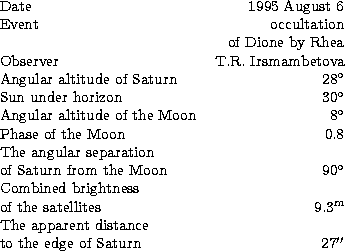
The results of the set of observations described above can be
found in file t0806o54.pmr. Each record in this file has a form
of a simple sequence of integers equal to the numbers of pulses
counted corresponding to the average number of photons
crossing the photometer diaphragm a 0.128-second time interval.
The time of the first count is  (UTC scale)
and the following counts are spaced at 1.024-s intervals.
Figure 1 shows the resulting light curve with the flux given in
relative units.
(UTC scale)
and the following counts are spaced at 1.024-s intervals.
Figure 1 shows the resulting light curve with the flux given in
relative units.
![\begin{figure}
™
\includegraphics [width=8.8cm,clip]{pict01d.eps}\end{figure}](/articles/aas/full/1999/16/ds1626/img8.gif) |
Figure 1: Photometric observations of occultation of Diona by Rhea performed from CL SAI on August 6, 1995. The total flux, S, is given in relative units. The line is a preliminary ephemeride |
This observing set has been reduced in order to extract
astrometric information [12, (Emel'yanov et al. 1997]). In
particular, the apparent angular coordinate differences of
satellites x0, y0 have been derived for a certain instant
t0 of time within the occultation observed.
The measured quantity E as a function of time t is determined
by the formula
 |
(1) |
 and
and  in
right ascension and declination, respectively.
The values of the refined parameters are published in
[12, (Emel'yanov et al. 1997]).
In Fig. 2 we
compare observations with the theoretical satellite light curve
computed after adjusting the above parameters. The flux is
normalized to the combined light of the two satellites outside the
event.
in
right ascension and declination, respectively.
The values of the refined parameters are published in
[12, (Emel'yanov et al. 1997]).
In Fig. 2 we
compare observations with the theoretical satellite light curve
computed after adjusting the above parameters. The flux is
normalized to the combined light of the two satellites outside the
event.
![\begin{figure}
\includegraphics [width=8.8cm,clip]{pict02d.eps}\end{figure}](/articles/aas/full/1999/16/ds1626/img12.gif) |
Figure 2: The calculated (line) and observed (dots) total brightness curves of the satellites for the occultation of Diona by Rhea performed from CL SAI on August 6, 1995. The calculated curve is based on adjusted event parameters. The observations have been corrected for scale, zero point and secular trend effects |
![\begin{figure}
\includegraphics [width=8.8cm,clip]{pict03d.eps}\end{figure}](/articles/aas/full/1999/16/ds1626/img13.gif) |
Figure 3: Photometric observations of occultation and simultaneous eclipse of Enceladus by Tethys performed from Assy on September 14, 1995. The total flux, S, is given in relative units. The line is a preliminary ephemeris |
![\begin{figure}
\includegraphics [width=8.8cm,clip]{pict04d.eps}\end{figure}](/articles/aas/full/1999/16/ds1626/img14.gif) |
Figure 4: The calculated (line) and observed (dots) total brightness curves of the satellites for the occultation and simultaneous eclipse of Enceladus by Tethys performed from Assy on September 14, 1995. The calculated curve is based on adjusted event parameters. The observations have been corrected for scale, zero point and secular trend effects |
Copyright The European Southern Observatory (ESO)