

The magnetic structure of the flare region can be derived from the polarization structure in microwaves (see Fig. 9b). The observations of the present event suggest that the main structural components were large-scale systems of intercrossed magnetic ropes during the whole development of the flare, as described in the Sect. 2.1.4.
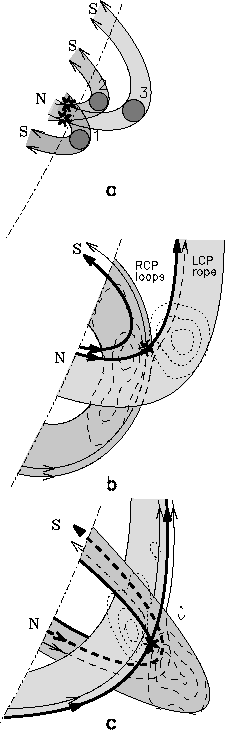 |
Figure 10:
Schemes of the most significant magnetic structures in the
three stages of the flare. Reconnection sites are marked by stars.
Some of magnetic loops are shown
schematically by lines with arrows indicating
direction of the magnetic field. The parts of
loops which were not hidden by overlain ones are plotted by solid lines. Those
parts of loops which could not be seen because of overlain loops are plotted
by broken lines. Dotted and dashed closed contours reproduce the polarization
observed in microwaves (see Fig. 4).
a) the  stage, the sources 1, 2, and 3. The N polarity region
is located farther behind the limb than the S polarity footpoints. The region
of interaction (marked by stars) is also behind the limb.
b) the stage, the sources 1, 2, and 3. The N polarity region
is located farther behind the limb than the S polarity footpoints. The region
of interaction (marked by stars) is also behind the limb.
b) the  stage, 02:49:50 UT. Rapid increase of energy release.
c) the stage, 02:49:50 UT. Rapid increase of energy release.
c) the  stage, 05:02:01 UT stage, 05:02:01 UT |
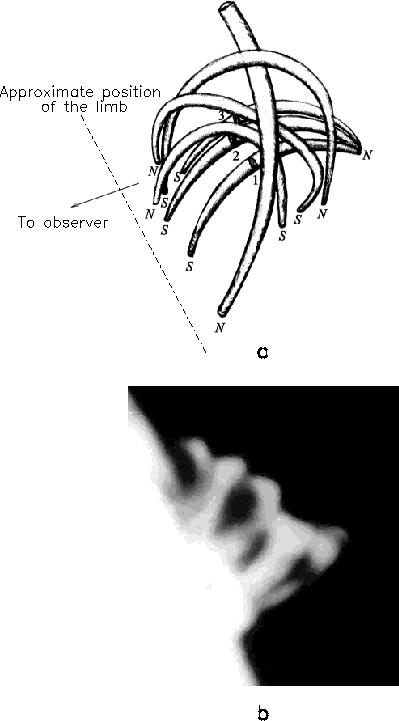 |
Figure 11:
Spatial configuration of the magnetic loop system.
a) A sketch of possible spatial disposition of some foremost loops.
The sources 1, 2, 3 are marked by digits.
b) The photograph of the post flare loops made at Baikal Astronomical
Observatory (H , 06:05 UT) can help to obtain a picture of the loop
system , 06:05 UT) can help to obtain a picture of the loop
system |
image of post-flare loops to compare it with that sketch.
The orientation of the sketch in
Fig. 11a is chosen to show the entire
loops whose parts were in fact hidden behind the limb. The orientation of the
H image in Fig. 11b is chosen to match the sketch.
In the beginning of the first stage
(Fig. 10a), the low-lying sources
located near the limb represented closeness of the brightness centres in I-
and V-images. High degree of their polarization (up to  ) indicated
orientation of the corresponding magnetic loops close to the line of sight.
These loops represented the low-lying magnetic system whose most part was
hidden by the limb.
) indicated
orientation of the corresponding magnetic loops close to the line of sight.
These loops represented the low-lying magnetic system whose most part was
hidden by the limb.
Further, sources appeared higher. A bipolar structure in polarization became typical late in the first stage and the second stage. A possible magnetic configuration seems to be two intercrossed magnetic ropes as shown in Fig. 10b. In this configuration, energy release is caused by magnetic reconnection between the two ropes.
In a reconnection of the two original magnetic ropes, two new sets of loops must be created: short loops, descending from the reconnection site, and long ones, slowly expanding upwards, which were braided within the original ropes. The shape of the short loops was closer to the circular one which was seen as the dome-like source. Cross sections of the long loops were seen in polarization. After the reconnection, the long loops did not change their orientation drastically, and the polarized emission which escaped from them delineated the magnetic structure.
The magnetic tension tended to lift reconnected long loops which could force the interaction between the original ropes in the first stage of the flare. Their upward motion can explain the gradual growth upwards of energy release sites and the appearance of the upper microwave source coincided with the hard X-ray one at the peak of the burst. Different elementary flux tubes were subsequently reconnecting, and new microwave sources appeared. As a result, their sites shifted clockwise along the boundary between the oppositely polarized regions performing almost total revolution.
Relative motion of two oppositely-polarized regions before the flare reflected corresponding motion of the magnetic configuration. It suggests a shear motion at footpoints of interconnecting magnetic ropes which provided energy storage for the flare.
The flare began from below. Probably, the region of energy release in the beginning of the first stage was behind the limb, and we only saw its manifestations in tops of loops.
The steady exponential growth irrelative to changes of energy release sites suggests existence of some large-scale mechanisms forced to increase the rate of energy release in the first stage of the flare. Existence of the fine temporal structures shows that there was no efficient trapping of accelerated electrons.
To the end of the first stage, the trapping became efficient. Accelerated electrons were accumulated in the dome-like emitting region which rapidly grew. The time profile at 17 GHz became smoother. However, a fine (sub-second) temporal structure was observed to be emitted by a source appeared at 5.7 GHz above the dome-like one. It was located well above the soft X-ray kernel. The height of this source above the limb was close to the hard X-ray one's found by Nakajima & Metcalf (1995). So this upper source can be classified as a "loop-top source'' (Masuda 1994).
In the second stage, when the upper 5.7 GHz source disappeared, the dome-like source became uniformly weaker with decreasing of the number of accelerated electrons, but the gyrosynchrotron mechanism continued to provide the main contribution to the microwave emission.
In the third stage, two different processes of energy release also went on. Evidence of particle acceleration is given by the almost continuous series of sub-bursts observed at lower frequencies low in corona. Prolonged particle acceleration during the late phase of a flare was also revealed by Akimov et al. (1994). High in corona, a reconnection of the two interacting oppositely-polarized ropes continued, which was marked by the compact hot microwave source at the place of their closest contact located near the brightness centre in X-rays. Free-free emission from the post-flare loops seen in soft X-rays became the main component at high frequencies.
Ichimoto et al. (1993)
analysed this flare in detail using
X-ray and H data. Calculating the gas pressure and the magnetic one,
they puzzled that the gas pressure exceeded the magnetic one, suggesting that
the magnetic field was not strong enough to confine the hot plasma as rigidly
as is commonly assumed (30 G). From the degree of polarization at 17 GHz, it
follows that even the line-of-sight component of the magnetic field was
 G. So the magnetic configuration essentially differed from the
potential one and could be sufficiently strong to balance the plasma pressure.
G. So the magnetic configuration essentially differed from the
potential one and could be sufficiently strong to balance the plasma pressure.
In summary, the observations of the present event seem to give evidence for the interaction of large-scale systems of multiple intercrossed flare loops during the whole development of the flare, and do not seem to be consistent with a merging of magnetic field lines at the tip of an inverse-Y-type field line configuration in long-duration events (LDEs) (see, e.g., Sturrock 1966; Kopp & Pneuman 1976; Tsuneta 1996). The flare of November 2, 1992 provides additional support to the existence of solar flares caused by interaction of loops (Kundu 1984; Machado et al. 1988; Hanaoka 1994; Hanaoka 1997; Inda-Koide et al. 1995; Shimuzu et al. 1994; Nishio et al. 1997).
Copyright The European Southern Observatory (ESO)