

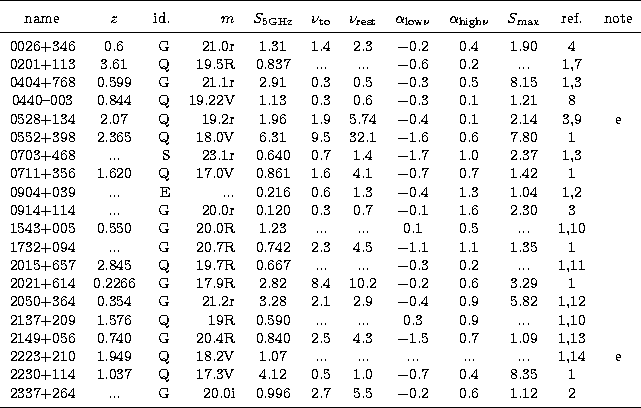
During the VLA observing sessions an additional 20 GPS candidate sources were observed (Table 2). These sources fail one or more criteria of the complete sample. Nevertheless, the majority of them show a clear GPS-like spectrum.
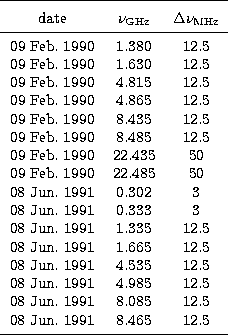
A second set of VLA observations was obtained on 9 February 1990, and a third session on 8 June 1991. The journal of these observations in shown in Table 3. In the third session, where the majority of the sources belonging to the complete sample were observed, we split the 2 frequencies in each band to obtain the maximum possible separation with adequate sensitivity. This was used in the previous observing sessions only in the L band, here we used it also in the C, X and P bands. This technique proved to be very useful, because it permitted a better definition of the spectral shape and a more accurate selection of the sources peaking close to the limit of 0.4 GHz that we adopted for our sample.
Furthermore, the observations separated in frequency permit us to
solve the  ambiguity that occurs in the determination
of the Faraday rotation measure.
ambiguity that occurs in the determination
of the Faraday rotation measure.
 |
 |
The data reduction has been performed in a uniform way for all the VLA data
sets. The errors in the flux densities are dominated by the
calibration errors which are estimated to be around 3 at L, C, X bands,
around 5 at P and K bands, respectively.
at L, C, X bands,
around 5 at P and K bands, respectively.
At VLA resolution almost all the objects observed are dominated by a single point-like component. The side lobes have been deconvolved from the images using the AIPS implementation of the Clark CLEAN algorithm (Clark 1980; Cornwell & Braun 1988). The data have been self-calibrated in phases (Schwab 1980; Cornwell & Fomalont 1988) with an initial point model, and when subsequent iterations of self-cal have been considered necessary, we used an appropriate number of non negative components obtained from the images in an interactive process until convergence to an acceptable solution was achieved. In most cases an amplitude self-calibration has been performed on the data to improve the final images and to allow a search for possible extended emission.
The data reduction for the data obtained in the 1990 has been done with the package DWARF. The data of the 1991 observations have been reduced with AIPS. These latter data in a format readable by AIPS did not have the redundant baselines, therefore the data were not self-calibrated, producing a lower dynamic range compared with the capabilities of this instrument.
A few objects were observed during the spring and the summer of 1991 with the Northern Cross, a radio telescope near Bologna operating at 408 MHz on the principle of the Mill's cross (Braccesi et al. 1969 and Ficarra et al. 1985). The radio telescope dates back to the sixties, however, recent mechanical and electronics upgrades allow completely automatic observations with increased sensitivity. The flux density values have been set to the scale of Baars (Baars et al. 1977) adopting a flux density of 37.7 Jy for the calibrator source 3C 380 (Riley 1988).
A few additional objects have been observed with the Russian radio telescope RATAN 600 (Esepkina et al. 1979), in transit mode, during various sessions in 1993 and 1994, at 11.2, 7.7, 3.9, 2.3 and 0.96 GHz (Mingaliev, private communication).
Copyright The European Southern Observatory (ESO)