100 radio sources, while
Dallacasa &
Stanghellini (1990)
collected a larger list of GPS and CSS radio sources and candidates.
To enable statistical analysis of the properties of these
objects we selected a complete sample of bright GPS radio sources.
100 radio sources, while
Dallacasa &
Stanghellini (1990)
collected a larger list of GPS and CSS radio sources and candidates.
To enable statistical analysis of the properties of these
objects we selected a complete sample of bright GPS radio sources.
The selection criteria were:
- declination 
- galactic latitude 
- flux density at 5 GHz  Jy
Jy
- turnover frequency between 0.4 and 6 GHz
- spectral index  (
( )in the high frequency, likely optically thin, part of the spectrum.
We started by selecting GPS candidates from the 1 Jy catalog of Kühr et al. (1981). We cleaned this first "dirty" sample (Stanghellini et al. 1990) using our multi-frequency observations from the VLA and the WSRT presented here, supplemented with data from the literature.
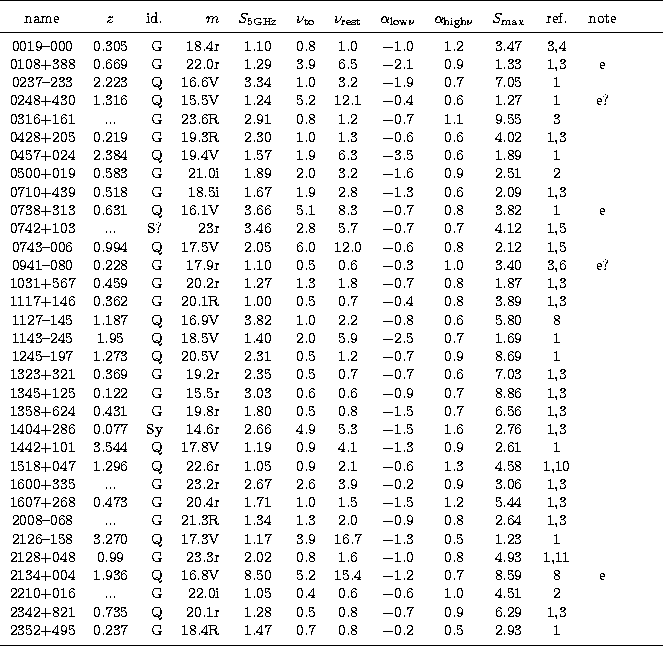
The final complete sample consists of the 33 objects listed in Table 1. This is the first complete sample of bright GPS objects. The new radio data permit the proper classification and the improvement in the estimate of important parameters such as spectral indices, turnover frequencies, and polarization properties.
We note the following regarding the sample and possible selection effects.
|
|
Since variability may influence the spectral shape, the fact that GPS sources are thought to not be significantly variable may be just due to selection effects. Even if the spectral shape is constant, if the flux density varies significantly, the source would probably not be recognized as GPS using data from the literature spanning several years. Therefore it is important to have simultaneous multi-frequency observations to build a sample unbiased with respect to variability (see also Sect. 4.4).
The turnover frequency and the spectral indices at low and high frequencies are difficult to derive when few data are available and/or the spectrum bends continuously. For this reason we included objects with a turnover frequency in a range a little larger than that of the canonical decade around 1 GHz.
The selection is based on the observed turnover frequency, hence we select objects with different intrinsic turnover frequencies at low and high redshifts. A selection based on the intrinsic turnover frequency is not currently possible due to the lack of complete redshift information on large samples of radio sources.
We note that the sample is unbiased regarding the optical identification.
Copyright The European Southern Observatory (ESO)