

The cluster of galaxies A2390 is located at a redshift of 0.231. Figure 7 (click here) shows an image of this cluster, obtained with ROSAT satellite. The resolution is one arc second per pixel, with a total number of 13506 photons for exposure time of approximately 8 hours. The background level is around 0.04 photons per pixel. It is clear that the raw data are not usable, and we need to filter it in order to extract the information. The standard method consists in convolving the image by a Gaussian. Figure 8 (click here) shows the result after applying this convolution (Gaussian with a full width at half maximum equal to 5'', which is approximatively the size of the instrumental response). The smoothed image shows structure, but we see also that a lot of noise remains, and it is difficult to assign a significance to these structures. Figure 9 (click here) shows the filtered image by the histogram based wavelet method. The noise has been eliminated, and we see that the wavelet transform has enhanced weak structures in the X-ray emission, which could explain the gravitational amplification phenomena which have been observed in the optical domain (Pierre et al. 1996).
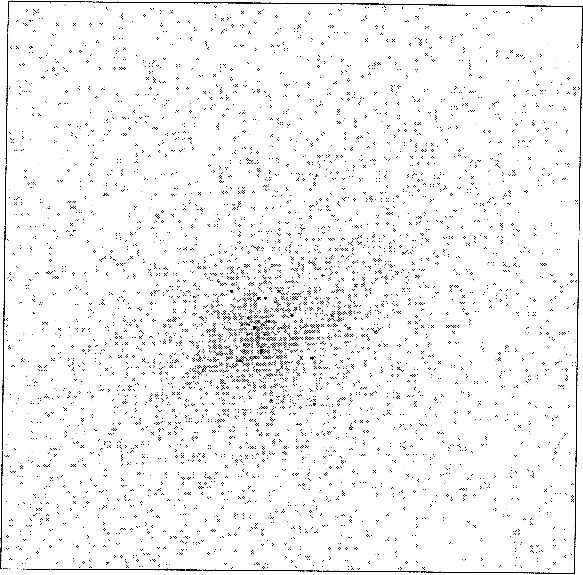
Figure 7: ROSAT image of the cluster A2390
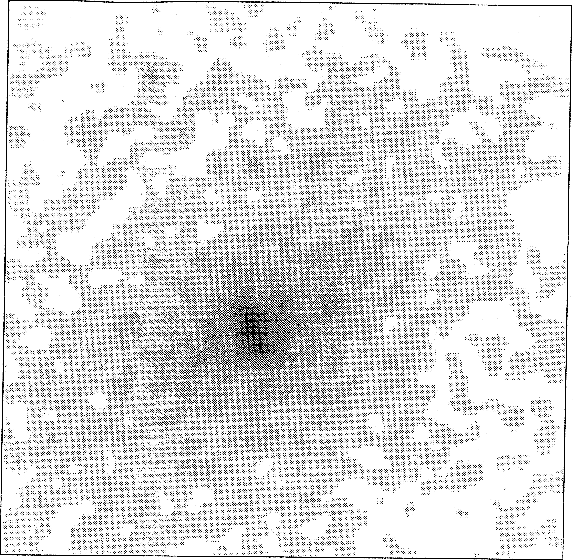
Figure 8: A2390 ROSAT image filtered by a standard method (convolution with a Gaussian)
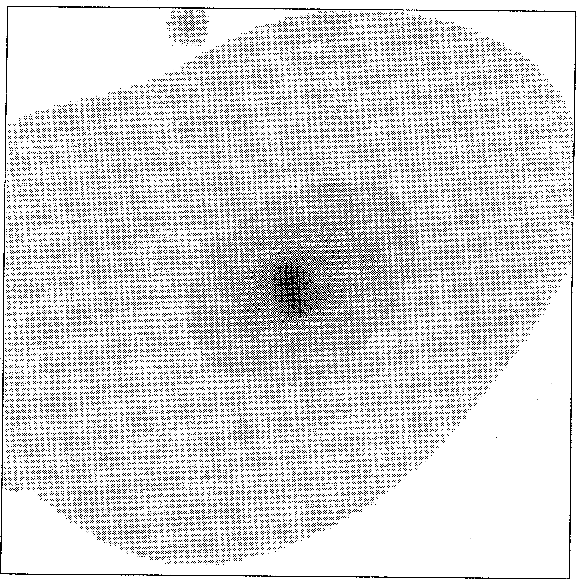
Figure 9: A2390 ROSAT image filtered by the wavelet based method