

We propose here to filter an image using the multiresolution support, which is determined from the significant wavelet coefficients (i.e. coefficient which are not due to the noise).
A multiresolution support of an image describes in a
logical or Boolean way if an image I contains information at a
given scale j and at a given position (x,y).
If M(I)(j,x,y) = 1 (or  ), then I contains information at
scale j and at the position (x,y).
M depends on several parameters:
), then I contains information at
scale j and at the position (x,y).
M depends on several parameters:
The multiresolution support of an image is computed in several steps:
The multiresolution support will be obtained by detecting at each scale the significant coefficients. The multiresolution support is defined by:

In the previous section, we have shown how to detect significant structures in
the wavelet scales. A simple filtering can be achieved by thresholding the
non-significant wavelet coefficients, and by reconstructing the filtered image
by the inverse wavelet transform. In the case of the à trous wavelet
transform algorithm, the reconstruction is obtained by a simple addition
of the wavelet scales and the last smoothed array. The solution S is

where wj(I) are the wavelet coefficient of the input data, and M is the
multiresolution support.
As the à trous wavelet transform algorithm is a non orthogonal wavelet
transform algorithm, the wavelet transform of the solution S does not
produce wavelet coefficients wj(S)(x,y) which are exactly
equal to M(j,x,y) wj(I)(x,y). This is evidently not a problem for wavelet coefficients where nothing was detected
(M(j,x,y)=0), but it means that
an error has been introduced during the reconstruction of objects from
the significant structures. This can be corrected using an iterative method
(Starck et al. 1995). If a wavelet coefficient of the
original image is significant, then the multiresolution coefficient of the
residual image (i.e. w(R<347>>(n))j with R = I - S) must be equal to zero.
This is obtained by the following iteration:

Thus the regions of the image which contain significant structures at all
levels are not modified by the filtering. The residual will contain the
value zero over all of these regions. If an object is close to another one,
which has the same size and has a stronger flux,
it is possible that we will not detect it because of the negative component around
the detected structure of the second object (this is due to fact that
a wavelet function has null mean). But after one or two iterations, the
solution will contain the second object, and the residual will
contain only the first one. This means that the wavelet coefficient (obtained
from the residual) of the first object will no longer be masked by the second.
The multiresolution support can be updated by reducing the wavelet
coefficient of the residual image (see 11 (click here)), and applying both
comparison tests of Eq. (12 (click here)) and Eq. (13 (click here)). Note that
 and
and  are not recomputed, because the detection level is
unchanged.
are not recomputed, because the detection level is
unchanged.
The algorithm becomes:
 .
.
 containing the significant residuals of the residual image.
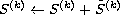 .
.
 then
then  and
go to 4.
and
go to 4.

The filtering can be seen as an inversed problem. Indeed, we want to
reconstruct an image from the detected wavelet coefficient.
The problem of reconstruction (Bijaoui & Rué 1995)
consists
in searching a signal S such that
its wavelet coefficients are the same as those of the detected
structure. By noting  , the wavelet transform operator, and P the
projection operator in the subspace of the detected coefficients
(i.e. set to zero all coefficients at scales and positions where
nothing where detected), the solution is found by minimization of
, the wavelet transform operator, and P the
projection operator in the subspace of the detected coefficients
(i.e. set to zero all coefficients at scales and positions where
nothing where detected), the solution is found by minimization of

where W represents the detected wavelet coefficients of the image I.
A complete description of algorithms for minimization of such an equation can
be found in Bijaoui & Rué (1995). In practice, compared to the
previous algorithm, the main modification is the introduction of the
adjoint wavelet transform operator, replacing the step 8 (reconstruction).
A simple thresholding generally provides poor results. Artifacts appear around the structures, and the flux is not preserved. The multiresolution support filtering requires only a few iterations, and preserves the flux. The use of the adjoint wavelet transform operator instead of the simple coaddition of the wavelet scale for the reconstruction (step 8 of the algorithm) suppresses the artifacts which may appear around objects. In fact, the algorithm is analogous to minimizing the Eq. (18 (click here)). The use of the Van Cittert algorithm for minimization of J leads to the modified multiresolution support filtering method. Other approaches for the minimization can also be used (conjugate gradient, etc.). The Van Cittert algorithm is not optimal for the time computation, but it has the advantage of allowing us to add constraints during the iterations. The positivity is a strong constraint which should be used. Other additional prior knowledge can be added. For instance, such prior knowledge could be in the form of a star position catalog, bad pixel positions, a given position where we expect the object to be located, or constraints on the size of the object. Hence the multiresolution constraint allows us to integrate into the same data structure other information sources (catalogs, images, etc.) and prior knowledge (positions, object sizes, etc.), in a way which facilitates subsequent image processing operations. In the most general case, we do not have such prior information available, so the multiresolution support is computed from the given input image and its noise properties.
Partial restoration can also be considered. Indeed, we may want to restore an image which is background free, objects which appears between two given scales, or one object in particular. Then, the restoration must be performed without the last smoothed array for a background free restoration, and only from a subset of the wavelet coefficients for the restoration of a set of objects (Bijaoui & Rué 1995).