

The magnetic CP star 3 Hydrae (= HR 3398 = HD 72968 = HV Hya)
was studied most recently by Catalano & Leone (1990) with
observations from the Catania Observatory in their UBV natural
system. Previous photometry is by Wolff & Wolff (1971),
Maitzen et al. (1978), and Heck et al. (1987).
Wolff & Wolff (1971) found a period of
5.57 days, but subsequent observers derived a double wave variation
in all filters with approximately twice this period. Maitzen et al.
(1978) found
 elements which have also been used by subsequently published
studies. When I plotted my FCAPT and previous uvby observations
according to this ephemeris, then except for zero point differences in
magnitude the shape and the amplitude of the variations in a given
filter are very similar and the phase shift if any is small. This is a
star with relatively small photometric variations.
elements which have also been used by subsequently published
studies. When I plotted my FCAPT and previous uvby observations
according to this ephemeris, then except for zero point differences in
magnitude the shape and the amplitude of the variations in a given
filter are very similar and the phase shift if any is small. This is a
star with relatively small photometric variations.
Ten FCAPT observations were obtained in 1990-91, 1 in 1991-92,
11 in 1992-93, 26 in 1993-94, 28 in 1994-95, and 57 in 1995-96.
Periodograms with my data alone gave a period close to that of
Maitzen et al., 11.304 days. When I used a periodogram
incorporating both the FCAPT and Maitzen et al. u photometry the
most likely period was 11.298 days. If correct it introduces a relative
shift of 0.420 between my photometry and previous results according
to the 11.305 day period. But as the light curve is symmetric either
the Maitzen et al. period is correct or the relative phase shift is closer
to 0.500. As the long gap in time between my photometry and
previous uvby values violates the assumptions of the periodogram
method, the period is probably close to 11.305 days with the error in
the period being  day. Thus I will use the Maitzen et al.
elements in comparing the observed light curves.
day. Thus I will use the Maitzen et al.
elements in comparing the observed light curves.
Figure 2 (click here) shows the FCAPT values as pluses and the previous uvby values from Maitzen et al. (1978) as closed diamonds. As there is a considerable amount of data, only one period is shown to simplify the figure. Corrections have been applied to the later data set to bring the mean values for each filter into agreement. The relative tightness of the photometry differs from filter to filter. The amplitudes are about 0.03 mag in u, 0.02 mag in v and 0.025 mag in b and y. The clarity of the light curves is least for v and best for b. The small amplitudes and the quality of the photometry make it difficult to judge whether any changes in the shapes of the light curves are seen.
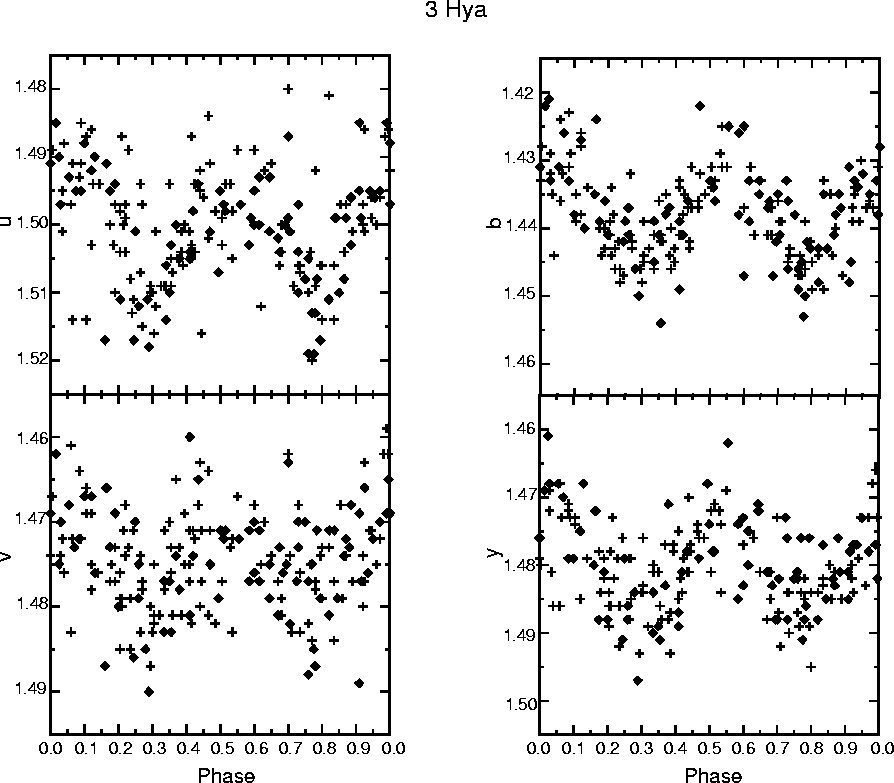
Figure 2: FCAPT (pluses) and Maitzen et al. (1978)
(closed diamonds) uvby photometry of the magnetic CP star 3 Hya
using the elements of Maitzen et al. (1978)