

AR Aurigae (= 17 Aur = HD 34364 = HR 1728) is a double lined eclipsing binary star (Popper 1959), both of whose components are HgMn stars. It is widely used as a standard to calibrate absolute parameters. Wyse (1936) determined the orbital elements of this spectroscopic binary system. Zverko et al. (1981) found evidence for a third object in this system. Johansen (1970) published photometry close to the Strömgen system.
In 1990-91 and in 1991-92, 25 and 23, respectively, sets of differential Strömgren values were obtained. Although the same check and variable stars were used, different neutral density filters were employed. Constant offsets were added to the year 2 values so that their values fit the trends of the year 1 values.
Figure 1 (click here), which is plotted using a single cycle, shows that there is very little variation in any color outside of the two eclipses which is in agreement with photometry of single HgMn stars (see, e.g., Adelman 1993). Excluding the eclipse observations, the v-c standard deviations are similar to those found between two constant stars, of order 0.005 mag. The ephemerides used is that of Zverko et al. (1981) with a period of 4.134695 days and a correction for the effect of the third body. Near phase 0.5 we see the secondary eclipse. Year 1 values are indicated with closed rectangles and year 2 values with plus signs.
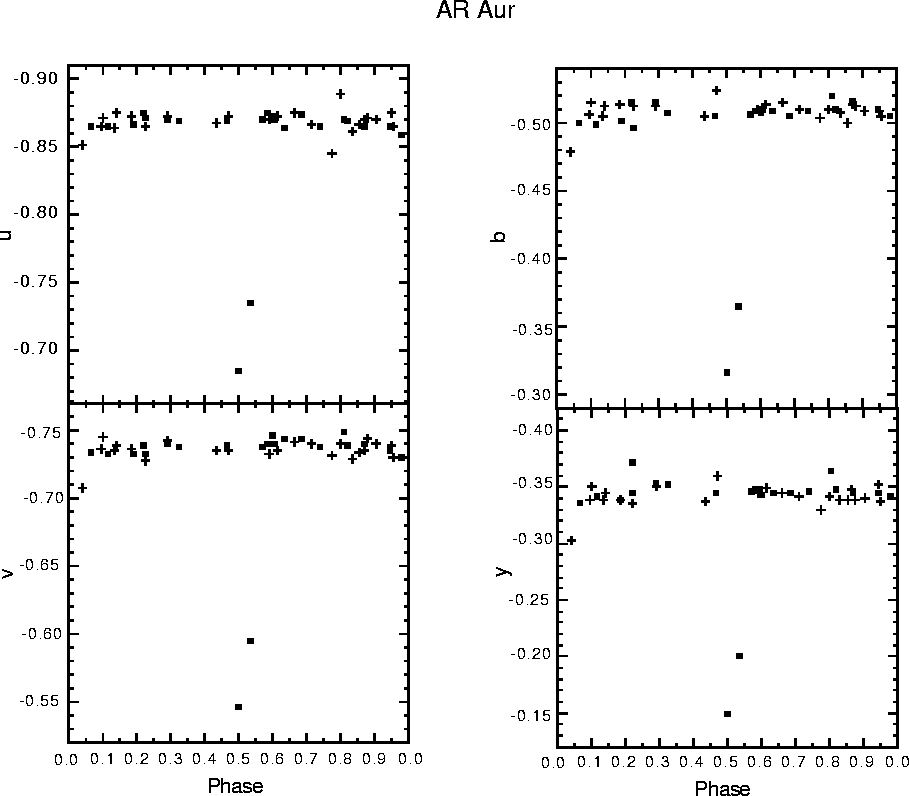
Figure 1: FCAPT uvby photometry of the eclipsing HgMn binary
star AR Aurigae plotted according to the ephemeris of
Zverko et al. (1981).
Solid rectangles are year 1 and pluses are year 2 values