

In order to investigate the structure of Westerlund1, we compare its intrinsic
size with those of the compact young open clusters NGC 3603 and Westerlund2.
For the sake of uniformity, we measured their angular dimensions on the ESO/SRC
Schmidt plates, obtaining:  ,
,
 and
and  for Westerlund
1, Westerlund2 and NGC 3603, respectively. Using the distances
of 1.1 kpc (Sect. 3 (click here)), 5.7 kpc (Sect. 4.2 (click here)) and 7.2 kpc
(Melnick et al. 1989), the corresponding linear sizes
are:
for Westerlund
1, Westerlund2 and NGC 3603, respectively. Using the distances
of 1.1 kpc (Sect. 3 (click here)), 5.7 kpc (Sect. 4.2 (click here)) and 7.2 kpc
(Melnick et al. 1989), the corresponding linear sizes
are:  ,
,  and
and
 , respectively.
Therefore, the size of Westerlund1 is
comparable to those of the massive clusters NGC 3603
and Westerlund2. Recently, Watson et al. (1996) have
examined the central region of the starburst spiral galaxy NGC 253 using
high resolution imaging. They
have reported the discovery of four compact young luminous stellar clusters,
with half-light radii between 1.0 and 5.0 pc, and masses and light profiles
comparable to those of Galactic globular clusters.
The existence of such clusters in starburst galaxies suggests that
enhanced star formation processes are required to form them.
, respectively.
Therefore, the size of Westerlund1 is
comparable to those of the massive clusters NGC 3603
and Westerlund2. Recently, Watson et al. (1996) have
examined the central region of the starburst spiral galaxy NGC 253 using
high resolution imaging. They
have reported the discovery of four compact young luminous stellar clusters,
with half-light radii between 1.0 and 5.0 pc, and masses and light profiles
comparable to those of Galactic globular clusters.
The existence of such clusters in starburst galaxies suggests that
enhanced star formation processes are required to form them.
We also measured on the ESO/SRC Schmidt plates the angular
dimensions of Gum29 (Gum 1955), which is part of the
HII region RCW49 (Rodgers et al. 1960)
directly associated to
Westerlund2, and obtained  (
( for the bright core). For
the HII region associated to NGC 3603 (Gum 38b, which in turn
is the eastern part of RCW57), we obtained
for the bright core). For
the HII region associated to NGC 3603 (Gum 38b, which in turn
is the eastern part of RCW57), we obtained  (
( for the bright core).
The linear sizes of Gum29 give
for the bright core).
The linear sizes of Gum29 give  (7.9 pc
  7.2 pc for
the core), and those of Gum38b,
7.2 pc for
the core), and those of Gum38b, 
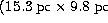 for the core).
Assuming similar gas densities, this suggests that the bulk of the ionization
caused by Westerlund2 is comparable to that of NGC 3603, showing that we are
also dealing with a massive star cluster. No HII region in the Gum nor in the RCW
catalogues appears to be related to
Westerlund1, nor is any apparent on the ESO/SERC R Schmidt plate.
Westerlund1 is somewhat
older than the former clusters (Sects. 3 (click here), 4.1 (click here) and 4.2 (click here)), but still presents residual
nebular emission lines in its spectrum (Sect. 4.1 (click here)).
for the core).
Assuming similar gas densities, this suggests that the bulk of the ionization
caused by Westerlund2 is comparable to that of NGC 3603, showing that we are
also dealing with a massive star cluster. No HII region in the Gum nor in the RCW
catalogues appears to be related to
Westerlund1, nor is any apparent on the ESO/SERC R Schmidt plate.
Westerlund1 is somewhat
older than the former clusters (Sects. 3 (click here), 4.1 (click here) and 4.2 (click here)), but still presents residual
nebular emission lines in its spectrum (Sect. 4.1 (click here)).
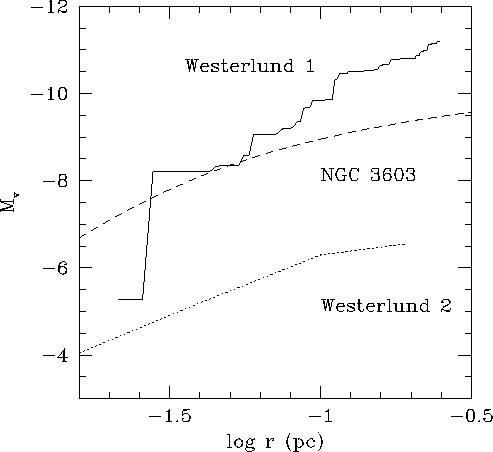
Figure 8: Radial light distribution for NGC 3603 (dashed line), Westerlund2
(dotted line) and Westerlund1 (solid line)
Finally, we study the radial light distribution of Westerlund1 from our CCD V image. We used the magnitude of individual stars (Sect. 2 (click here)) and integrated them in radial annuli. In addition, we considered circles with radii smaller than 100 pixels, thus including the core and part of the corona, to minimize the field contamination (see Sect. 3 (click here)). We compare in Fig. 8 (click here) the resulting radial light distribution to those of NGC 3603 and Westerlund2 (MSP91), in terms of the accumulated absolute visual magnitude as a function of radius. We adopted our distance estimation for Westerlund2, which placed the cluster 0.7 mag fainter than in MSP91. Since the clusters have similar ages, we conclude, from the accumulated Mv at the larger radius available, that Westerlund1 is as massive as NGC 3603. Although we placed Westerlund2 closer with respect to MSP91, it is still a rather massive open cluster. Finally, contrarily to what has been pointed out by MSP91, NGC 3603 is not the unique case of massive cluster in the Galactic disk, comparable to the 30Dor cluster in the LMC and the four massive young clusters in the starburst galaxy NGC 253 (Watson et al. 1996).
As shown by Moffat et al. (1985) the central parts of
NGC 3603, having a compact small core, are well fitted
by a King's (1962) profile. Westerlund2
may have a similar feature, but could not be resolved in MSP91.
For Westerlund1, we could not satisfactorily fit a King profile with
reasonable  values.
A fundamental question is how large amounts of luminous stars, confined in
a relatively small
volume, could be formed either in massive clusters as NGC 3603, or in
small compact open clusters as Westerlund1 (which has approximately 15
luminous stars within r=0.1 pc)? Efforts in this direction are, e.g., the
numerical simulations by Murray & Lin (1996). They found that the most
massive stars require many dissipative cloudlet mergers, and so are preferentially
formed in the cluster center.
values.
A fundamental question is how large amounts of luminous stars, confined in
a relatively small
volume, could be formed either in massive clusters as NGC 3603, or in
small compact open clusters as Westerlund1 (which has approximately 15
luminous stars within r=0.1 pc)? Efforts in this direction are, e.g., the
numerical simulations by Murray & Lin (1996). They found that the most
massive stars require many dissipative cloudlet mergers, and so are preferentially
formed in the cluster center.