

In Fig. 3 (click here)a we show the V vs. (V-I) diagram for 233 measured stars in the
field of Westerlund1. It is evident that the cluster is projected against
a rich field of foreground/background stars, making it very difficult to
trace a clear fiducial main sequence. In order to obtain a better definition
of the CMD for the cluster stars by eliminating possible non-physical members, we
first determined a centre for the cluster. This was accomplished by building
the stellar density profiles as a function of pixel bins in the
x and y directions, using all stars in Fig. 3 (click here)a.
The final coordinates that we adopted for the
position of the cluster centre are ( ,
, 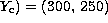 . We determined
the cluster extent by calculating the average stellar density in successive
20 pixel wide annuli around the adopted centre. The resulting density
profile is shown in Fig. 4 (click here), which shows that Westerlund1 presents a
core and a relatively extended low-density corona.
The angular radius of the core is about 36
. We determined
the cluster extent by calculating the average stellar density in successive
20 pixel wide annuli around the adopted centre. The resulting density
profile is shown in Fig. 4 (click here), which shows that Westerlund1 presents a
core and a relatively extended low-density corona.
The angular radius of the core is about 36 (80 pixels) while the
angular cluster diameter reaches
(80 pixels) while the
angular cluster diameter reaches  . This value was obtained by
comparing the radial density profile of the cluster with independent determinations
of the stellar density in four different fields around the cluster region. The
derived diameter is very close to the average of 2
. This value was obtained by
comparing the radial density profile of the cluster with independent determinations
of the stellar density in four different fields around the cluster region. The
derived diameter is very close to the average of 2 and3
estimated by Westerlund (1961) and
van den Bergh & Hagen (1975), respectively.
and3
estimated by Westerlund (1961) and
van den Bergh & Hagen (1975), respectively.
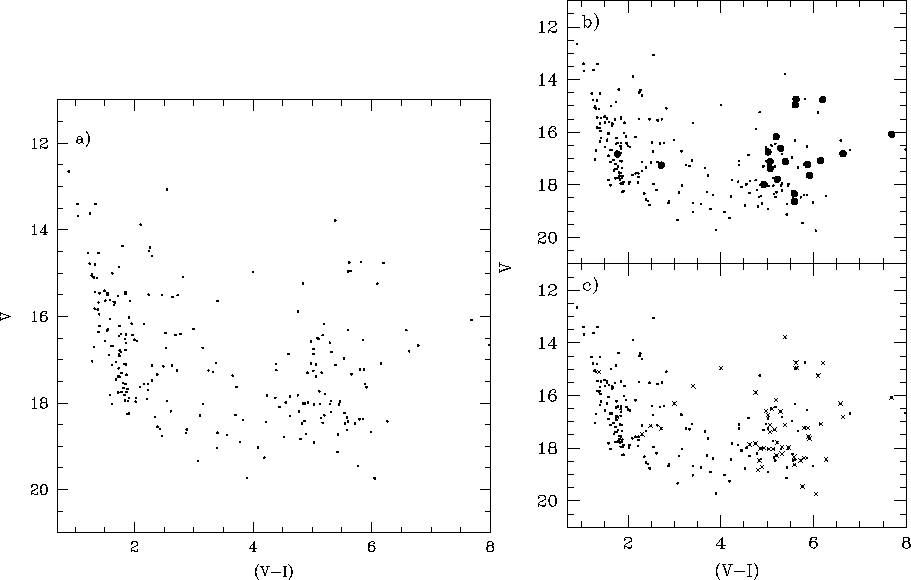
Figure 3: Colour-magnitude diagrams for Westerlund1: a)
all measured stars (dots), b)
circular extraction for  (filled circles) are
superimposed, c) same as b) for
(filled circles) are
superimposed, c) same as b) for  (crosses)
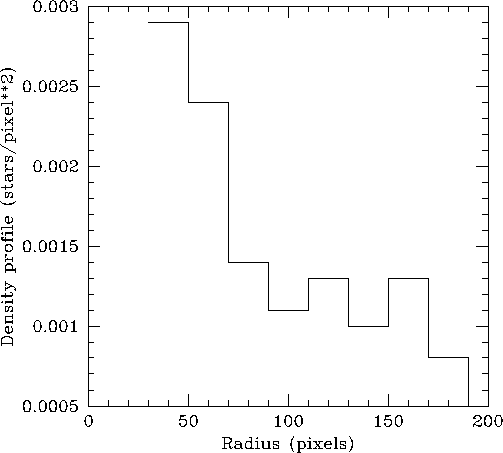
Figure 4: Density profile of Westerlund1
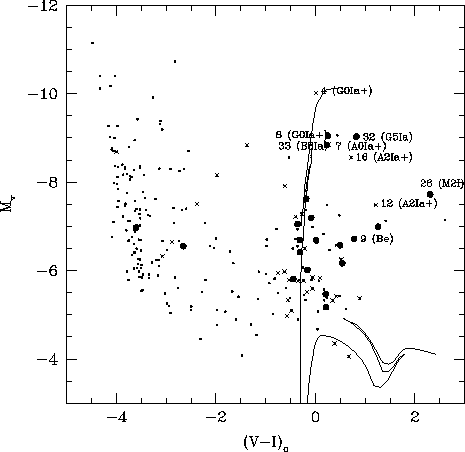
Figure 5: HR diagram of Westerlund1. The solid lines are the solar metallicity isochrones
of Bertelli et al. (1994) corresponding to 4 and 50
Myr, respectively. Symbols are as in Fig. 3 (click here). Identification
and spectral types of stars are from Westerlund
(1987)
We extracted V vs. (V-I) diagrams around  ,
,  )
for
(50 pixels), basically corresponding to the cluster core, and
(100 pixels), thus extending to the coronal region. These diagrams are
shown in Figs. 3 (click here)b,c. The smallest circular extraction allowed
us to know which are the CMD zones where the fiducial cluster sequences are
located. Figure 3 (click here)c is a compromise between minimizing the unavoidable field
contamination and maximazing the number of cluster stars.
)
for
(50 pixels), basically corresponding to the cluster core, and
(100 pixels), thus extending to the coronal region. These diagrams are
shown in Figs. 3 (click here)b,c. The smallest circular extraction allowed
us to know which are the CMD zones where the fiducial cluster sequences are
located. Figure 3 (click here)c is a compromise between minimizing the unavoidable field
contamination and maximazing the number of cluster stars.
Despite the presence of a certain amount of field stars, the main features of the cluster CMD are now clear. Westerlund1 appears as a vertical and very reddened main sequence affected by scatter. The vertical position of the main sequence resembles those in young open clusters. The scatter mainly arises from differential reddening, since the photometric internal errors are much smaller (Sect. 2 (click here)). Figures 3 (click here)b,c also exhibit several supergiant stars, as previously shown by W87.
To estimate the mean cluster reddening and apparent distance modulus we matched the
CMD extractions (Figs. 3 (click here)b,c) to the theoretical isochrones
by Bertelli et al. (1994). Figure 5 (click here) shows the
results of our fitting using a solar abundance (see Sect. 4.1 (click here)) isochrone,
corresponding to an age of 4 Myr; we have also included the next available
isochrone (50 Myr) for comparison purposes. We derived  or
or  according to the E(V-I)/E(B-V) ratio given by
Walker (1985), and an apparent distance modulus
according to the E(V-I)/E(B-V) ratio given by
Walker (1985), and an apparent distance modulus  . It is important to note that both the vertical position of the
main sequence and its width makes it difficult to achieve an accurate
placement of the isochrone, mainly along the V-axis. The presence of
supergiants at
. It is important to note that both the vertical position of the
main sequence and its width makes it difficult to achieve an accurate
placement of the isochrone, mainly along the V-axis. The presence of
supergiants at  mag helped us to match the rapid
evolutionary phase at the top of the 4 Myr isochrone more properly. Using
E(B-V) = 4.3 and R=Av/E(B-V)=3.0, we derived a visual absorption
Av=12.9 and a true distance modulus of V0 - Mv=10.9 mag, equivalent to a distance of 1.5 kpc.
mag helped us to match the rapid
evolutionary phase at the top of the 4 Myr isochrone more properly. Using
E(B-V) = 4.3 and R=Av/E(B-V)=3.0, we derived a visual absorption
Av=12.9 and a true distance modulus of V0 - Mv=10.9 mag, equivalent to a distance of 1.5 kpc.
The derived visual absorption Av shows a very good agreement with the values
found by Lockwood (1974) from stars observed at near-infrared wavelengths
 ), and that of Borgman et al. (1970) using
K-filter observations. We have also obtained a similar value of Av
from our CCD integrated spectrum (see Sect. 4.1 (click here)). The present visual
absorption and true distance modulus differ significantly from the values
derived by W87, whereas they are in fairly good agreement with
Westerlund's (1961) earlier results (see also Sect. 1 (click here)).
), and that of Borgman et al. (1970) using
K-filter observations. We have also obtained a similar value of Av
from our CCD integrated spectrum (see Sect. 4.1 (click here)). The present visual
absorption and true distance modulus differ significantly from the values
derived by W87, whereas they are in fairly good agreement with
Westerlund's (1961) earlier results (see also Sect. 1 (click here)).
Looking for a possible explanation for the difference with W87, we first examined
how similar both (CCD and photographic) photometries are. This was done from 8
supergiants spread out within the cluster core region and for which W87 obtained MK
spectral-types, V-Johnson magnitudes and (V-I) Kron colour indices. The
comparison between both V magnitude scales yields a mean difference of
 mag, our values being sistematically brighter. To compare the (V-I)
colour indices we first transformed the present (V-I) Cousins
values to the Kron system. For this purpose,
we used the MK vs.
mag, our values being sistematically brighter. To compare the (V-I)
colour indices we first transformed the present (V-I) Cousins
values to the Kron system. For this purpose,
we used the MK vs.  relationship given by W87, Bessell's (1979)
relations between the Cousins and Kron systems, and the
fact that the ratio Av/E(V-I) is the same in both systems (W87). A comparison
of our transformed (V-I) indices with the values
published by W87 yields a mean difference of 0.8 mag. This
implies a 0.8 mag shift in the E(V-I) colour excess, which in turn leads to an
Av value increased by 1.6 mag with respect
to that of W87. Therefore, taking into account these
zero points, the revised W87 true distance modulus and cluster distance
are 11.7 and about 2.0 kpc, respectively, which are now consistent with the
present CMD-fitting values.
relationship given by W87, Bessell's (1979)
relations between the Cousins and Kron systems, and the
fact that the ratio Av/E(V-I) is the same in both systems (W87). A comparison
of our transformed (V-I) indices with the values
published by W87 yields a mean difference of 0.8 mag. This
implies a 0.8 mag shift in the E(V-I) colour excess, which in turn leads to an
Av value increased by 1.6 mag with respect
to that of W87. Therefore, taking into account these
zero points, the revised W87 true distance modulus and cluster distance
are 11.7 and about 2.0 kpc, respectively, which are now consistent with the
present CMD-fitting values.
An alternative way to derive the cluster distance is to use
our CCD V magnitudes and Mv from W87 for the nine brightest stars in the
cluster central region. We obtained  , equivalent to a
distance of 1.2 + 0.3-0.2 kpc, adopting
, equivalent to a
distance of 1.2 + 0.3-0.2 kpc, adopting  computed
from appropriate R values (Crawford & Mandwewala 1976). This distance is somewhat
smaller than that we
obtained from the fitting analysis (Fig. 5 (click here)). However, if the couple
(Av,
computed
from appropriate R values (Crawford & Mandwewala 1976). This distance is somewhat
smaller than that we
obtained from the fitting analysis (Fig. 5 (click here)). However, if the couple
(Av,  ) is adopted, the 4 Myr isochrone in Fig. 5 (click here) would be
displaced downwards nearly 1.0 mag, the fit being still satisfactory.
In this case, only the brightest star (G0Ia+, No. 4 in W87) would slightly fall
away from the sequence. Nevertheless, it might still be a member considering the amount
of differential reddening present in the cluster.
) is adopted, the 4 Myr isochrone in Fig. 5 (click here) would be
displaced downwards nearly 1.0 mag, the fit being still satisfactory.
In this case, only the brightest star (G0Ia+, No. 4 in W87) would slightly fall
away from the sequence. Nevertheless, it might still be a member considering the amount
of differential reddening present in the cluster.
An additional method to derive distance is to use the Mv magnitudes given by Mermilliod (1981a,b) from his open cluster age groups. We have recognized several features in the V vs. (V-I) plane with the aid of W87's MK spectral types, which resemble those in Mermilliod's NGC 457 and NGC 884 age groups (10-15 Myr). These features are: (i) a concentration of blue and yellow supergiants (Nos. 7, 8, 16, 32 and 33 in W87), (ii) a single very bright blue supergiant (No. 4), (iii) a red supergiant (No. 26, M2I), (iv) a Be star (No. 9), (v) the upper main sequence, and (vi) a V gap between the main sequence and the hotter supergiants. These features are consistent with a cluster distance of about 0.7 kpc.
After considering the three independent determinations, we
adopted  kpc, thus considerably improving the
knowledge of the distance for Westerlund1.
kpc, thus considerably improving the
knowledge of the distance for Westerlund1.