

Integrated spectra of star clusters allow one to determine their basic parameters such as reddening, age and metallicity. Bica & Alloin (1986, 1987) have studied integrated spectra in the visible and near-infrared ranges of Galactic open and globular clusters, as well as Magellanic Cloud clusters. They investigated the behaviour of metallic and Balmer-line equivalent widths (W) as well as the continuum energy distribution from 3700 to 10000 Å. Once the age and metallicity are established from W measurements and comparisons with templates, the reddening can be derived by matching the observed cluster spectrum to that of the template which most resembles it.
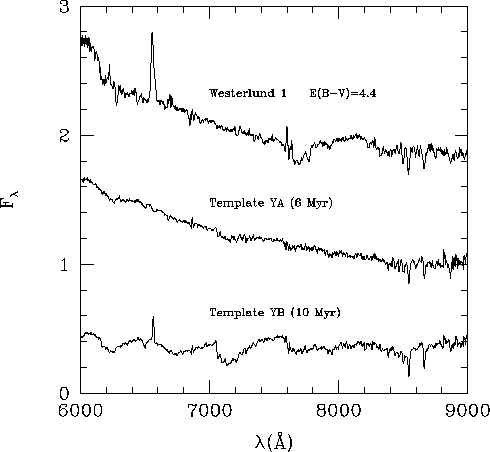
Figure 6: Integrated spectrum of Westerlund1 corrected for
E(B-V)=4.4 (top), the template YA (middle) and the template YB (bottom)
We show in Fig. 6 (click here) the near-IR integrated spectrum of Westerlund1, corrected for E(B-V)=4.4
(see discussion below). Given the extremely high absorption for
Westerlund1, its spectrum has no measurable flux for  Å. The prominent
 could arise
either from stellar sources in clusters younger than 35 Myr
(Bica et al. 1990), or extended gas (e.g. HII region). As
already pointed out by W87 star No. 9 is a Be star with pronounced emission
lines, and star No. 31 is possibly another Be. W87 also detected diffuse
H
could arise
either from stellar sources in clusters younger than 35 Myr
(Bica et al. 1990), or extended gas (e.g. HII region). As
already pointed out by W87 star No. 9 is a Be star with pronounced emission
lines, and star No. 31 is possibly another Be. W87 also detected diffuse
H emission in the cluster central region. We have investigated in
our integrated spectrum the intensity variation of H across the
cluster profile and found that the highest values occur within a small
region approximately 5 pixel wide, in the central part of the cluster. The
emission is fainter in the remaining zones of the central region as well as
in the wings of the cluster profile. The pronounced inner H emission
could be assigned to the Be star located in the central part of the cluster
(see Fig. 1 (click here) in W87), while the weak emission could be due to
extended nebular gas. Diffuse emission occurs in HII regions as old as 5
Myr, or even older clusters which have residual gas emission from
photoionization and/or supernova remnants, as can be seen in the templates
of Santos et al. (1995).
emission in the cluster central region. We have investigated in
our integrated spectrum the intensity variation of H across the
cluster profile and found that the highest values occur within a small
region approximately 5 pixel wide, in the central part of the cluster. The
emission is fainter in the remaining zones of the central region as well as
in the wings of the cluster profile. The pronounced inner H emission
could be assigned to the Be star located in the central part of the cluster
(see Fig. 1 (click here) in W87), while the weak emission could be due to
extended nebular gas. Diffuse emission occurs in HII regions as old as 5
Myr, or even older clusters which have residual gas emission from
photoionization and/or supernova remnants, as can be seen in the templates
of Santos et al. (1995).
The presence of in emission, when caused by stellar sources such
as Be stars, is a remarkable feature in the YB and YC templates of Bica
et al. (1990), whose age ranges are 7-12 Myr and 12-35 Myr,
respectively. The YB template reflects the full development of the red
supergiant (RSG) phase, and consequently the near-IR spectrum presents
strong TiO bands and CaII triplet lines as well as
a flat continuum. We show in Fig. 6 (click here) the YB template, where the strong
emission and the effects of the RSGs can be seen. The slightly
older YC template (see Bica et al. 1990) is bluer, since RSGs do not
contribute significantly.
The M2I star (No. 26 in W87) near the center of Westerlund1 produces
moderate TiO bands around  Å and
Å and  Å in our reddening-corrected integrated spectrum
(Fig. 6 (click here)). Notice also that the CaII triplet is
well developed in the cluster, which sets a lower age limit of 5 Myr;
the template YA in Bica et al. (1990), corresponding to this
evolutionary stage (5 Myr
Å in our reddening-corrected integrated spectrum
(Fig. 6 (click here)). Notice also that the CaII triplet is
well developed in the cluster, which sets a lower age limit of 5 Myr;
the template YA in Bica et al. (1990), corresponding to this
evolutionary stage (5 Myr  age 7 Myr), is also shown in
Fig. 6 (click here).
age 7 Myr), is also shown in
Fig. 6 (click here).
The above considerations about occurrence of diffuse and stellar emissions,
RSG, and developed CaII triplet indicate that the most probable
age for the cluster is  Myr, in very good
agreement with the estimation of 7-9 Myr by W87.
Myr, in very good
agreement with the estimation of 7-9 Myr by W87.
A prominent absorption feature in the range  Å is present.
Sanner et al. (1978) have studied several diffuse
interstellar features in the near-IR, including four within this range.
Based on integrated spectra of globular clusters,
Armandroff
& Zinn (1988) have studied an interstellar feature at a longer wavelength
(
Å is present.
Sanner et al. (1978) have studied several diffuse
interstellar features in the near-IR, including four within this range.
Based on integrated spectra of globular clusters,
Armandroff
& Zinn (1988) have studied an interstellar feature at a longer wavelength
( Å), clearly detectable for E(B-V) > 1.2. We suggest that the
absorption feature found in the Åregion is of
interstellar origin, because it is also prominent in globular clusters more
reddened than E(B-V)=2.0 (Bica et al. 1997).
Sanner et al. (1978) have only
detected a few interstellar lines in this region, probably due to the fact that
their stars are not enough reddened, and also because their spectra
were not corrected for the telluric A band.
Å), clearly detectable for E(B-V) > 1.2. We suggest that the
absorption feature found in the Åregion is of
interstellar origin, because it is also prominent in globular clusters more
reddened than E(B-V)=2.0 (Bica et al. 1997).
Sanner et al. (1978) have only
detected a few interstellar lines in this region, probably due to the fact that
their stars are not enough reddened, and also because their spectra
were not corrected for the telluric A band.
The reddening of Westerlund1 was obtained by varying E(B-V) following Seaton's
(1979) law to match the continuum of
the YA template, as shown in Fig. 6 (click here). Notice the flux excess of the cluster spectrum
with respect to that of the YA template for  Å, which we attribute
to the contribution of the M2I star. An attempt to match the RSG-dominated continuum
of the YB template yields E(B-V)=4.0. We favour the higher reddening value because
the cluster spectrum resembles most that of the YA template. This spectroscopically
derived reddening is consistent with that estimated from the CMD-fitting (Sect. 3).
We finally adopted
Å, which we attribute
to the contribution of the M2I star. An attempt to match the RSG-dominated continuum
of the YB template yields E(B-V)=4.0. We favour the higher reddening value because
the cluster spectrum resembles most that of the YA template. This spectroscopically
derived reddening is consistent with that estimated from the CMD-fitting (Sect. 3).
We finally adopted  .
.
We measured W of the CaII triplet lines using as continuum points the
regions around  Å and
Å and  Å (Bica & Alloin 1987).
Table 2 (click here) presents the window limits and the Ws. The error assigned to each measurement
was calculated by considering local high and low continuum tracings in
order to take into account the spectral noise. Although the correlations between
W of CaII triplet lines with metallicity are basically
single-valued for integrated spectra of star clusters (Bica & Alloin 1987),
there are sources of scatter which affect the
Å (Bica & Alloin 1987).
Table 2 (click here) presents the window limits and the Ws. The error assigned to each measurement
was calculated by considering local high and low continuum tracings in
order to take into account the spectral noise. Although the correlations between
W of CaII triplet lines with metallicity are basically
single-valued for integrated spectra of star clusters (Bica & Alloin 1987),
there are sources of scatter which affect the  determination. These uncertainties are related to the different stellar
components contributing to the integrated light rather than to the errors
arising from the quality of the spectrum itself. The contamination by TiO
bands and Paschen lines affects the CaII windows. TiO may reinforce the
metallicity dependence of the CaII triplet (especially for the 8498 and
8542 Å lines), while Paschen lines introduce a systematic increase for
blue clusters whatever their metallicity. The Paschen absorptions affect
more the CaII 8662 Å line.
determination. These uncertainties are related to the different stellar
components contributing to the integrated light rather than to the errors
arising from the quality of the spectrum itself. The contamination by TiO
bands and Paschen lines affects the CaII windows. TiO may reinforce the
metallicity dependence of the CaII triplet (especially for the 8498 and
8542 Å lines), while Paschen lines introduce a systematic increase for
blue clusters whatever their metallicity. The Paschen absorptions affect
more the CaII 8662 Å line.
| Window | Limits (Å) | Westerlund1 |
| CaII+TiO | 8476-8520 | 2.20  0.18 0.18 |
| CaII+TiO | 8520-8564 | 4.77 0.13 |
| CaII+P13 | 8564-8700 | 5.52 0.04 |
|
|
To estimate the metallicity of Westerlund1 we compared the W(CaII) values
with those measured by Santos & Bica (1993) and Bica & Alloin (1987) for three
open clusters with independent metallicity determinations from individual stars.
The sum of the equivalent widths for the three CaII lines in Westerlund1 is
 . This value compares well
with the average (
. This value compares well
with the average ( ) of those for NGC 4755,
NGC 6067, and NGC 6705, whose [Fe/H] values
are 0.0 (Brown et al. 1986), -0.1 (Piatti et al.
1995) and +0.21 (Thogersen et al. 1993),
respectively. We thus conclude that Westerlund1 has nearly solar metal content.
) of those for NGC 4755,
NGC 6067, and NGC 6705, whose [Fe/H] values
are 0.0 (Brown et al. 1986), -0.1 (Piatti et al.
1995) and +0.21 (Thogersen et al. 1993),
respectively. We thus conclude that Westerlund1 has nearly solar metal content.
The observed CCD integrated spectrum of Westerlund2 (Fig. 2 (click here)b) was obtained by scanning
the slit  25
25 across the central region of the cluster in the north-south
direction. The most relevant features in this spectrum are the nebular emission lines
[OIII]4959, 5007 Å, H, and [SIII]9068 Å, and a continuum with a pronounced
slope denoting important reddening. These nebular emission lines are expected
since Westerlund2 is the core of the HII region RCW 49
(Belloni & Mereghetti
1994). We adopted as template spectrum that of the cluster NGC 3603, which is also
the core of an HII region (Santos & Bica 1993 and references therein). We assume
as the age of Westerlund2 that of NGC 3603, i.e., 2-3 Myr
(Melnick et al. 1989; Santos & Bica 1993). This
value is consistent with the presence of a WN7 star (MSP91) located away
from the core of Westerlund2, not included in our integrated spectrum.
Furthermore, MSP91 have spectroscopically recognized several O7V stars,
which confirms the adopted age range.
across the central region of the cluster in the north-south
direction. The most relevant features in this spectrum are the nebular emission lines
[OIII]4959, 5007 Å, H, and [SIII]9068 Å, and a continuum with a pronounced
slope denoting important reddening. These nebular emission lines are expected
since Westerlund2 is the core of the HII region RCW 49
(Belloni & Mereghetti
1994). We adopted as template spectrum that of the cluster NGC 3603, which is also
the core of an HII region (Santos & Bica 1993 and references therein). We assume
as the age of Westerlund2 that of NGC 3603, i.e., 2-3 Myr
(Melnick et al. 1989; Santos & Bica 1993). This
value is consistent with the presence of a WN7 star (MSP91) located away
from the core of Westerlund2, not included in our integrated spectrum.
Furthermore, MSP91 have spectroscopically recognized several O7V stars,
which confirms the adopted age range.
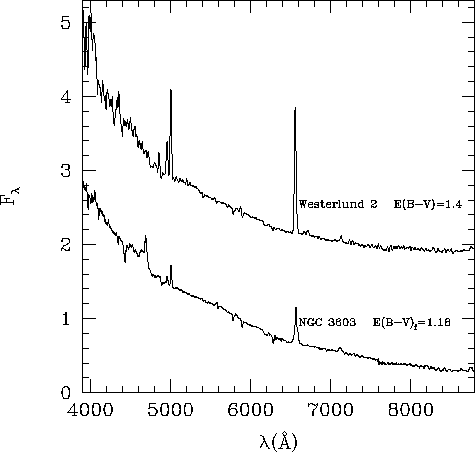
Figure 7: Integrated spectrum of Westerlund2 corrected for E(B-V)=1.4
(top) compared to the NGC 3603 corrected for foreground
 (bottom)
We show in Fig. 7 (click here) the spectrum of Westerlund2 with a reddening correction E(B-V)=1.4
to match that of NGC 3603, which in turn is corrected for its foreground reddening
 , Santos & Bica 1993). Notice that the core of NGC 3603 presents
several WR stars (Moffat & Niemela 1984), which are responsible for the
observed WN features in the
integrated spectrum. The CaII triplet has not yet developed in such young cluster,
and consequently we have not measured equivalent widths.
, Santos & Bica 1993). Notice that the core of NGC 3603 presents
several WR stars (Moffat & Niemela 1984), which are responsible for the
observed WN features in the
integrated spectrum. The CaII triplet has not yet developed in such young cluster,
and consequently we have not measured equivalent widths.
Our spectroscopic reddening
estimation should be considered as a foreground value. From 72
member stars of Westerlund2 in MSP91's Table 2 (click here), we derived a mean cluster reddening of
 . The difference between this value and the spectroscopic one
suggests an internal reddening of
. The difference between this value and the spectroscopic one
suggests an internal reddening of  in such a young object. For comparison,
Santos & Bica (1993) estimated an internal reddening of
in such a young object. For comparison,
Santos & Bica (1993) estimated an internal reddening of  in NGC 3603.
We have reexaminated MSP91's estimation of the cluster distance (7.9 kpc) by considering
four cluster core O7V stars (Nos. 167, 183, 188 and 203). We derived from their
V and Mv magnitudes a mean apparent distance modulus of  . Subsequently, using
the information available in MSP91, the mean E(B-V) colour excess for these stars was
determined in two different ways. First, we compared the observed
CCD (B-V) index with the intrinsic (B-V)0 colour according to the MK type. The
second method consists simply in averaging the E(B-V) values calculated by MSP91
from their UBV photometry. These procedures yield
. Subsequently, using
the information available in MSP91, the mean E(B-V) colour excess for these stars was
determined in two different ways. First, we compared the observed
CCD (B-V) index with the intrinsic (B-V)0 colour according to the MK type. The
second method consists simply in averaging the E(B-V) values calculated by MSP91
from their UBV photometry. These procedures yield  and
and
 , respectively, which in turn lead to a cluster distance of 5.5 and
5.9 kpc. The considerably larger distance obtained by MSP91 certainly comes from
uncertainties in their ZAMS-fitting, owing to the almost vertical position of the
observed CMD-sequence.
, respectively, which in turn lead to a cluster distance of 5.5 and
5.9 kpc. The considerably larger distance obtained by MSP91 certainly comes from
uncertainties in their ZAMS-fitting, owing to the almost vertical position of the
observed CMD-sequence.