

Our approach was originally motivated by the aim to simulate the possible detection of g - modes by a Na I resonance spectrometer, like the one proposed for the GOLF experiment on board of SOHO, or those in use by the IRIS network. Therefore, we planned to follow this scheme:
 ;
;

where  and
and  represent the flux in blue and red working
points of the spectrometer, respectively.
represent the flux in blue and red working
points of the spectrometer, respectively.
The interaction with the GOLF community has stimulated us to afford first of all the problem of solar noise, and, for this work, we have modified the scheme outlined above in the first two items that became
We assume that active regions consist of two components, a warmer structure or plage and a cooler structure or spot. Let us discuss how the daily distribution of spots and plages over the solar disk has been determined.
For the period from June 10, 1990 to November 29, 1991, the daily distribution of spots and plages over the disk has been determined from the Ca II K line full disk archive of the Big Bear Solar Observatory.
For example, in Fig. 1 (click here), we show the K line image of the Sun for February 1, 1991 from BBSO, and the distribution we have inferred for plages and spots, after removing the center-to-limb variations. To get the active region areas, we used as contrast thresholds an upper bound of 0.8 for spots, and a lower bound of 1.3 for plages. However, because the fraction of solar disk covered by plages depends strongly on the latter threshold, in Sect. 4 we report also on results obtained with a plage lower bound of 1.15.
Note that eventually we used only the images from August 1 to November 29, 1991 for comparison with IRIS, because in this period the IRIS offset velocities have the minimum scatter, and also the BBSO archive has a gap from August to December 1990 as a result of the well-known earthquake.
As model atmosphere for the quiet Sun
we have selected model C of Fontenla et al. (1993). The spot
model was the version of the Maltby et al. (1986) umbral model
modified by Severino et al. (1994). Finally, the
plage model is one of the active region models developed by Andretta
& Giampapa (1995). Following the approach of Cram & Mullan
(1979), these models have been built by shifting inward the
temperature structure, by a fixed amount  , where m is the
mass column density (in
, where m is the
mass column density (in  ) of the quiet atmosphere.
In particular we used the model
corresponding to
) of the quiet atmosphere.
In particular we used the model
corresponding to  (hereafter called PLAGE07).
Moreover, we shifted inward of the same amount also the microturbulence
structure. As shown by Severino et al. (1993), we selected
this particular plage model, because, in this way, it is possible to
reproduce the "antiplage'' behaviour
observed in the sodium
(hereafter called PLAGE07).
Moreover, we shifted inward of the same amount also the microturbulence
structure. As shown by Severino et al. (1993), we selected
this particular plage model, because, in this way, it is possible to
reproduce the "antiplage'' behaviour
observed in the sodium  line at about 100 mÅ from the line
center, (Ulrich et al. 1993). Otherwise, when the sodium line
is computed with the Fontenla et al. model atmosphere for plage,
the plage appears bright at the working points of a sodium cell
(e.g. Fig. 3 of Paper I).
However we remark that the agreement we got between computed and observed
plage contrasts is qualitative, and in Sect. 4 we will allow for
a number of different contrasts (see Figs. 6 (click here) and 7 (click here)).
line at about 100 mÅ from the line
center, (Ulrich et al. 1993). Otherwise, when the sodium line
is computed with the Fontenla et al. model atmosphere for plage,
the plage appears bright at the working points of a sodium cell
(e.g. Fig. 3 of Paper I).
However we remark that the agreement we got between computed and observed
plage contrasts is qualitative, and in Sect. 4 we will allow for
a number of different contrasts (see Figs. 6 (click here) and 7 (click here)).
Finally, we used the version 2.0 of the code MULTI of Mats Carlsson (1986) for the NLTE sodium line synthesis; more details on this are given in Sect. 2 of Paper I.
Since the velocity measures refer to low degree modes, we have to integrate the emergent intensity over the entire disk to find the flux in the sodium line, accounting for the three-component time dependent distribution of the intensity over the disk. We performed the flux integration analytically, which allowed us to have more insight into results. However, we checked that for a number of different distributions of spots over the disk the analytical method produces velocity fluctuations which agree within 5% with the results of the direct numerical integration.
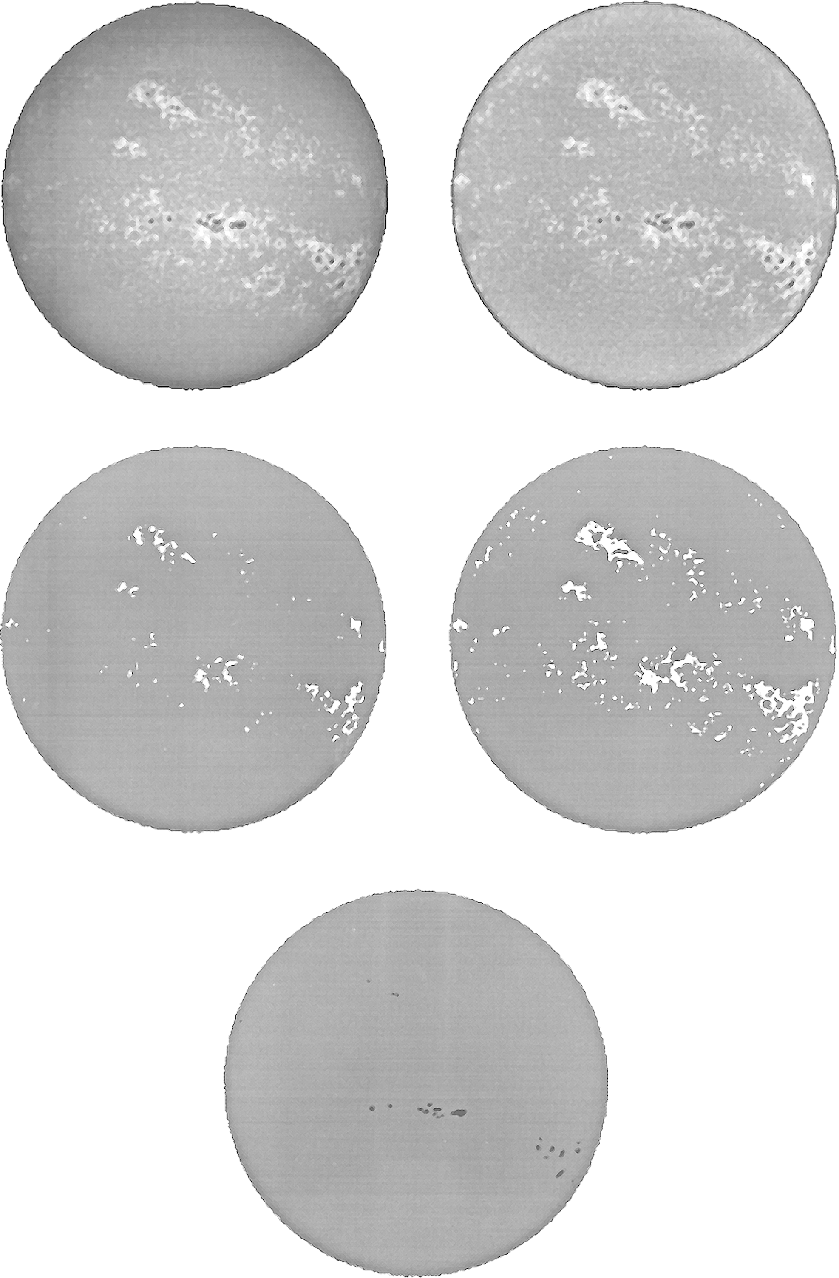
Figure 1: Distribution of active regions over the solar disk on February 1,
1991. From left to right, and top to bottom: CaII K line image from the
Big Bear Solar Observatory; the same image with the center-to-limb
variations removed; inferred plage distributions
obtained with a lower bound for the plage contrast of 1.30 and 1.15
respectively; inferred spot distribution
used for the simulation. The total projected area covered by spots is
0.27 percent of disk, and that covered by plages is 1.5% and 5.7%
respectively
The analytical formulation of the irradiance variations
produced by active regions was extensively developed in Sect. 3
of Paper I. The final result of that section was that,
with the assumptions that the disk is covered by a discrete distribution
of active regions with a contrast depending only upon the heliocentric angle,
and that the emergent intensity can be adequately represented by the
linear terms in the solar rotational velocity,
we can write the emergent flux at wavelength  as
as

where  is the flux emergent from
the quiet disk, broadened by solar rotation and shifted
by
is the flux emergent from
the quiet disk, broadened by solar rotation and shifted
by  because of the
relative velocity V0, which includes the Sun-Earth
relative motions and the gravitational redshift;
the other two terms represent the modulations due to
the active regions, with
because of the
relative velocity V0, which includes the Sun-Earth
relative motions and the gravitational redshift;
the other two terms represent the modulations due to
the active regions, with  independent of the solar rotation,
and
independent of the solar rotation,
and  at the first order
in the rotation velocity.
Both these terms can be expressed by summations over the active regions
effectively present on the disk as (see also Livingston et al.
1991)
at the first order
in the rotation velocity.
Both these terms can be expressed by summations over the active regions
effectively present on the disk as (see also Livingston et al.
1991)



where Ai is the area (in units of solar hemisphere),
 is the emergent intensity of the quiet Sun,
Ci denotes the
contrast of the
is the emergent intensity of the quiet Sun,
Ci denotes the
contrast of the  active region located at distance
 from the disk center and with azimuth
  , and
, and
 is the line-of-sight component of the rotational
velocity.
is the line-of-sight component of the rotational
velocity.
Once the active region distribution is known from the K line daily images,
and the relative velocity is determined according to the ephemerides,
we can compute the fluxes in the blue and red flanks of the sodium
line from Eqs. (2), (3) and (4), and then we can determine the
photometric ratio r according to Eq. (1).