

In Fig. 2 (click here), we plot the results of our simulation of the
offset velocities measured by IRIS, for
the period from August 1 to November 29, 1991.
In this case, we got a constant calibration factor with a value of
 .
.
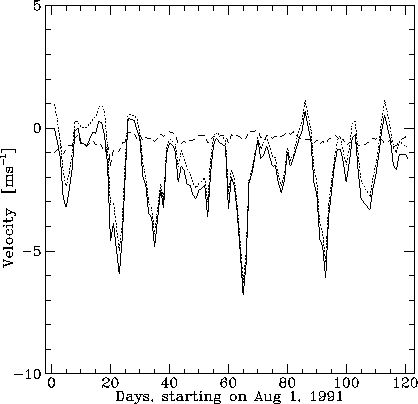
Figure 2: Simulated velocity vs. time for the period from August 1
to November 29, 1991, and for the IRIS measurement.
Solid line is the signal produced by the active regions; dotted line
is the signal obtained with zero relative velocity, i.e. by
fixing the passbands of the cell at  during the full
period, and dashed line represents the difference between these
two signals
during the full
period, and dashed line represents the difference between these
two signals
In our model, the magnetic darkening velocity are modulated not only by the
solar rotation rate, but also by the Sun-instrument
relative velocity, because the latter controls the effective position
of the cell working points.
In fact, there is a contribution to the computed velocity produced by
the combined presence
of both the active regions and a non-zero relative velocity, with the
active regions changing the shape of the sodium line and the relative
velocity making the instrumental response to this change different
on the red and blue flanks of the line.
This velocity,
which is independent of the solar rotational velocity, and whose amplitude is
of the order of one  , was called in Paper I the
active region-relative velocity effect (hereafter,
, was called in Paper I the
active region-relative velocity effect (hereafter,  effect).
Because the relative velocity (Earth rotation plus gravitational redshift)
varied between a maximum of  (on August 1) and a
minimum of
(on August 1) and a
minimum of  (on October 5), during the observing period
the center of the red (blue) cell passband moved within
the range from +98 to +108 (-108 to -98) mÅ (in separation
from the
(on October 5), during the observing period
the center of the red (blue) cell passband moved within
the range from +98 to +108 (-108 to -98) mÅ (in separation
from the  line center).
In Fig. 2 (click here), we
plot also the signal simulated with zero relative velocity, that was
computed by fixing the working points of the cell at
during the full period, and the difference between the signals
simulated with and without relative velocity. This difference
can be produced by the effect, and
by any  asymmetry of the active region distribution.
Because the Sun was very active at that time, we would expect
a shorter time scale for the asymmetry effect than for the
effect. In fact, the general trend of the difference
is of the order of
asymmetry of the active region distribution.
Because the Sun was very active at that time, we would expect
a shorter time scale for the asymmetry effect than for the
effect. In fact, the general trend of the difference
is of the order of  , negative and slightly decreasing
in time towards
October; both the sign and the trend are consistent with the
effect (see Paper I), since the relative velocity
is positive during the period
under examination, and has its minimum in October;
moreover it can be shown that it is essentially connected with plages,
which have larger areas and a larger effect than spots.
As a result, the signal simulated in the presence of a non-zero relative
velocity is generally negative (the mean is
, negative and slightly decreasing
in time towards
October; both the sign and the trend are consistent with the
effect (see Paper I), since the relative velocity
is positive during the period
under examination, and has its minimum in October;
moreover it can be shown that it is essentially connected with plages,
which have larger areas and a larger effect than spots.
As a result, the signal simulated in the presence of a non-zero relative
velocity is generally negative (the mean is  ), and
velocity deeps are generally sharper than peaks.
), and
velocity deeps are generally sharper than peaks.
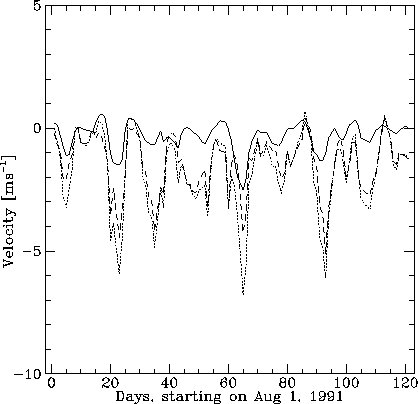
Figure 3: Simulated velocity vs. time for the period from August 1
to November 29, 1991, and for the IRIS measurement.
Dotted line is the signal produced by the active regions; while solid
and dashed lines are the contributions of plages and spots to the
total velocity, respectively
Figure 3 (click here) shows the separate contribution of plages and spots to the
total velocity signal produced by active regions in our simulation.
Generally, the two trends are similar, i.e. they show most
of the same peaks and dips at the same days; this is a consequence of both
the location of the plages, which occur around the spots,
and of the antiplage character of the plage contrast in
the Na I line flanks.
As already stated in Paper I, it appears that plages give
the dominant contribution;
the rms contribution of spots to total velocity fluctuations
is not negligible. It is not easy to understand
why this result holds, because also with the approximation that
only the term  is affecting the ratio r,
there are the mixed influences of the active region areas and contrasts with
their dependences on wavelength (see Eq. 4).
Obviously, the plage contribution to the total simulated signal is
even more enhanced when the intensity threshold used to determine the plage
areas is lowered.
is affecting the ratio r,
there are the mixed influences of the active region areas and contrasts with
their dependences on wavelength (see Eq. 4).
Obviously, the plage contribution to the total simulated signal is
even more enhanced when the intensity threshold used to determine the plage
areas is lowered.
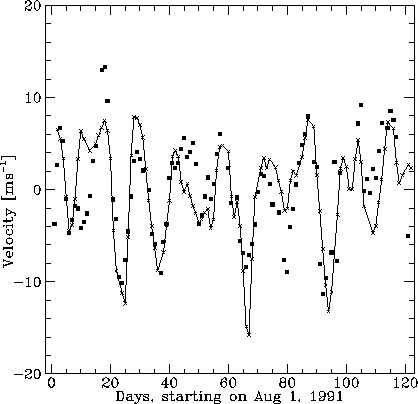
Figure 4: Velocity fluctuation vs. time for the period from August 1
to November 29, 1991: solid line is the signal produced by our simulation,
multiplied times the factor 3.6, and the full squares represent
the IRIS offset velocities
In Fig. 4 (click here), we compare our simulation with the IRIS data.
Our calculation has been detrended for the effect, which, at
least partly, calibration may have already canceled in the observed data.
They have also been scaled with the
ratio of the observed to calculated rms velocity amplitude,
 ,
which is analogous to the saturation factor used by Ulrich et al.
(1993). A value of the saturation factor larger than unity is partly
explained by the high value of the IRIS calibration,
about
,
which is analogous to the saturation factor used by Ulrich et al.
(1993). A value of the saturation factor larger than unity is partly
explained by the high value of the IRIS calibration,
about  , with respect to ours,
  .
The calibration of the IRIS instrument at Tenerife in 1991 was high because
of both instrumental unresonant
diffused light and imperfect performance of the circular analysers.
.
The calibration of the IRIS instrument at Tenerife in 1991 was high because
of both instrumental unresonant
diffused light and imperfect performance of the circular analysers.
Moreover, since the IRIS velocities are daily means (and we assume noon as the mean observation time), while BBSO images have exposure times of few seconds (usually obtained between 3 and 6 pm), we applied a two point smoothing to our simulation.
We measure the goodness of the fit by two quantities,
the correlation coefficient  between computed and
observed velocities, and the residual relative amplitude
between computed and
observed velocities, and the residual relative amplitude
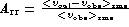 , which is equal to the square root of the
variance ratio used by Ulrich et al.
(see their Fig. 13); we shifted in time the computed velocities
by a quantity
, which is equal to the square root of the
variance ratio used by Ulrich et al.
(see their Fig. 13); we shifted in time the computed velocities
by a quantity  in order to maximize
and minimize
in order to maximize
and minimize  , however we found that it is
easier to increase the
correlation than to reduce the residual relative amplitude.
The comparison reported in Fig. 4 (click here) has
, however we found that it is
easier to increase the
correlation than to reduce the residual relative amplitude.
The comparison reported in Fig. 4 (click here) has  and
and  ;
all observed peaks and dips are present also in the simulation,
and during specific periods (e.g. from
September 1 to 30), the fit is strikingly good.
On this base we consider the agreement between our simulation and the IRIS
data as rather good;
however if we subtract
our calculations from the data, the residual fluctuation is about
;
all observed peaks and dips are present also in the simulation,
and during specific periods (e.g. from
September 1 to 30), the fit is strikingly good.
On this base we consider the agreement between our simulation and the IRIS
data as rather good;
however if we subtract
our calculations from the data, the residual fluctuation is about  , i.e. twice the mean error we may ascribe to the data as
inferred from a comparison between the velocities
obtained at Kumbel and Tenerife during the same period (see Fig. 8 of
Pallé et al. 1993). Therefore, not differently
from Ulrich et al., we conclude that our ability to simulate the IRIS
offset velocities is not yet enough, and the use of the present approach
as a standard correction procedure to remove the active regions noise
deserves a refinement of the simulation as well as more
than one observing dataset to compare with.
, i.e. twice the mean error we may ascribe to the data as
inferred from a comparison between the velocities
obtained at Kumbel and Tenerife during the same period (see Fig. 8 of
Pallé et al. 1993). Therefore, not differently
from Ulrich et al., we conclude that our ability to simulate the IRIS
offset velocities is not yet enough, and the use of the present approach
as a standard correction procedure to remove the active regions noise
deserves a refinement of the simulation as well as more
than one observing dataset to compare with.
Possible changes in the parameters of our simulation to reduce the discrepancies with the IRIS data are described in the following chapter; while a critical discussion of the ingredients of our model and of the possible future improvements is given in Sect. 5.
The parameters upon which our simulation depends can be inferred from the
inspection of Eqs. (1)-(4):
the intensity thresholds used for the analysis of the K line images
determine the areas of spots and plages, as described in Sect. 3.
The contrast of the active regions is obviously relevant, and, finally,
there is the effect of the relative velocity V0, entering
through the effect.
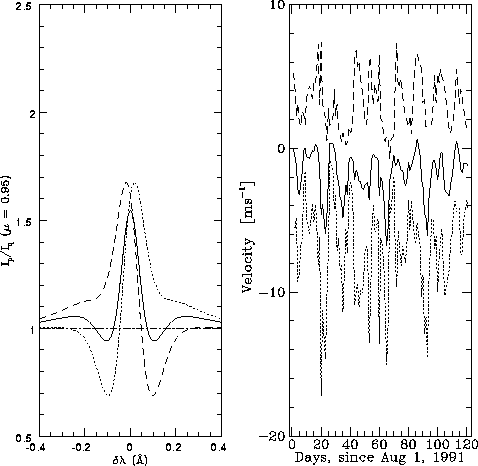
Figure 5: Sensitivity of the simulation to changes in V0.
Solid line is the signal produced by our simulation, while
dotted and dashed lines correspond to a change of  and
and  , respectively
We ran a simulation with a lower bound for the plage contrast (15% instead of 30%); this more than doubles the area covered by plages. The general trend of the simulated signal, as shown in Fig. 4 (click here), is present also in this case, with the a reduction from 3.6 to 1.2 of the saturation factor, needed to match the observed amplitudes.
Figure 5 (click here) shows the sensitivity of the simulation to changes in
V0.
The general trend of the simulated signal is not changed by a constant
variation of the relative velocity of  . However, it
has to be noted that we assumed that each
IRIS datum refers to noon, and then we neglected the contribution
of the line-of-sight component of the Earth spin in the relative velocity,
i.e.
. However, it
has to be noted that we assumed that each
IRIS datum refers to noon, and then we neglected the contribution
of the line-of-sight component of the Earth spin in the relative velocity,
i.e.  . Because the tables of the IRIS observing times
were not at our disposal,
we cannot rule out
that the average of
. Because the tables of the IRIS observing times
were not at our disposal,
we cannot rule out
that the average of  during
some observing days may be not zero; therefore. our incomplete knowledge of
V0 is a possible source of errors in
the simulation, which might
change sharply from one day to the next.
during
some observing days may be not zero; therefore. our incomplete knowledge of
V0 is a possible source of errors in
the simulation, which might
change sharply from one day to the next.
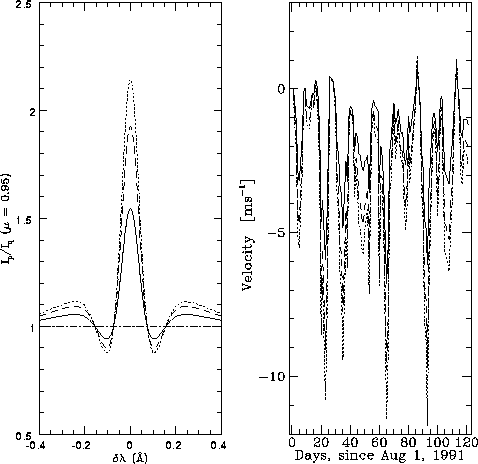
Figure 6: Sensitivity of the simulation to changes in the strength
of the plage contrast. Each velocity curve in the right
panel corresponds to the contrast plotted with
the same linetype in the left panel
In Fig. 6 (click here), we show the sensitivity of the simulation to a variation in strength of the plage contrast. An inspection of Fig. 1 in Ulrich et al. (1993) indicates that our synthetic plage contrast is smaller than the observed one by a factor up to 1.7 at the cell working points. An underestimate of the plage contrast and areas partly explains the value of 3.6 of our saturation factor. We ran a number of simulations with increasing plage contrasts; the results show again that peaks and dips of the simulated signal are emphasized with respect to the result with standard contrast, but their locations and shapes are substantially unmodified.
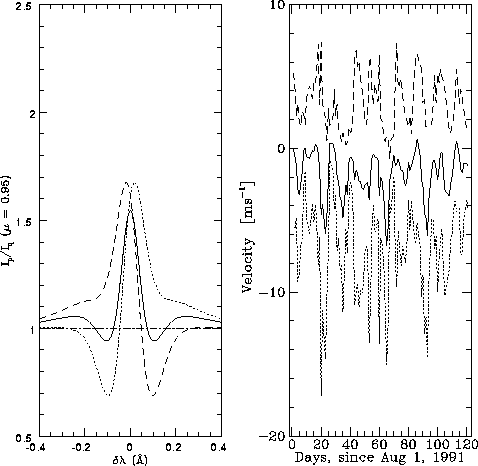
Figure 7: Sensitivity of the simulation to shifts of the plage relative
to quiet Sun line profile.
Each velocity curve in the right
panel corresponds to the contrast plotted with
the same linetype in the left panel
The same conclusion does not apply when we make the plage contrast
asymmetric by shifting the plage relative to quiet Sun line profile,
as it is illustrated in Fig. 7 (click here).
In fact, in the simulations considered so far,
we did not include
the contribution of intrinsic velocities of the active regions;
while there are both observations and theoretical reasons supporting
the existence of motions in active regions, and, hence, of Doppler
shifts in particular between the plage and the quiet Sun profiles.
Moreover, convection produces line shifts,
which may be different in the quiet and active areas of the Sun;
e.g. in the case
of Na I and at the working points of the IRIS,
the absolute line shift should be of about  (1 mÅ), at the quiet solar disk center (Boumier
1991).
(1 mÅ), at the quiet solar disk center (Boumier
1991).
The two cases reported in the figure, which correspond to a  shift between the plage relative
to quiet Sun line profile, are somewhat extreme
(in fact, a 20 mÅ shift in a circularly polarized component
of the Na I line may be produced by a downdraft
of
shift between the plage relative
to quiet Sun line profile, are somewhat extreme
(in fact, a 20 mÅ shift in a circularly polarized component
of the Na I line may be produced by a downdraft
of  );
however, also by running simulations
with half this value for the plage line shift, it is apparent
that the inclusion of intrinsic line shifts can change strongly
not only the amplitude of the simulated signal but also the shapes
of peaks and dips, and then may be an important source of uncertainty
for the simulation.
);
however, also by running simulations
with half this value for the plage line shift, it is apparent
that the inclusion of intrinsic line shifts can change strongly
not only the amplitude of the simulated signal but also the shapes
of peaks and dips, and then may be an important source of uncertainty
for the simulation.
We compare our simulation with the one of Ulrich et al. (1993) in Fig. 8 (click here).
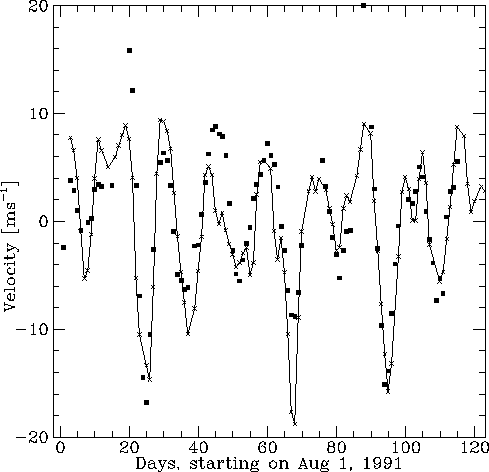
Figure 8: Velocity fluctuation vs. time for the period from August 1
to November 29, 1991. Solid line is the signal produced by our simulation,
multiplied times the factor 4.3, and the full squares represent
the results of the simulation from Ulrich et al.
(1993)
The Ulrich et al. simulation is based on the distribution of the
longitudinal magnetic field as obtained from the daily Mount Wilson
magnetograms, and on an empirical correlation between the value
of this magnetic field and the darkening in the flanks of the Na I
line. The quantitative comparison of the two simulations give
a correlation of 0.79 and a residual relative amplitude of 0.72. Both these
values are slightly better than those obtained by comparing
our simulation with the IRIS data (0.71 and 0.78 respectively),
however this does not seem
to have a particular meaning.
The major difference between the
two simulations is in the fact that Ulrich et al. defined the active
regions in terms of the longitudinal magnetic field, whilst we do that
according to the intensity in the Ca II K line core. In fact, one
would expect that the plage brightening does not strictly "remake''
the magnetic field distribution; also, the longitudinal field
may become a poor description of the active regions close to limb.
On the other hand, Ulrich et al.
allow for a continuous range of values of the magnetic darkening,
whilst we consider only a two component (spot-plage) distribution.
In spite of these differences,
both simulations have essentially the same ability
in reducing the observed offset velocity fluctuations,
since from Fig. 13 of Ulrich et al. we infer a best residual
variance close to 0.6, and then a residual relative amplitude of 0.77,
which is very close to ours.