

The passage from the photometric ratio r to a velocity is not trivial, but requires a calibration procedure which has been argument of many papers reporting oscillation measures from resonant spectrometers (see e.g. van der Raay et al. 1985; Pallé et al. 1993).
The calibration is based on a best fitting procedure of the relation
r = f(V), where V represents a total line of sight velocity. The
difficulties arise since the velocity V is partly unknown and partly
spurious.
In effect, according to Pallé et al. (1993),
we can write

where
 is the unknown solar oscillation velocity,
 is an unknown solar offset, and
V0 is the known part of V.
includes the integrated signal produced by the active
region as well as by the solar velocity fields at different scales.
Pallé et al. claim that is roughly constant during a 12-hour
observation (
is an unknown solar offset, and
V0 is the known part of V.
includes the integrated signal produced by the active
region as well as by the solar velocity fields at different scales.
Pallé et al. claim that is roughly constant during a 12-hour
observation (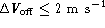 ) while it changes by
as much as
) while it changes by
as much as  in 7 days.
In the case of ground-based measurements, V0 is
in 7 days.
In the case of ground-based measurements, V0 is

where the first two terms are due to Earth-Sun relative motion,
 is the signal produced by the Earth atmosphere differential
extinction, and
is the signal produced by the Earth atmosphere differential
extinction, and  is the gravitational redshift in velocity
unit (
is the gravitational redshift in velocity
unit ( ).
In the case of the GOLF measurements, V0 is
).
In the case of the GOLF measurements, V0 is

where  is the component relative to the satellite halo orbit
around the Lagrangian point
is the component relative to the satellite halo orbit
around the Lagrangian point  , and
, and  is the same as
for ground-based observation with the approximation that the Lagrangian
point is placed at the Earth position.
In both cases, V0 can be calculated with great accuracy.
is the same as
for ground-based observation with the approximation that the Lagrangian
point is placed at the Earth position.
In both cases, V0 can be calculated with great accuracy.
The calibration procedure developed by Pallé et al. (1993)
for the IRIS data consists of two steps: i) first a table  vs.
V0 was built, where is the mean of r over
vs.
V0 was built, where is the mean of r over  bins of V0, in which the variations of and
are minimized, and an average calibration function
bins of V0, in which the variations of and
are minimized, and an average calibration function  was
determined by fitting the function
was
determined by fitting the function 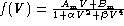 to the table vs. V0;
ii) the
to the table vs. V0;
ii) the  and
and  coefficients derived in the previous step
are used to calculate the linearized ratio
coefficients derived in the previous step
are used to calculate the linearized ratio  ; and then the fit of
  vs.
vs.  to the straight line A V + B for each observing day provides the daily
varying sensitivity A and offset B.
to the straight line A V + B for each observing day provides the daily
varying sensitivity A and offset B.
Boumier et al. (1994) discussed a method of analyzing data
in the case of a resonant spectrometer sampling the sodium line profiles
at 4 points, 2 in the red wing and 2 in the blue wing.
A 4-point spectrometer is realized by modulating the instrumental
magnetic field B by a small amount  around its working value
(Isaak & Jones 1988).
In this case, it is
possible to define the two crossed ratios
around its working value
(Isaak & Jones 1988).
In this case, it is
possible to define the two crossed ratios
 ,
and
,
and
 ,
with the opposite
signs denoting the two magnetic configurations
,
with the opposite
signs denoting the two magnetic configurations
 and
and
 .
The calibration,
.
The calibration,
 ,
is defined in terms of the average ratio
,
is defined in terms of the average ratio
 ,
and is obtained from
,
and is obtained from
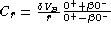 ,
where
,
where
 is the velocity displacement corresponding to the magnetic modulation,
and
is the velocity displacement corresponding to the magnetic modulation,
and
 .
Rigorously, the coefficient depends on the observed velocity
itself, and then has to be estimated to carry on the procedure.
To follow the time evolution of
.
Rigorously, the coefficient depends on the observed velocity
itself, and then has to be estimated to carry on the procedure.
To follow the time evolution of
 , Boumier et al. fit the calibration
factor with a 9th order polynomial on their one day dataset.
, Boumier et al. fit the calibration
factor with a 9th order polynomial on their one day dataset.
Looking at the expression of , we note that its main
time dependence comes from the inverse dependence on  ,
because it is
,
because it is
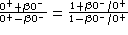 ,
and
,
and
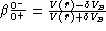 (see Boumier et al. 1994, their Eq. (8)).
In fact, in our simulation of the IRIS offset velocities we have experimented
the crossed method, following the whole time evolution of
from August 1 to November 29, 1991, and we got the result that the
active region signal was essentially canceled by this calibration.
Therefore, in our opinion, one should apply to the crossed method
the caution that the higher the order of the polynomial representing
the calibration factor, the more precise the observed velocity fit,
but also the higher the filtering probability of possible signals, as,
on the other hand, Boumier et al., in the same paper, have stated
for the polynomial method and the 2-point measure.
(see Boumier et al. 1994, their Eq. (8)).
In fact, in our simulation of the IRIS offset velocities we have experimented
the crossed method, following the whole time evolution of
from August 1 to November 29, 1991, and we got the result that the
active region signal was essentially canceled by this calibration.
Therefore, in our opinion, one should apply to the crossed method
the caution that the higher the order of the polynomial representing
the calibration factor, the more precise the observed velocity fit,
but also the higher the filtering probability of possible signals, as,
on the other hand, Boumier et al., in the same paper, have stated
for the polynomial method and the 2-point measure.
Eventually, we have selected for our simulation a calibration
method, which is based on the Pallé et al.
calibration procedure with one main difference: on one hand,
we have at disposal only one ratio
per day, because there is one solar image in the CaII K line per day, and,
on the other hand, we have the possibility to build the ratio  corresponding to the Sun without active regions;
therefore, we fit directly the calibration function
corresponding to the Sun without active regions;
therefore, we fit directly the calibration function
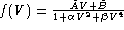 to the table vs. V0.
In conclusion, we emphasize that it is important to understand and model the different causes of solar noise in order to remove them directly without the risks inherent in methods based essentially on data smoothing. In other words, the best approach to calibration is to reduce as much as possible the unknown part of the velocities used for calibration.