In the present section, we investigate the ability of the XMM-OM photometric system to segregate quasars from stars on the basis of their colours in the multicolour space definable from the set of the different filters used. Therefore, we integrated both the stellar spectra discussed in Sect. 2.3 and the average quasar spectra discussed in Sect. 2.4. The latter ones have been considered at redshifts from 0.0 to 4.4 by steps of 0.1. We start our analysis with the XMM-OM version of the classical (U-B) vs. (B-V) colour diagram.
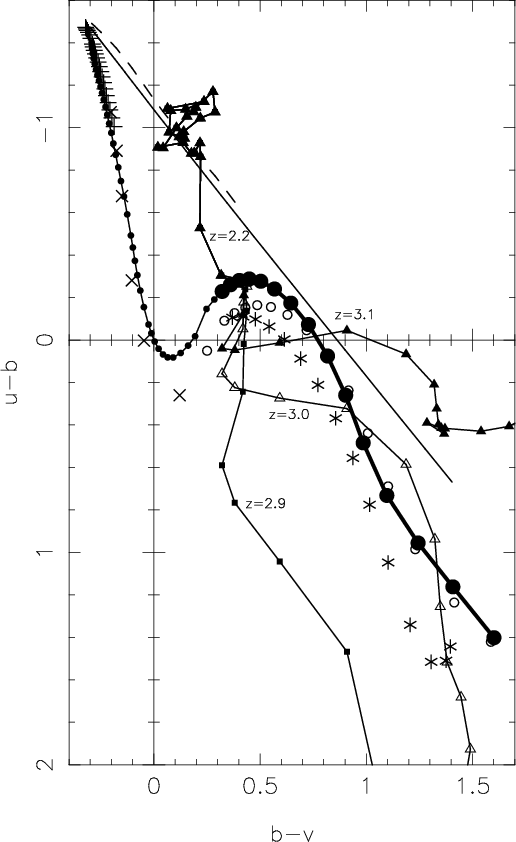
The (U-B) vs. (B-V) colour diagram is probably one of the most widely used in astronomy. Therefore, Fig. 7 presents the XMM-OM version ((u-b) vs. (b-v)) of this diagram. Fortunately, no huge difference appears between the two versions and the XMM-OM colour diagram retains most of the properties of its classical counterpart.
The locus of the theoretical halo main sequence stars is given (filled circles).
The classical potential-well
shape of the curve outlining the effect
of the Balmer continuum is clearly visible. The part below the turn-off represents
the stars that are still on the
main sequence in the halo of our Galaxy; it is represented by a bold
line. This bold line is the locus of the majority of the field stars
which are the objects against which we have to perform the basic
discrimination when looking for quasars. The locus of cool giants is
also given (open circles) and is very similar to the previously
discussed one. On the other hand, the disk main sequence (spectral
types FGKM), which could also provide some confusion, is visible below
the halo main sequence (asterisks). The HB stars (crosses) have
colours very similar to the hot part (astronomically non populated) of
the halo main sequence. This is also true for the sdOB stars (plus
signs). These objects are classical contaminants of the samples of
quasar candidates selected on the basis of the U/B excess. Another
contaminant are the degenerate stars. The black body line is also
given in Fig. 7 and the Koester's models whose spectrum we integrated
fall close to this line.
Figure 7 also exhibits the track of our
average quasars as a function of redshift. For redshifts z  2.1,
the average quasars are wandering around u-b = -1.0 and
b-v = 0.15. This is 0.2 magnitude bluer in u-b than in the case of
the standard system (see e.g. Fig. 6 of Cristiani & Vio 1990 and
Fig. 9 of Moreau & Reboul 1995). This ability to better detect the
bluer objects is essentially due to the comparatively high
transmission of the u filter below 3200 Å (see Fig. 1b and Sect. 2.1).
2.1,
the average quasars are wandering around u-b = -1.0 and
b-v = 0.15. This is 0.2 magnitude bluer in u-b than in the case of
the standard system (see e.g. Fig. 6 of Cristiani & Vio 1990 and
Fig. 9 of Moreau & Reboul 1995). This ability to better detect the
bluer objects is essentially due to the comparatively high
transmission of the u filter below 3200 Å (see Fig. 1b and Sect. 2.1).
The wandering around the mean place is essentially due to the various
emission lines entering and going out of the different filters but
also partly to the particular shapes of the top of the transmission
curves. The region around this mean place is also where one can find
degenerate stars (with typical
 K)
and the presently investigated colour combination is
not useful in discriminating between both kind of objects. At
z = 2.2, the quasars have left their low-redshift location to move
almost parallel to the (u-b) axis. This is due to the fact that the
Ly
K)
and the presently investigated colour combination is
not useful in discriminating between both kind of objects. At
z = 2.2, the quasars have left their low-redshift location to move
almost parallel to the (u-b) axis. This is due to the fact that the
Ly emission line is leaving the u filter to enter the bone and is progressively replaced by the Ly
forest. This
occurs 0.07 earlier in redshift than in the Johnson standard system.
emission line is leaving the u filter to enter the bone and is progressively replaced by the Ly
forest. This
occurs 0.07 earlier in redshift than in the Johnson standard system.
The tracks of the average quasars are also
given for higher redshifts.
It should however be clearly stated that for redshifts
 ,
both the u and the b filters are mainly sampling
the Ly
forest and the related quasar location in the bidimensional
(2D) colour diagram is highly model dependent. It is interesting
to notice that the model B spectra tend to follow the
stellar locus whereas model C quasars stay bluer in
b-v. In any case, the discrimination is essentially
possible for low-redshift (
,
both the u and the b filters are mainly sampling
the Ly
forest and the related quasar location in the bidimensional
(2D) colour diagram is highly model dependent. It is interesting
to notice that the model B spectra tend to follow the
stellar locus whereas model C quasars stay bluer in
b-v. In any case, the discrimination is essentially
possible for low-redshift (
 )
quasars and for
high-redshift weakly or strongly absorbed objects.
)
quasars and for
high-redshift weakly or strongly absorbed objects.
Figure 8 gives the distance (in this two-dimensional space) between the model A quasar and the stellar locus as a function of redshift (by steps of 0.1, filled circles). The stellar locus adopted here is the whole halo main sequence. Except for degenerate stars, this locus can be considered as representative of most of the other potential contaminants.
Figure 8 clearly demonstrates the ability to discriminate
between non-degenerate stars and quasars with redshifts
 .
In the range
.
In the range
![$z \in[2.2, \sim 3.]$](/articles/aas/full/2000/14/ds9582/img143.gif) (or more), quasars have
ubv colours very similar to stars and the discrimination power will
only improve through the use of additional filters.
The apparent improvement for redshifts in the range
(or more), quasars have
ubv colours very similar to stars and the discrimination power will
only improve through the use of additional filters.
The apparent improvement for redshifts in the range
![$z \in[3.3,3.6]$](/articles/aas/full/2000/14/ds9582/img144.gif) is not present for model B quasars: this pinpoints
the model dependent character of this particular result.
is not present for model B quasars: this pinpoints
the model dependent character of this particular result.
At z>3.8, all three filters are essentially in the
Ly
forest and the increase in distance
is indicative of a potential discrimination but the latter
is bound to be highly dependent on the particular
realization of the distribution of the Lyabsorbers both in redshift and in density. The completeness
of the related sample will be hard to ascertain.
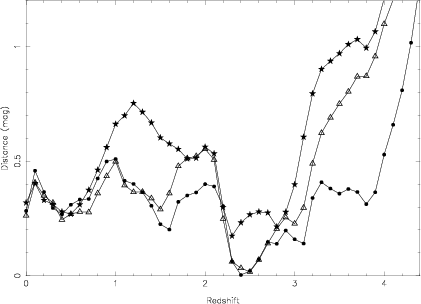 |
Figure 8:
The reduced distance between the average model A quasar and
the stellar locus as a function of redshift, by steps of 0.1.
The first curve
(circles) represents the two-dimensional distance in the 2D (u-b) vs.
(b-v) colour diagram as given in Fig. 7. The second curve
(triangles) represents
 times the
three-dimensional distance in the 3D (uvw1-u) vs. (u-b) vs. (b-v)
colour diagram. The third curve (stars) gives
times the
three-dimensional distance in the 3D (uvw1-u) vs. (u-b) vs. (b-v)
colour diagram. The third curve (stars) gives
 times the four-dimensional distance in the 4D (uvw2-uvw1)
vs. (uvw1-u) vs. (u-b) vs. (b-v) colour diagram
times the four-dimensional distance in the 4D (uvw2-uvw1)
vs. (uvw1-u) vs. (u-b) vs. (b-v) colour diagram |
Our simulations concerning the uvw1 filter clearly
indicate that this filter is roughly as sensitive to the Balmer continuum
(not to confuse with the Balmer jump) as the u filter.
The (uvw1-b) colour index of stars has a behaviour very similar
to the (u-b) one and the locus of stars in a
(uvw1-b) vs. (b-v) diagram is very reminiscent of
Fig. 7. The (uvw1-u) colour index is much
less sensitive
to the Balmer continuum. It is interesting to notice that
in a 2D (uvw1-u) vs. (uvw1-v) colour diagram, the quasars
with  are perfectly superimposed on the locus of stars.
Therefore, this combination is not interesting for
low-redshift quasars but quasars with redshifts between 1.6 and 2.1
are moving away from the stellar locus in the same diagram.
This is essentially due to the Ly
emission line
leaving uvw1 for the u filter and to the Lyforest becoming dominant in uvw1. Nevertheless, full exploitation of this
phenomenon requires observations in the b filter. This is particularly striking
in the (uvw1-u) vs. (u-b) colour diagram (not shown here).
are perfectly superimposed on the locus of stars.
Therefore, this combination is not interesting for
low-redshift quasars but quasars with redshifts between 1.6 and 2.1
are moving away from the stellar locus in the same diagram.
This is essentially due to the Ly
emission line
leaving uvw1 for the u filter and to the Lyforest becoming dominant in uvw1. Nevertheless, full exploitation of this
phenomenon requires observations in the b filter. This is particularly striking
in the (uvw1-u) vs. (u-b) colour diagram (not shown here).
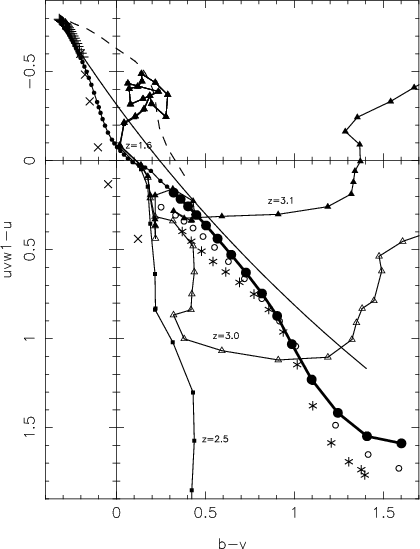 |
Figure 9: The (uvw1-u) vs. (b-v) colour diagram. The symbols have the same meaning as those used for Fig. 7. The highest plotted redshifts are 4.1, 3.9 and 2.6 for the quasars of models A, B and C respectively |
Figure 9 gives the 2D (uvw1-u) vs. (b-v) colour diagram.
At redshifts ,
quasars are wandering around
uvw1-u = -0.4 and b-v = 0.15. This is slightly aside
the non-degenerate stellar locus and the uvw1 filter
contributes, although weakly, to the star-quasar separation.
For redshifts
 ,
the average quasar joins the
stellar locus in this 2D diagram of Fig. 9 but it is known
to deviate from the stellar locus in the (uvw1-u) vs. (uvw1-v) colour diagram for
,
the average quasar joins the
stellar locus in this 2D diagram of Fig. 9 but it is known
to deviate from the stellar locus in the (uvw1-u) vs. (uvw1-v) colour diagram for
 .
In Fig. 8 is also given the
distance between the quasar and the stellar locus
in the three-dimensional space
(uvw1-u) vs. (u-b) vs. (b-v). Increasing the number of dimensions
of the space always brings an increase of the distance between
objects, although the effect is purely geometrical. To test
whether or not the added filter brings a strategical contribution
due to its location in the wavelength domain, one
has to compare the distances reduced to the lower dimension space.
Therefore, in Fig. 8, we compare the two-dimensional true distance
(in (u-b) vs. (b-v)) to the reduced 3D distance which is the
three-dimensional true distance (in (uvw1-u) vs. (u-b) vs. (b-v))
multiplied by a
factor.
.
In Fig. 8 is also given the
distance between the quasar and the stellar locus
in the three-dimensional space
(uvw1-u) vs. (u-b) vs. (b-v). Increasing the number of dimensions
of the space always brings an increase of the distance between
objects, although the effect is purely geometrical. To test
whether or not the added filter brings a strategical contribution
due to its location in the wavelength domain, one
has to compare the distances reduced to the lower dimension space.
Therefore, in Fig. 8, we compare the two-dimensional true distance
(in (u-b) vs. (b-v)) to the reduced 3D distance which is the
three-dimensional true distance (in (uvw1-u) vs. (u-b) vs. (b-v))
multiplied by a
factor.
From Fig. 8, it is absolutely clear that the main contribution of the
use of uvw1 to the discriminating power of the XMM-OM photometry is
essentially located at the redshift range 1.6 to 2.1. It is also
interesting to notice that low-redshift quasars are wandering in
Fig. 9 slightly aside the black body line. However, the degenerate
stars do not follow the black body locus but, rather, are again mixed
with low-redshift quasars (a typical effective temperature for a white
dwarf in the middle of the low-redshift quasar locus is 12 000 K).
This suggests that the discrimination between degenerate stars and
quasars is bound to remain poor. Beyond z = 3.0, the
model A quasars seem to remain out of the stellar locus,
and the model C quasars stay bluer in b-v. This again depends on the
particular behaviour of the Ly
absorbers in the line of sight
of the observed quasar.
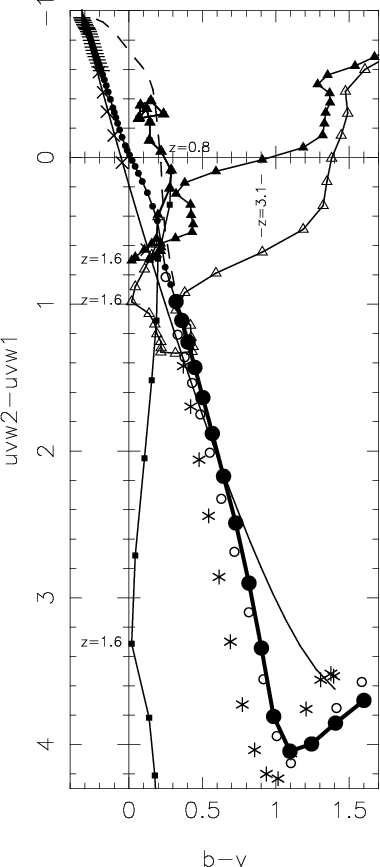 |
Figure 10: The (uvw2-uvw1) vs. (b-v) colour diagram. The symbols have the same meaning as those used for Fig. 7. The highest plotted redshifts are 4.1, 3.9 and 1.8 for the quasars of models A, B and C respectively |
Filter uvw2 could also be used to build-up colour diagrams.
However, it should be kept in mind that the XMM-OM is not very
sensitive in this passband and the precision of the measurement in
uvw2 could be markedly worse than in any of the other filters. The
use of filter uvw2 is illustrated in Fig. 10 where the 2D
(uvw2-uvw1) vs. (b-v) colour diagram is given. Similarly to the
previous case, low-redshift ( )
quasars are wandering at
(uvw2-uvw1) = -0.3 and, of course, (b-v) = 0.15. This is
slightly out of the stellar locus. However, at
)
quasars are wandering at
(uvw2-uvw1) = -0.3 and, of course, (b-v) = 0.15. This is
slightly out of the stellar locus. However, at  ,
the
average quasars progressively become redder in (uvw2-uvw1) due as
usual to the Ly
emission line going from the first filter to
the second. The present colour index is expected to be discriminant
when the Ly
line is located in the uvw1 filter, i.e. roughly for redshifts between 0.8 and 1.6. This is easily seen in the
(uvw2-uvw1) vs. (uvw1-u) colour diagram as well as in the
(uvw2-uvw1) vs. (uvw1-b) one; this pinpoints the importance of the
joint use of the u filter (or perhaps the b one) along with the
pair uvw2, uvw1. Figure 8 exhibits the reduced (
,
the
average quasars progressively become redder in (uvw2-uvw1) due as
usual to the Ly
emission line going from the first filter to
the second. The present colour index is expected to be discriminant
when the Ly
line is located in the uvw1 filter, i.e. roughly for redshifts between 0.8 and 1.6. This is easily seen in the
(uvw2-uvw1) vs. (uvw1-u) colour diagram as well as in the
(uvw2-uvw1) vs. (uvw1-b) one; this pinpoints the importance of the
joint use of the u filter (or perhaps the b one) along with the
pair uvw2, uvw1. Figure 8 exhibits the reduced (
 )
four-dimensional distance in the 4D
(uvw2-uvw1) vs. (uvw1-u) vs. (u-b) vs. (b-v) colour space. It is
clear that the contribution of the uvw2 filter contrasting with the
uvw1 one is increasing the discrimination power in the redshift
range 0.8 to 1.6. This effect could help in generating quasar samples
that are more homogeneous in redshift since the use of the new filters
alleviates the well-known bias of U/B selected quasar candidates due
to the presence of a strong C IV line in the B filter (at
)
four-dimensional distance in the 4D
(uvw2-uvw1) vs. (uvw1-u) vs. (u-b) vs. (b-v) colour space. It is
clear that the contribution of the uvw2 filter contrasting with the
uvw1 one is increasing the discrimination power in the redshift
range 0.8 to 1.6. This effect could help in generating quasar samples
that are more homogeneous in redshift since the use of the new filters
alleviates the well-known bias of U/B selected quasar candidates due
to the presence of a strong C IV line in the B filter (at
 ). From Fig. 10, it is again clear that the degenerate
stars do not follow the black body line and that they still remain a
strong contaminant of the samples of quasars (particularly around
). From Fig. 10, it is again clear that the degenerate
stars do not follow the black body line and that they still remain a
strong contaminant of the samples of quasars (particularly around
 K).
K).
From Fig. 8, one can conclude that the XMM-OM filter set is good at
discriminating between non-degenerate stars and quasars at low
redshifts (
). This is particularly true in the range 0.8
to 2.1 where the use of the uvw1 and uvw2 filters allows a
significantly better discrimination that is even able to wash out the
decrease in efficiency around
 sometimes exhibited
by traditional (U-B) vs. (B-V) surveys. For very low redshifts
(z < 0.8), the advantage of this photometric system is less
marked. However, one should not forget that Fig. 8 gives the reduced
distance. Indeed, the minimum true distance between the quasar and the
stellar locus is, in the 4D space of Sect. 6.3, somewhat larger than
0.35 magnitudes (occuring at z=0.5); this already implies a real
possibility of segregation. For redshifts between 2.3 and 3.5, the
selection is essentially inefficient, as for ground-based surveys
neglecting the use of the R and I filters (for example). It is
beneficial to recall that XMM-OM was originally designed with a red
optical path that has been abandoned in the meantime. Beyond
z = 3.5, the average quasar is usually off the stellar locus but
this corresponds to the presence of the Ly
forest in most of
the filters and is thus again highly dependent on the particular
realization of the Ly
absorption (density and actual locations
of the strong Ly
absorbers on the line of sight). In
addition, the flux below Ly
is comparatively much lower
implying a far less precise photometry. Generally, it is clear that
the XMM-OM filter set is not adapted to the study of high-redshift
quasars: although some of them will be easily spotted, the selection
criterion will remain inhomogeneous. On the other hand, the XMM-OM
photometry has no discrimination power between degenerate stars and
quasars. Particularly for white dwarfs with effective temperatures in
the range
sometimes exhibited
by traditional (U-B) vs. (B-V) surveys. For very low redshifts
(z < 0.8), the advantage of this photometric system is less
marked. However, one should not forget that Fig. 8 gives the reduced
distance. Indeed, the minimum true distance between the quasar and the
stellar locus is, in the 4D space of Sect. 6.3, somewhat larger than
0.35 magnitudes (occuring at z=0.5); this already implies a real
possibility of segregation. For redshifts between 2.3 and 3.5, the
selection is essentially inefficient, as for ground-based surveys
neglecting the use of the R and I filters (for example). It is
beneficial to recall that XMM-OM was originally designed with a red
optical path that has been abandoned in the meantime. Beyond
z = 3.5, the average quasar is usually off the stellar locus but
this corresponds to the presence of the Ly
forest in most of
the filters and is thus again highly dependent on the particular
realization of the Ly
absorption (density and actual locations
of the strong Ly
absorbers on the line of sight). In
addition, the flux below Ly
is comparatively much lower
implying a far less precise photometry. Generally, it is clear that
the XMM-OM filter set is not adapted to the study of high-redshift
quasars: although some of them will be easily spotted, the selection
criterion will remain inhomogeneous. On the other hand, the XMM-OM
photometry has no discrimination power between degenerate stars and
quasars. Particularly for white dwarfs with effective temperatures in
the range
 ,
the colours are very
similar and the domain in effective temperature is too small to
authorize a proper segregation.
,
the colours are very
similar and the domain in effective temperature is too small to
authorize a proper segregation.
As a last point, we would like to recall the existence of the uvm2filter which has already been used to define the
 index.
We found no combination where this filter could be of some help to
improve the situation. For example, in a 2D (uvw2-uvm2) vs.
(uvm2-uvw1) colour diagram, the quasars are well located on the
stellar locus except perhaps for redshifts around
index.
We found no combination where this filter could be of some help to
improve the situation. For example, in a 2D (uvw2-uvm2) vs.
(uvm2-uvw1) colour diagram, the quasars are well located on the
stellar locus except perhaps for redshifts around
 where they leave the stellar locus but this brings no
strong improvement compared to the previously analysed filters.
where they leave the stellar locus but this brings no
strong improvement compared to the previously analysed filters.
Copyright The European Southern Observatory (ESO)