

 where
where
 are constants which differ from galaxy to galaxy.
Essentially, but with the "hole-cutting'' data-reduction process described
in Roscoe 1999A,
are constants which differ from galaxy to galaxy.
Essentially, but with the "hole-cutting'' data-reduction process described
in Roscoe 1999A,  and
and  for each rotation curve were
determined by linear regression of
for each rotation curve were
determined by linear regression of  data on
  data.
Thus, for the PS sample of 900 good quality rotation curves we obtain
900 pairs
data.
Thus, for the PS sample of 900 good quality rotation curves we obtain
900 pairs
 .
.
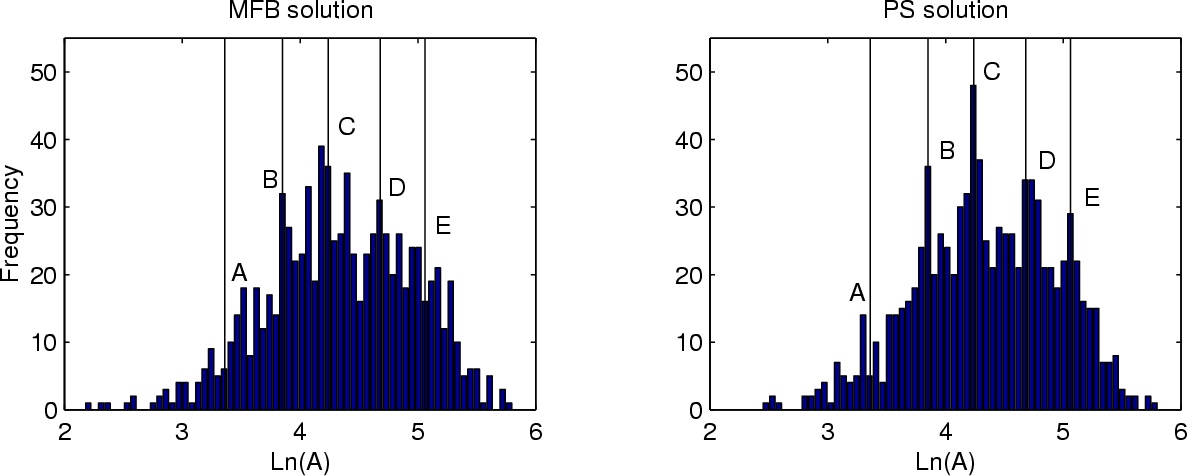 |
Figure 2: Comparison of MFB and PS solutions. The vertical lines in both diagrams indicate the positions of the A, B, C, D and E peaks in the PS solution |
distribution for the MFB solution
(that is, when the rotation curves are folded using MFB's optical centre and their estimate
of
 ), whilst Fig. 2 (right) shows the corresponding distribution
for the PS solution.
A comparison shows that the peaks labelled B, C and D in the MFB solution are reproduced -
enhanced and with much reduced noise - in the PS solution.
Since the MFB solutions were determined directly from observational estimates of optical
centres and systematic redshifts whilst the PS solutions were determined using a "by-eye''
folding process without any reference to an underlying power-law structure
(and hence without reference to any
distribution),
then the foregoing comparison strongly suggests that the B, C, D peak structure reflects
objective physical qualities in the underlying distribution of rotation curves.
This conclusion was reached independently (with the addition of the A and E peaks), supported
by very strong statistics, in Roscoe 1999B.
), whilst Fig. 2 (right) shows the corresponding distribution
for the PS solution.
A comparison shows that the peaks labelled B, C and D in the MFB solution are reproduced -
enhanced and with much reduced noise - in the PS solution.
Since the MFB solutions were determined directly from observational estimates of optical
centres and systematic redshifts whilst the PS solutions were determined using a "by-eye''
folding process without any reference to an underlying power-law structure
(and hence without reference to any
distribution),
then the foregoing comparison strongly suggests that the B, C, D peak structure reflects
objective physical qualities in the underlying distribution of rotation curves.
This conclusion was reached independently (with the addition of the A and E peaks), supported
by very strong statistics, in Roscoe 1999B.
For these reasons, the
distribution is adopted here as a suitable statistical
representation of a folding solution over a large number of rotation curves.
Copyright The European Southern Observatory (ESO)