

Up: The effective temperature scale
According to the procedure described in the preceding sections,
we have derived three (four) effective temperatures for each star
in the sample by applying the IRFM at the IR wavelengths considered
(Eq. 3). The individual values of TJ, TH,
TK (and TL') derived with their corresponding
errors, are listed in Tables 6 and 7.
![\begin{figure}
\includegraphics [width=8.8cm]{ds1675f5.ps}\end{figure}](/articles/aas/full/1999/17/ds1675/Timg73.gif) |
Figure 5:
Differences  , ,  , , and and  versus effective temperature
(only temperatures obtained from more than one
filter are displayed). The dotted lines
show the region versus effective temperature
(only temperatures obtained from more than one
filter are displayed). The dotted lines
show the region  % % |
![\begin{figure}
\includegraphics [width=8.8cm]{ds1675f6.ps}\end{figure}](/articles/aas/full/1999/17/ds1675/Timg75.gif) |
Figure 6:
Differences , , and versus [Fe/H]
(only temperatures obtained from more than one
filter are displayed). The dotted lines
show the region  K. The vertical accumulations
correspond to the temperatures
of the stars of the globular clusters contained
in our sample K. The vertical accumulations
correspond to the temperatures
of the stars of the globular clusters contained
in our sample |
Table 7:
Temperatures derived for the globular cluster stars of the sample. Column 1
Globular cluster. Column 2: Identification: M 3 nomenclature from Cohen et al. (1978)
and Arribas & Martínez-Roger (1987); M 13, M 92 and M 67 nomenclature from Cohen et al. (1978);
M 71 nomenclature from Frogel et al. (1979); 47 Tuc nomenclature from Frogel et al. (1981);
NGC 288, NGC 1261, NGC 362 nomenclature from Frogel et al. (1983).
Column 3: Metallicity.
Column 4: Surface gravity. Column 5: Bolometric flux in  .
Column 6: Interstellar reddening. Column 7: Temperature derived in band J
(units are K). Column 8: Error
in TJ computed considering errors in
.
Column 6: Interstellar reddening. Column 7: Temperature derived in band J
(units are K). Column 8: Error
in TJ computed considering errors in  , monochromatic fluxes,
log(g) and [Fe/H].
Columns 9-10: The same as in Cols. 7-8 for temperature derived in band H.
Columns 11-12: The same as in Cols. 7-8 for temperature derived in band K.
Column 13: The
weighted mean temperature derived from TJ, TH and TK. Column 14: Mean
error computed by considering linear transmission of errors from Cols. 8, 10 and 12.
Column 14. Number of temperatures considered in the average of Col. 13
, monochromatic fluxes,
log(g) and [Fe/H].
Columns 9-10: The same as in Cols. 7-8 for temperature derived in band H.
Columns 11-12: The same as in Cols. 7-8 for temperature derived in band K.
Column 13: The
weighted mean temperature derived from TJ, TH and TK. Column 14: Mean
error computed by considering linear transmission of errors from Cols. 8, 10 and 12.
Column 14. Number of temperatures considered in the average of Col. 13
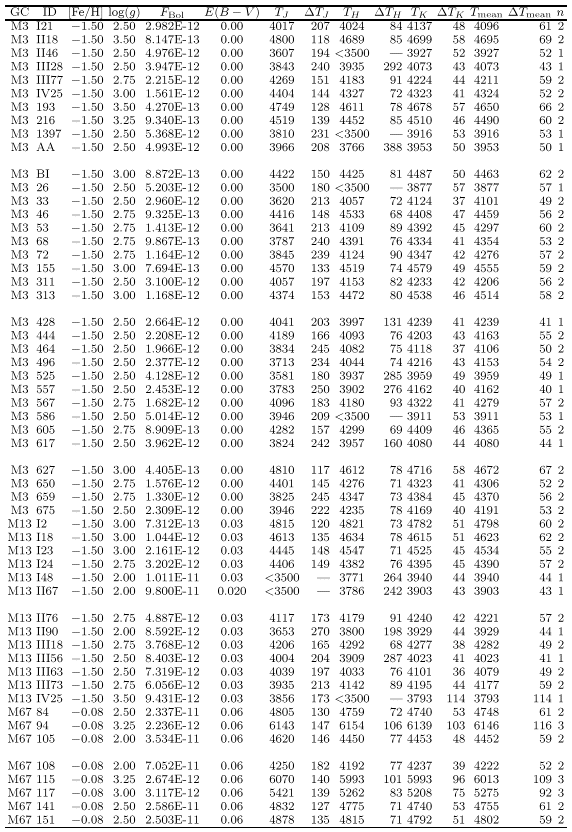 |
Table 7:
continued
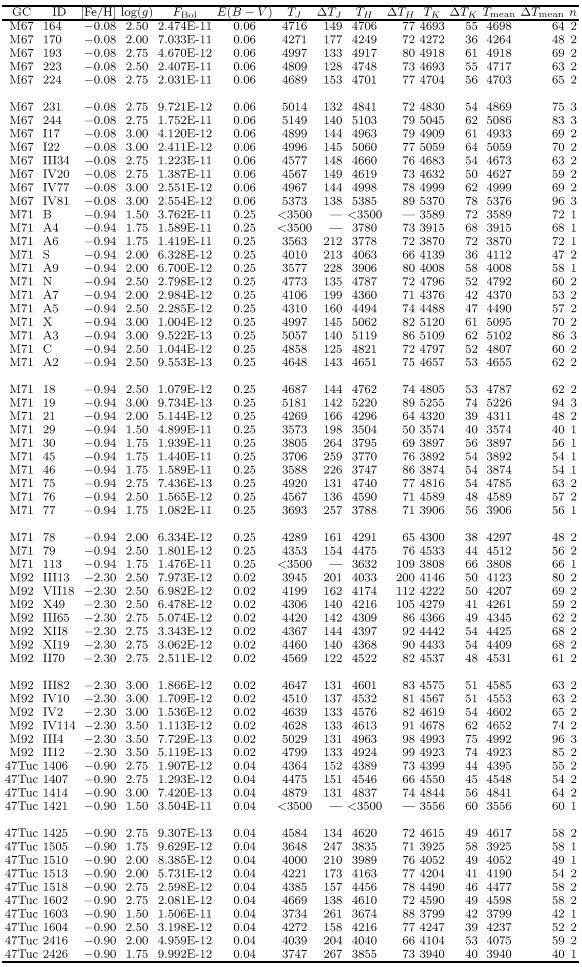 |
Table 7:
continued
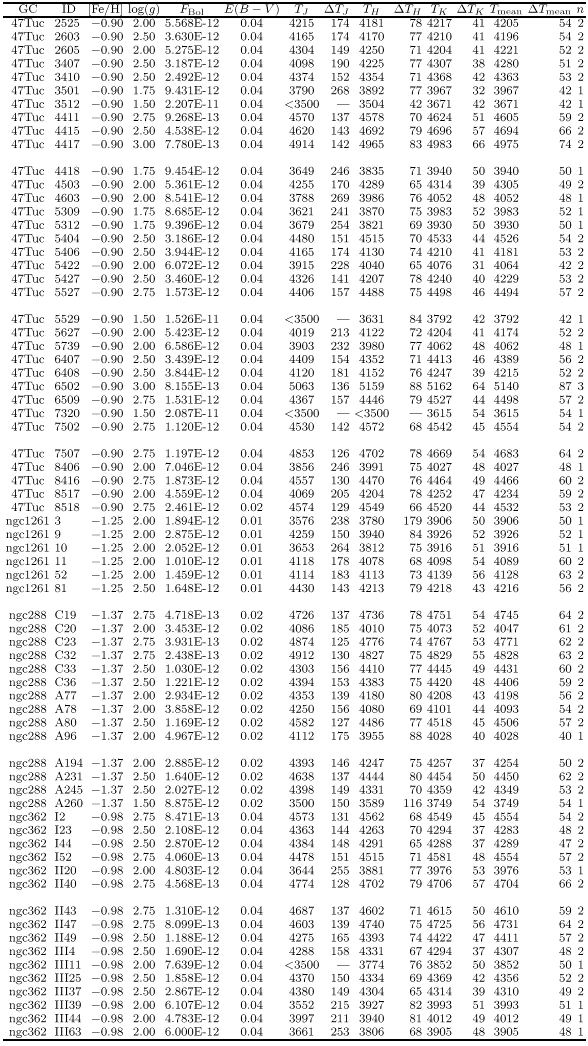 |
Table 7:
continued
 |
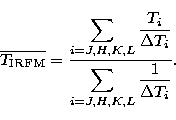
The final temperature
was derived as an average
of TJ, TH, TK (and TL') weighted with the
inverse of their errors:
|  |
(6) |
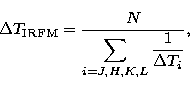
In order to estimate the error of the mean temperature, a linear transmission of the errors
was considered, given that the errors in each band are not totally independent:
|  |
(7) |
where N is the number of bands considered and the error in the temperature of each band is defined by
| ![\begin{eqnarray}
(\Delta T_{i})^{2}=\left[\frac{\partial T_{i}}{\partial [q(\lam...
...partial T_{i}}{\partial \log(g)}\right]^{2}\;(\Delta \log(g))^{2}.\end{eqnarray}](/articles/aas/full/1999/17/ds1675/img80.gif) |
|
| (8) |
The quantities in square brackets have been estimated by considering finite-difference interpolation with the help of grids of values similar to those displayed in
Tables 1-4 with a finer spacing.
Over 5000 K, the temperatures in the three (four) bands enter the average with similar
weight. In that range, the assignment of weights automatically takes into
account the uneven sensitivity of the IRFM in the different bands and the
individual quality of IR photometry. However, below 5000 K only TH,
TK and TL' have been considered in the average, since RJ is a very
insensitive indicator of temperature for the cooler stars. Under 4000 K, only
TK and TL' have been considered. This is due to
the fact that the coolest models show in the H band a local maximun of
flux which is not observed in IR spectra (Lançon & Rocca-Volmerange 1992).
The mean error in the final temperatures is around 1-2%. Note however,
that the uncertainties in the temperatures derived under 4000 K are greater
than the errors determined from Eq. (8) due to the model imperfections in
this range caused by the absence of important sources of opacity associated with certain molecules. Likewise, the IRFM is difficult to apply at temperatures above
8000 K because, as these
stars emit a substantial proportion of energy at short wavelengths, the
correction for insterstellar extinction and the determination of the
bolometric flux are rather uncertain. For these reasons, the temperatures
outside the range  have a lower level of accuracy,
and the error-bars quoted in Tables 6 and 7 have to be considered, in some
cases, as lower
estimates.
have a lower level of accuracy,
and the error-bars quoted in Tables 6 and 7 have to be considered, in some
cases, as lower
estimates.
We show in Figs. 5 and 6 the difference between TJ, TH, TK and TL', and the average temperature adopted. The individual
residuals reveal that the dispersion is compatible with
the estimated errors derived from the uncertainties in the input parameters
of the IRFM. They follow approximately a normal distribution both
with temperature and metallicity. As expected, the uncertainties are greater for temperatures
obtained from RJ factors, due to the lower sensitivity of the IRFM in this band and the
greater photometric error in the measurement of magnitude J. The consistency of
TJ and TH is good over 4500 K; however, under this
temperature noteworthy discrepancies appear to be due to the fact that RJ- and RH-factors lose their sensitivity to temperature in this range.
![\begin{figure}
\includegraphics [width=8.8cm]{ds1675f7.ps}\end{figure}](/articles/aas/full/1999/17/ds1675/Timg84.gif) |
Figure 7:
Differences between the temperatures derived in
this work ( ) and those derived by other authors. circles:
Direct measurements: C76, R80, BR87, H89, M91, and WF87; squares:
Bell & Gustafsson (1989),
triangles: Arribas & Martínez-Roger (1987). stars:
Blackwell & Lynas-Gray (1998). In the upper figure
the lines corresponding to the mean internal error of
the work ( ) and those derived by other authors. circles:
Direct measurements: C76, R80, BR87, H89, M91, and WF87; squares:
Bell & Gustafsson (1989),
triangles: Arribas & Martínez-Roger (1987). stars:
Blackwell & Lynas-Gray (1998). In the upper figure
the lines corresponding to the mean internal error of
the work ( 1.5%) are shown 1.5%) are shown |
![\begin{figure}
\includegraphics [width=8.8cm]{ds1675f8.ps}\end{figure}](/articles/aas/full/1999/17/ds1675/Timg86.gif) |
Figure 8:
Differences between the temperatures derived in
this work () and those derived
by Frogel et al. (1979, 1981, 1983)
and Cohen et al. (1978) ( ). Top: Differences against .Bottom: Differences against metallicity. The differences
are consistent with a zero-point offset amounting to 56 K (dotted line) ). Top: Differences against .Bottom: Differences against metallicity. The differences
are consistent with a zero-point offset amounting to 56 K (dotted line) |
Table 8:
Comparison between the temperatures derived in the present work (Col. 3) and
those derived by direct methods (Col. 2). When several direct
measurements were available we have considered the average value. The temperatures
of the Sun
and Procyon, measured in Paper I, are also listed. The mean difference
 is 3 51 K
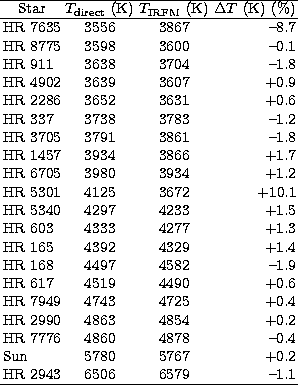 |
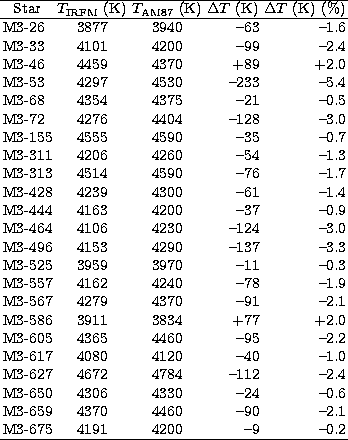
Table 9:
Comparison between the temperatures derived in the present work
(Col. 2) and those derived by Arribas & Martínez-Roger (1987)
(Col. 3). The mean difference
 is -1.3 1.4% (without M3-53)
 |
Up: The effective temperature scale
Copyright The European Southern Observatory (ESO)
![\begin{figure}
\includegraphics [width=8.8cm]{ds1675f5.ps}\end{figure}](/articles/aas/full/1999/17/ds1675/img73.gif)
![\begin{figure}
\includegraphics [width=8.8cm]{ds1675f6.ps}\end{figure}](/articles/aas/full/1999/17/ds1675/img75.gif)
![\begin{figure}
\includegraphics [width=8.8cm]{ds1675f7.ps}\end{figure}](/articles/aas/full/1999/17/ds1675/img84.gif)
![\begin{figure}
\includegraphics [width=8.8cm]{ds1675f8.ps}\end{figure}](/articles/aas/full/1999/17/ds1675/img86.gif)