Although spectroscopic observations are not available for this binary the UBV
photoelectric observations can be used for obtaining the tentative absolute
elements. Using the derived luminosities (Table 1, Col. 6), the differential
magnitudes,  , at the quadrature and the standard values of the magnitudes
of the comparison star in the UBV passbands (Sect. 2), we derived the following
magnitudes and colours of the individual components: Hotter component V=8.84,
B-V=0.32, U-B=-0.06, Cooler component V=9.47, B-V=0.45, U-B=0.07.
, at the quadrature and the standard values of the magnitudes
of the comparison star in the UBV passbands (Sect. 2), we derived the following
magnitudes and colours of the individual components: Hotter component V=8.84,
B-V=0.32, U-B=-0.06, Cooler component V=9.47, B-V=0.45, U-B=0.07.
Assuming no interstellar reddening, the (B-V) of the primary corresponds to a
temperature of  K which in turn corresponds to a spectral type of F1V
[3, (Allen 1976];
[20, Popper 1980];
[23, Schmidt-Kaler 1982)].
The above temperature
agrees quite well with that of the fixed temperature
K which in turn corresponds to a spectral type of F1V
[3, (Allen 1976];
[20, Popper 1980];
[23, Schmidt-Kaler 1982)].
The above temperature
agrees quite well with that of the fixed temperature  K used for the
primary component in the analysis. The (B-V) of 0.45 for the secondary component
corresponds to a spectral type of F5V (6450 K) and its derived temperature
of 6145 K (Table 1, Col. 6) suggests a spectral type of F8V
[3, (Allen 1976];
[20, Popper 1980];
[23, Schmidt-Kaler 1982)].
This small discrepancy of about 300 K between the
spectral types derived from the colour (B-V) and effective temperature for the
secondary component could be attributed to the uncertainties in the model atmospheres
incorporated in the W-D programme, appropriate for each spectral type. Keeping
in view the bigger sizes (radii) of both the components (see the following) we
adopted a spectral type of F1V-IV for the primary and F5V-IV for the secondary
component. Our improved solution based on UBV photometry gives an earlier spectral
type for the primary compared to other authors.
K used for the
primary component in the analysis. The (B-V) of 0.45 for the secondary component
corresponds to a spectral type of F5V (6450 K) and its derived temperature
of 6145 K (Table 1, Col. 6) suggests a spectral type of F8V
[3, (Allen 1976];
[20, Popper 1980];
[23, Schmidt-Kaler 1982)].
This small discrepancy of about 300 K between the
spectral types derived from the colour (B-V) and effective temperature for the
secondary component could be attributed to the uncertainties in the model atmospheres
incorporated in the W-D programme, appropriate for each spectral type. Keeping
in view the bigger sizes (radii) of both the components (see the following) we
adopted a spectral type of F1V-IV for the primary and F5V-IV for the secondary
component. Our improved solution based on UBV photometry gives an earlier spectral
type for the primary compared to other authors.
Since no spectroscopic studies exist for this system, neither the spectral
types nor the individual masses of the components are presently available. Hence
it is difficult to get reliable absolute elements for the components. However,
to get tentative dimensions and masses of the components, we assumed the
primary F1V component to obey the spectral type-mass relation of the normal
main sequence stars
[4, (Andersen 1991)].
From this assumption one gets a mass of
 for the primary component. From the presently derived mass-ratio,
 and the assumed mass of for
  ,one gets a mass of
  for the secondary component.
Using Kepler's 3rd law
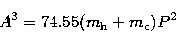 |
(1) |
 [2, (Abhyankar 1962b)],
one gets
[2, (Abhyankar 1962b)],
one gets  as the
separation of the components. From the derived average fractional radii
as the
separation of the components. From the derived average fractional radii
![$[r=(r_{\rm pole}+r_{\rm side}+r_{\rm back})/3]$](/articles/aas/full/1999/16/ds8332/img43.gif) of 0.393 and 0.371 for the primary and
secondary components respectively, one gets
of 0.393 and 0.371 for the primary and
secondary components respectively, one gets  and
and
 . The above derived radii of the primary and
secondary components,
. The above derived radii of the primary and
secondary components,  and
and  , are larger than those of
 and
and  of normal F1V and F5V stars respectively
[4, (Andersen 1991)].
This may be due to the evolution of
both the primary and secondary components which are overfilling their Roche
lobes
of normal F1V and F5V stars respectively
[4, (Andersen 1991)].
This may be due to the evolution of
both the primary and secondary components which are overfilling their Roche
lobes  for q=0.89;
[19, Plavec & Kratochvil 1964)]
by 3%. The
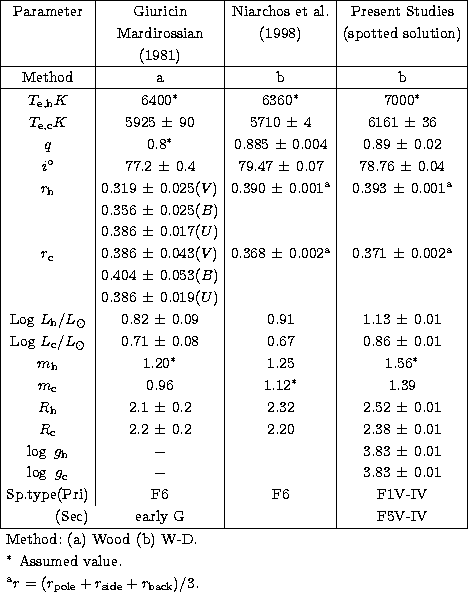
system parameters are as given in Table 3 along with the elements and
parameters given by
[7, Giuricin & Mardirossian (1981)] and
[18, Niarchos et al. (1998)].
for q=0.89;
[19, Plavec & Kratochvil 1964)]
by 3%. The
system parameters are as given in Table 3 along with the elements and
parameters given by
[7, Giuricin & Mardirossian (1981)] and
[18, Niarchos et al. (1998)].
The bolometric corrections are from
[20, Popper (1980)].
According to
[6, Buser & Kurucz (1978)]
a star with a (B-V) colour of 0.32 and  of
3.83 should have a temperature of about 7000 K. This agrees quite well, within the
errors of assumed parameters, with the temperatures of K used by us
for the primary component in our analysis.
of
3.83 should have a temperature of about 7000 K. This agrees quite well, within the
errors of assumed parameters, with the temperatures of K used by us
for the primary component in our analysis.
Copyright The European Southern Observatory (ESO)