

 ) and a metallicity range
from Z = 0.0001 to Z= 0.05. Their tracks include all stages in stellar evolution
from the zero age main sequence to the tip of the RGB and from the zero age horizontal
branch to the tip of the EAGB. For the stellar mass loss we use the method described in
Bressan et al. (1993) with Reimers law.
) and a metallicity range
from Z = 0.0001 to Z= 0.05. Their tracks include all stages in stellar evolution
from the zero age main sequence to the tip of the RGB and from the zero age horizontal
branch to the tip of the EAGB. For the stellar mass loss we use the method described in
Bressan et al. (1993) with Reimers law.
For lower masses ( to
to  ) we use the
calculations from Chabrier & Baraffe (1997). They based
their calculation on a new description of the interiour of low mass
objects and use non-grey atmospheres. Since their grid in metallicity
does not match the grid of the Padova group we have linearly
interpolated the values for [M/H] = -1.7, [M/H] = -0.7 and [M/H]
= -0.4 while for [M/H] = -2.3 and [M/H] = 0.4 we used the
calculations for [M/H] = -2.0 and [M/H] = 0, respectively. The
contributions of these low mass stars to the integrated light is very
low, therefore the error should be small.
) we use the
calculations from Chabrier & Baraffe (1997). They based
their calculation on a new description of the interiour of low mass
objects and use non-grey atmospheres. Since their grid in metallicity
does not match the grid of the Padova group we have linearly
interpolated the values for [M/H] = -1.7, [M/H] = -0.7 and [M/H]
= -0.4 while for [M/H] = -2.3 and [M/H] = 0.4 we used the
calculations for [M/H] = -2.0 and [M/H] = 0, respectively. The
contributions of these low mass stars to the integrated light is very
low, therefore the error should be small.
To obtain synthetic colours, the conversion from theoretical quantities to observable quantities is very important. The evolutionary tracks for stars give effective temperatures, bolometric luminosities and gravities at the surface of stars of different masses as a function of time. These values have to be converted to colours in the various bands and to atmospheric indices of the evolutionary states.
For the fluxes and colours we use the theoretical library of model
atmosphere spectra for various metallicities of Lejeune et al.
(1997, 1998). Lejeune et al. have assembled a coherent library of
synthetic stellar atmosphere calculations from Kurucz (see e.g.
Kurucz 1979);
Fluks et al. (1994);
Bessell et al. (1989, 1991).
The library has an effective
temperature range from  K to 50000 K and covers a
broad range of metallicities. To cope with discrepancies between
colours derived from model atmosphere spectra and observed colours,
they correct (i.e. bend ) the model spectra to give agreement
with observed colours for U through K. To fit their metallicity grid
to that of the stellar evolutionary tracks, colours and bolometric
corrections are interpolated linearly.
K to 50000 K and covers a
broad range of metallicities. To cope with discrepancies between
colours derived from model atmosphere spectra and observed colours,
they correct (i.e. bend ) the model spectra to give agreement
with observed colours for U through K. To fit their metallicity grid
to that of the stellar evolutionary tracks, colours and bolometric
corrections are interpolated linearly.
For a series of absorption indices, the empirical functions of Worthey
et al. (1994) are used. Worthey et al. supply fitting
functions that give index strength as a
function of  ,
,  , and
, and ![${\rm [Fe/H]}$](/articles/aas/full/1999/13/ds7606/img9.gif) . These were obtained from observations of 460 stars,
covering a large range in the above parameters.
. These were obtained from observations of 460 stars,
covering a large range in the above parameters.
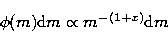
The IMF can be expressed as:
 |
(1) |
 for
[M/H] = -2.0 to
for
[M/H] = -2.0 to  for [M/H] = 0.
Theoretical stellar tracks are supplied for discrete stellar masses only. In real stellar systems, the mass distribution is expected to be continuous. Using only the discrete mass grid of the track libraries would result in severe discontinuities, since all stars of a given mass would move to the red giant branch and die at the same time. We would see many "bumps'' in the luminosity and colour evolution of the stellar population. This effect is large for SSPs where all stars have about the same age. For continuous star formation rates (as in e.g. late spirals) the evolution is much smoother as expected.
To avoid the discontinuity problem we use a Monte-Carlo -method
to calculate the distribution of stars in the HRD at each timestep of
our evolutionary synthesis model. This method was developed by
Loxen (1992, 1997). For this method, no
isochrones with interpolated stellar evolutionary tracks are needed.
Instead, at each timestep a large grid in stellar masses and ages is
created. The grid is created randomly, hence the
Monte-Carlo designation. Each cell in this grid has a size  in the 2-dimensional mass - time space. The grid
ranges in mass from the lower mass to upper mass cutoff. In the case
of an SSP the grid ranges in time from zero to the end of the burst,
while for a continous SFR this would be from zero to the model age.
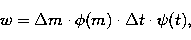
Each cell represents a pseudo star, which is weighted with the value
of the initial mass function (IMF) and the value of the star formation
rate (SFR) at the position of the cell. This weight is given by
in the 2-dimensional mass - time space. The grid
ranges in mass from the lower mass to upper mass cutoff. In the case
of an SSP the grid ranges in time from zero to the end of the burst,
while for a continous SFR this would be from zero to the model age.
Each cell represents a pseudo star, which is weighted with the value
of the initial mass function (IMF) and the value of the star formation
rate (SFR) at the position of the cell. This weight is given by
 |
(2) |
 is the value of the IMF at the mass of the pseudo star
and
is the value of the IMF at the mass of the pseudo star
and  is the star formation rate at the time the pseudo star
is born. In the case of an SSP, the function is constant
over the time of the burst and then equal to zero. The unit of the
value w is number of stars , although it can be
fractional. For each of these cells, the lifetime of the pseudo star
is determined by interpolation between the nearest two stellar tracks
supplied in the library. Then the timesteps of the tracks are
stretched according to this new lifetime. The cell is then split in
two parts with relative weights given by
is the star formation rate at the time the pseudo star
is born. In the case of an SSP, the function is constant
over the time of the burst and then equal to zero. The unit of the
value w is number of stars , although it can be
fractional. For each of these cells, the lifetime of the pseudo star
is determined by interpolation between the nearest two stellar tracks
supplied in the library. Then the timesteps of the tracks are
stretched according to this new lifetime. The cell is then split in
two parts with relative weights given by
 |
(3) |
The only interpolation that is done is to determine the life times and hence the duration of the individual states. No interpolation is done for the luminosities or the effective temperatures which would require a precise definition of equivalent evolutionary stages. In this way, no artificial tracks are created. Especially in mass ranges were there is a strong dependance of the stellar evolution on the mass this is important.
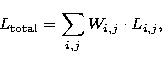
The cells in the grid do not represent individual stars since
their weights are not necessarily unity. The weights w are added in
a book-keeping list for the individual states in the tracks of the
input library to get weights Wi,j. Thereafter, the luminosities
of all states on all tracks are summed up, each weighted with the
calculated weights:
 |
(4) |
 is the luminosity in some band, Wi,j are the
assigned weights and Li,j are the luminosities of a theoretical
star from the library at ith mass and jth state.
is the luminosity in some band, Wi,j are the
assigned weights and Li,j are the luminosities of a theoretical
star from the library at ith mass and jth state.
Due to the randomly spaced grid, there is a noise on the
results, but the finer the grid (i.e. the more cells in the grid), the
better is the signal-to-noise ratio. For the models in this paper, we
use  masses distributed evenly in
  mass and 1000
ages distributed evenly, which make up a grid of
mass and 1000
ages distributed evenly, which make up a grid of  cells.
Any further increase of the size of the grid does not give
significantly better results. For more continuous SFRs, the grid can
be coarser. Trivially the grid extends in time such that all stars are
born in the burst interval, i.e. in the first 107 years. This
implies that each
cells.
Any further increase of the size of the grid does not give
significantly better results. For more continuous SFRs, the grid can
be coarser. Trivially the grid extends in time such that all stars are
born in the burst interval, i.e. in the first 107 years. This
implies that each  from Eq. (2) is equal to
around 104 years.
from Eq. (2) is equal to
around 104 years.
For the same input physics data set, the Monte Carlo method has been tested in detail against the standard synthesis model for SSPs (Fritze - v. Alvensleben 1995). Results for solar metallicity are compared to those of various evolutionary synthesis codes including the isochrone synthesis code of Bruzual & Charlot in Sect. 4.3.
On our Linux Pentium II 300 MHz work stations a single run with a timestep of one Gyr needs a few minutes of cpu time for the evolution of an SSP over a Hubble time.
This method has many advantages. Models at any time can be calculated without the need of any interpolation between stellar evolutionary tracks avoiding the problem of defining equivalent evolutionary stages, i.e. only the time intervals of the individual tracks are interpolated (but not the temperatures or gravities and therefore the colours). It is also possible to use an arbitrary star formation history. In the future, this code will be extended to be able to work with arbitrary metallicities not covered by the stellar tracks available. Since this is an evolutionary synthesis code rather than a population synthesis code, it can also be extended to calculate the chemical enrichment of galaxies.
Copyright The European Southern Observatory (ESO)