

Up: Random-error minimization during cross-correlation
Subsections
Let c(i) be a discretized function with a prominent peak, the position
of which
is to be determined. As in
Tonry & Davis (1979)
we do so by finding the position of the
maximum of a parabola fitted to the peak. Let  denote the pixel with the highest value; if one uses an
odd number of pixels (say,
2p+1) chosen symmetrically around , then the position of the
maximum (expressed in pixels) can be written as
denote the pixel with the highest value; if one uses an
odd number of pixels (say,
2p+1) chosen symmetrically around , then the position of the
maximum (expressed in pixels) can be written as  and the
pixel fraction
and the
pixel fraction  is given by:
|  |
(A1) |
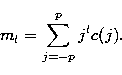
where ml denotes the  moment of the cross-correlation peak (within the
interval used in the fit):
moment of the cross-correlation peak (within the
interval used in the fit):
|  |
(A2) |
With an even number of pixels chosen symmetrically around the highest two
values, a similar expression can be obtained; if necessary both
results can be combined to reduce the discretization error as
discussed in
David & Verschueren (1995).
The random error on the position of a cross-correlation peak,
i.e. the part
of the error which is due to noise on the spectra, can be estimated in a
straightforward way as the square root of the variance of the shift measured
between two spectra, say S and T, which are intrinsically identical and
unshifted with respect to one another. We assume the spectra to be binned on
N pixels so that
|  |
(A3) |
where the subscript 0 indicates the intrinsic part and N(n) represents the
noise. We shall assume throughout that the noise on any pixel is statistically
independent from the noise on all others. This assumption may not always be
valid in practice, e.g. if the data have been rebinned at some stage of the
data-reduction process or if they
have been filtered prior to cross-correlation;
in that case the results derived below
will have to be modified but the argument
remains essentially the same. Let us define
|  |
(A4) |
Then the correlation function can be written as:
|  |
(A5) |
where we have assumed,
conveniently but without loss of generality, that N is
even. Similarly, we limit ourselves to the case where we can fit an odd
number of pixels
and we can apply Eq. (A1) (with  ). Moreover, for the
present purpose it is sufficient to retain only terms
of first order in the noise;
m1 is itself of first order since the noise-free part of the correlation
function is symmetrical, so we obtain the approximation
). Moreover, for the
present purpose it is sufficient to retain only terms
of first order in the noise;
m1 is itself of first order since the noise-free part of the correlation
function is symmetrical, so we obtain the approximation
|  |
(A6) |
where K0 is given by (A1) and
the subscript 0 again indicates that noise contributions have been
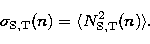
omitted. The variance  of the correlation-peak position
is obtained now as the statistical average of
of the correlation-peak position
is obtained now as the statistical average of  :
:
| ![\begin{displaymath}
{\sigma_{\rm P}}^2 \equiv \; \langle \delta^2\rangle \; =
\f...
...g^2(n,p)
\left[\sigma_{\rm S}^2(n) + \sigma_{\rm T}^2(n)\right]\end{displaymath}](/articles/aas/full/1999/09/h1238/img81.gif) |
(A7) |
where we used  and defined
|  |
(A8) |
|  |
(A9) |
By its definition, the random error  in Sect. 5 must be
identified with
in Sect. 5 must be
identified with  .
.
With spectra given by Eq. (A3), both the error on the position of the
cross-correlation maximum and the antisymmetric part of the correlation
function originate from the noise only. Pre-eminently in this case,
any relation
between those two should be revealed most clearly, at least through their
statistical average. We therefore
calculated the average of  defined
in Eq. (11), applied with
defined
in Eq. (11), applied with  since
there is no intrinsic shift:
since
there is no intrinsic shift:
| ![\begin{displaymath}
\langle {\sigma_{\rm a}}^2\rangle = \frac{1}{C^2}\sum_{n=0}^{N-1} h(n)
\left[\sigma_{\rm S}^2(n) + \sigma_{\rm T}^2(n)\right]\end{displaymath}](/articles/aas/full/1999/09/h1238/img88.gif) |
(10) |
where
| ![\begin{displaymath}
h(n) = \frac{1}{2N}\sum_{i=0}^{N/2-1}\left[S_0(n\oplus i) -
S_0(n\ominus i)\right]^2.\end{displaymath}](/articles/aas/full/1999/09/h1238/img89.gif) |
(11) |
Up: Random-error minimization during cross-correlation
Copyright The European Southern Observatory (ESO)

