

The limiting magnitude for NGS-based adaptive optics system can be easily computed by both numerical and analytical formulations (Rigaut et al. 1997). Matching with experimental results is relatively satisfactory (Roddier 1998). In the LGS case the extension is straightforward only accepting conical anisoplanatism degradation and omitting the tip-tilt treatment. Few experimental results are available to confirm such results. To my knowledge there is no published result on noise propagation in tomographic wavefront sensing. It should be pointed out that in the modal formulation given by Ragazzoni et al. (1999) it would be easier to approach the problem in an analytical way because error-propagation in matrices involves straightforward matrices manipulation. A careful analysis and numerical confirmation, however, still requires a thorough discussion that is beyond the scope of this work.
At the current state of knowledge it is very hard to make a firm projection of the limiting magnitude for tomographic wavefront sensing. In this section I try to outline some considerations useful for giving a rough estimate of such limiting magnitude.
I assume that the following statements are true:
 of relevant perturbing layers is equal to the
number of sensed NGSs;
of relevant perturbing layers is equal to the
number of sensed NGSs;
Let us suppose that, under some given conditions for the Fried parameter
r0, Greenwood frequency  , overall quantum efficiency of the wavefront
sensing system q and its spectral bandwidth
, overall quantum efficiency of the wavefront
sensing system q and its spectral bandwidth  expressed in nm,
a certain zonal error in the wavefront correction
expressed in nm,
a certain zonal error in the wavefront correction  is obtained
when a star of magnitude V0 is used to close a classical adaptive
optics loop.
For each coherence zone (sized r0) of the collected wavefront and in a
single coherence time (of the order of
is obtained
when a star of magnitude V0 is used to close a classical adaptive
optics loop.
For each coherence zone (sized r0) of the collected wavefront and in a
single coherence time (of the order of  ), the number of collected
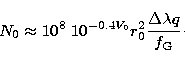
photons N0 will be given by
(Zombeck 1990):
), the number of collected
photons N0 will be given by
(Zombeck 1990):
 |
(1) |
layers is representative of
most of the total turbulence experienced by the starlight coming into the
telescope (grouping of very close layers can improve the
effectiveness of the technique).
Each of these layers is numbered from 1 (the lowest) to (the
highest) and will be interested by an average number of NGSs given by ni.
For instance  using the condition 1 and
  using the condition 3. For each layer one can define a r0i
characteristic of the wavefront passing just through that portion of
turbulence.
using the condition 3. For each layer one can define a r0i
characteristic of the wavefront passing just through that portion of
turbulence.
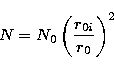
Supposing the use of a
star of magnitude V0 to sense directly just the i-th single layer a
number of photons given by:
 |
(2) |
 given
by:
given
by:
 |
(3) |
 |
(4) |
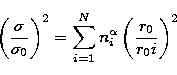
 represent the pessimistic case and
  the
optimistic one. The summation of the errors is incoherent. The case for
the
optimistic one. The summation of the errors is incoherent. The case for
 represent the (unlikely, and not treated here) case of
coherent superpositions of the errors.
In Eq. (4) it has been implicitly assumed that the weights for each zonal
sensing are
of the order of the unity. Of course this is a rather unjustified
assumption. At this stage one can only imagine that very different weights
combine together
to mimic the situation coarsely expressed by
Eq. (4).
On the other hand the variations due to the choice on
represent the (unlikely, and not treated here) case of
coherent superpositions of the errors.
In Eq. (4) it has been implicitly assumed that the weights for each zonal
sensing are
of the order of the unity. Of course this is a rather unjustified
assumption. At this stage one can only imagine that very different weights
combine together
to mimic the situation coarsely expressed by
Eq. (4).
On the other hand the variations due to the choice on  span less than
one order of magnitude in the
span less than
one order of magnitude in the  ratio.
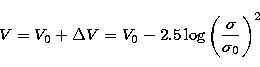
In order to reach
with
the tomographic approach the same zonal error
as
the classical
single guide star approach,
a limiting magnitude for each of the NGS (the
condition 2 is used here) of:
 |
(5) |
 represent the variation due to the approach used).
Using r0 = 0.25 m,
represent the variation due to the approach used).
Using r0 = 0.25 m,  Hz, q=0.5,
  nm and an
error
nm and an
error  radian of wavefront phase, we can
determine
the number of required photocounts
radian of wavefront phase, we can
determine
the number of required photocounts  , being
(Kern et al. 1989):
, being
(Kern et al. 1989):
 |
(6) |
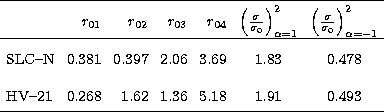
 , n1=n2=4, n3=2 and
n4=1 and scaling the various r0i in order to match
the overall r0=0.25 m and reported for convenience of the reader in
Table 1.
Equations (4) and (5) gives
, n1=n2=4, n3=2 and
n4=1 and scaling the various r0i in order to match
the overall r0=0.25 m and reported for convenience of the reader in
Table 1.
Equations (4) and (5) gives  (a brighter limiting magnitude) for the
pessimistic case and
(a brighter limiting magnitude) for the
pessimistic case and  (the option to look for
fainter NGSs) for the optimistic case in the SLC-N model. For the HV-21 model
(the option to look for
fainter NGSs) for the optimistic case in the SLC-N model. For the HV-21 model  () and
  ().
().
Conservatively we assume in the following  , that is V=12.0
or V=14.0
as extrema of limiting magnitudes for the NGSs to be used in the tomographic
approach.
While no attempt is made to use many more fainter NGSs to mimic fewer brighter NGSs
(an approach that could widen the practicability of the proposed approach)
the approximate and tentative nature of these calculations must be reiterated.
Also, it
should
be pointed out that essentially no literature is available on possible
techniques for efficient wavefront sensing and correction in the tomographic
mode and there is no evidence that straightforward sensing with classical
wavefront sensor of each star to be coupled together in a dedicated
wavefront computer represent the ultimate achievable performance.
Moreover
I have
not speculated on the possibility
of using
NGSs to
directly retrieve
tomographic information as suggested for instance by
Ribak (1995).
, that is V=12.0
or V=14.0
as extrema of limiting magnitudes for the NGSs to be used in the tomographic
approach.
While no attempt is made to use many more fainter NGSs to mimic fewer brighter NGSs
(an approach that could widen the practicability of the proposed approach)
the approximate and tentative nature of these calculations must be reiterated.
Also, it
should
be pointed out that essentially no literature is available on possible
techniques for efficient wavefront sensing and correction in the tomographic
mode and there is no evidence that straightforward sensing with classical
wavefront sensor of each star to be coupled together in a dedicated
wavefront computer represent the ultimate achievable performance.
Moreover
I have
not speculated on the possibility
of using
NGSs to
directly retrieve
tomographic information as suggested for instance by
Ribak (1995).
 |
Copyright The European Southern Observatory (ESO)