A total of 27 stars in the field of NGC2354 brighter than V = 13.1 and
redder than B-V = 0.78, were selected as red giant candidates from the
colour-magnitude diagram published by Dürbeck (1960). With the exception of
one star (#152), all the red giant candidates were
observed in the Washington photometric system (Canterna 1976), while nineteen
of them with  were observed in the UBV and DDO systems
with the purpose of obtaining additional information about their reddening
and metallicity. Three additional stars fainter than V = 11.9 were also
observed in the UBV system.
were observed in the UBV and DDO systems
with the purpose of obtaining additional information about their reddening
and metallicity. Three additional stars fainter than V = 11.9 were also
observed in the UBV system.
The photometric data reported here were obtained at Cerro Tololo Inter-American Observatory (CTIO) using the 0.6- and 1.0-m telescopes in January 1992 and January 1993. Single-channel pulse-counting photometers were used at CTIO in conjunction with dry-ice cooled Hamamatsu R943-02 and EMI 9781A photomultipliers for the UBV and DDO observations, while Hamamatsu R943-02 and RCA 31034A phototubes were used for the CMT1T2 observations. Only the four primary filters of the DDO system were used, since they provide adequate information for the present purposes. Mean UBV, DDO and CMT1T2 extinction coefficients for CTIO were used to reduce the photometric data, and nightly observations of about 13-15 standard stars from the lists of Cousins (1973, 1974), Graham (1982), McClure (1976), Dean (1981) and Canterna (1976), were used to place the observations in the standard UBV, DDO and Washington systems. Some UBV measurements were also done in March 1992 at the Complejo Astronómico El Leoncito (CASLEO) using the 2.15-m telescope and the photopolarimeter VATPOL (Magalhães et al. 1986), which has two Ga-As RCA 31034 phototubes refrigerated with dry ice. Mean extinction coefficients derived by Minniti et al. (1989) for CASLEO were used. A comparison of the observed mean values with the published ones for the standard stars yields the external mean errors of a single UBV, DDO and CMT1T2 observation, an indication of how closely the standard systems have been reproduced. External mean errors of the UBV and Washington photometries range between 0.01 and 0.02 mag, while those of the DDO photometry are typically lower than 0.01 mag.
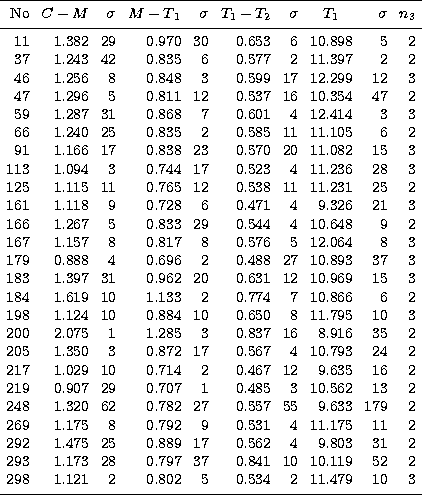
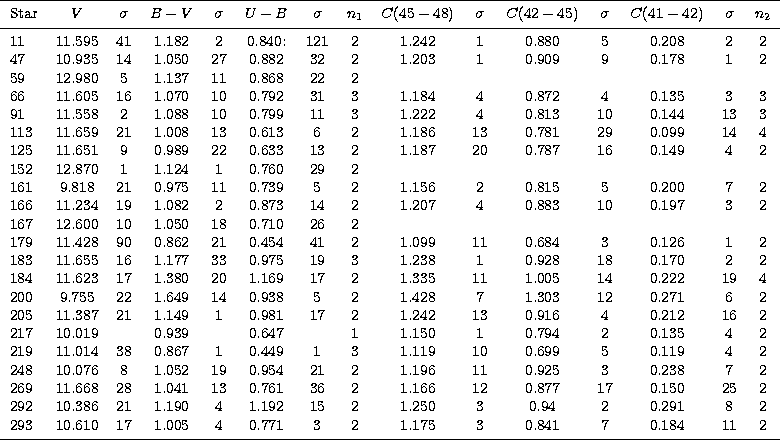
The observed UBV, DDO and Washington photometric data together with their
mean internal errors  , in units of 0.001 mag, are given in Tables 1
and 2 (using the numbering system of Dürbeck 1960), where n1, n2,
and n3 indicate the number of nights on which each star was observed in
the UBV, DDO, and CMT1T2 systems, respectively. Stars #292, 293 and
298 in the tables are those denoted as B, C, and H, respectively, by Dürbeck.
A comparison of the previous photographic V and B-V data of Dürbeck
(1960) and the present photoelectric ones is rather poor, the mean differences
(previous minus present value) being:
, in units of 0.001 mag, are given in Tables 1
and 2 (using the numbering system of Dürbeck 1960), where n1, n2,
and n3 indicate the number of nights on which each star was observed in
the UBV, DDO, and CMT1T2 systems, respectively. Stars #292, 293 and
298 in the tables are those denoted as B, C, and H, respectively, by Dürbeck.
A comparison of the previous photographic V and B-V data of Dürbeck
(1960) and the present photoelectric ones is rather poor, the mean differences
(previous minus present value) being: 
 0.20 (s.d.)
and
0.20 (s.d.)
and  (B-V)= 0.04 0.19 (s.d.). The large standard deviations
are almost entirely due to the low accuracy of Dürbeck's photographic
data. However, if the four most discrepant stars #47, 161, 200 and 248 are
omitted, the mean differences are: V = 0.04 0.10 and
(B-V) = 0.04 0.07.
(B-V)= 0.04 0.19 (s.d.). The large standard deviations
are almost entirely due to the low accuracy of Dürbeck's photographic
data. However, if the four most discrepant stars #47, 161, 200 and 248 are
omitted, the mean differences are: V = 0.04 0.10 and
(B-V) = 0.04 0.07.
Radial velocity observations have been obtained in February 1989, March 1990 and
January 1994 and 1995 with the radial velocity scanner
CORAVEL (Baranne et al. 1979) installed on the 1.54 m Danish telescope at the ESO
observatory at La Silla (Chile). The candidate giants were selected from the list of
Dürbeck (1960). It appears that star #157 (V = 11.04, B-V = 1.31) has been
inadvertently dropped from the list. We shall try to get some observations for this object
because it could be a probable member lying on the ascending giant branch. Usually three
observations were obtained for non variable, member stars, while binaries received more
attention. The radial velocity system is that
defined by Mayor & Maurice (1985) which is a natural system for the southern
CORAVEL. It corresponds to the IAU standard system defined by the faint list (V > 4.3).
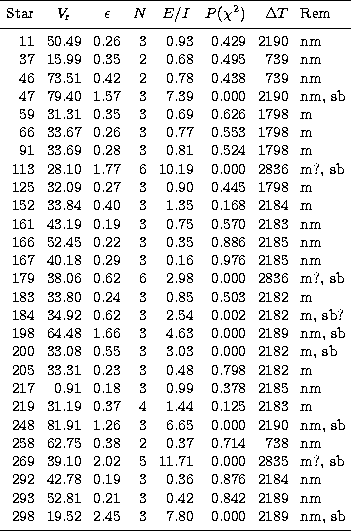
Columns (2) to (7) of Table 3 give
in succession the mean radial velocity and its uncertainty in [km s-1], the number of
radial-velocity observations, the ratio of the external to internal errors (E/I), the
probability  ) that the scatter is due to random noise, the time interval
covered by the observations of each star, and remarks on membership and duplicity
The star designations are from Dürbek (1960). Although most stars have only three
observations, the interval of time, nearly six years and the good agreement between the
observations mean that binaries with periods less than about 5000 days have been detected.
The probability to obtain three radial velocities at the same values over six years is
quite low, although, of course, not zero.
) that the scatter is due to random noise, the time interval
covered by the observations of each star, and remarks on membership and duplicity
The star designations are from Dürbek (1960). Although most stars have only three
observations, the interval of time, nearly six years and the good agreement between the
observations mean that binaries with periods less than about 5000 days have been detected.
The probability to obtain three radial velocities at the same values over six years is
quite low, although, of course, not zero.
 for the red giant members is small: either is smaller than 1.8 km s-1
or only an upper limit has been determined. The two different cases are #179 and 219, with
equal to 3.8 1.8 and 5.6 1.7 km s-1 respectively.
for the red giant members is small: either is smaller than 1.8 km s-1
or only an upper limit has been determined. The two different cases are #179 and 219, with
equal to 3.8 1.8 and 5.6 1.7 km s-1 respectively.
Individual observations, including the Julian dates, are listed in Table 7, which is only available in electronic form.
Copyright The European Southern Observatory (ESO)