

 plane
plane in which each (n,l) multiplet is represented
by a point corresponding to its central frequency.
In such
a diagram, modes of the same n lie along clearly-defined "ridges".
In order to locate the regions of the plane where modes
are likely not to be well-separated from leaks,
we need to know how the linewidth
plane
plane in which each (n,l) multiplet is represented
by a point corresponding to its central frequency.
In such
a diagram, modes of the same n lie along clearly-defined "ridges".
In order to locate the regions of the plane where modes
are likely not to be well-separated from leaks,
we need to know how the linewidth
 varies as a function of
  and l.
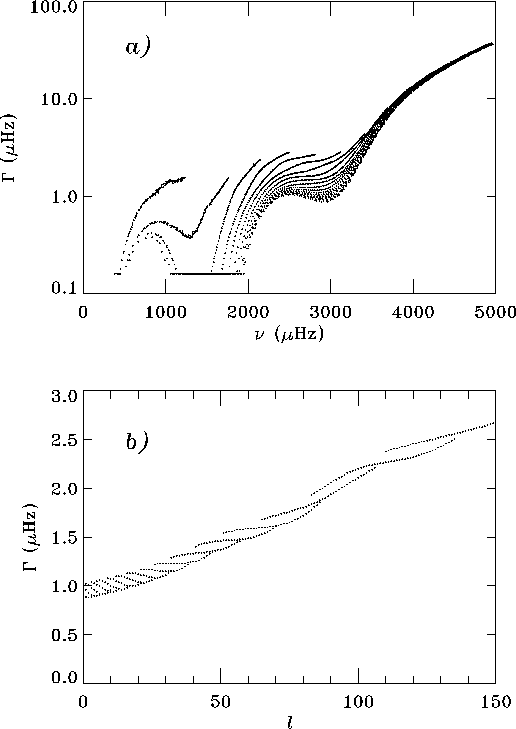 |
Figure 6:
The approximated linewidth a) as a function
of frequency , and b) as a function of l for the frequency range
 Hz (where the width depends only weakly
on ). The fit to is not allowed to be smaller than
half a
frequency resolution bin-width, i.e. 0.32 Hz (where the width depends only weakly
on ). The fit to is not allowed to be smaller than
half a
frequency resolution bin-width, i.e. 0.32  Hz
for the time series used in this plot Hz
for the time series used in this plot |
We illustrate in Fig. 6
the mode linewidths as observed by GONG.
The linewidths have been estimated by a fitting
procedure, as briefly described by Hill et al. (1996).
We have then fitted to these estimated
linewidths , averaged over m, a
sum of two cubic splines in and l.
This provides a smooth approximation to the linewidth, which is more
useful for illustrating and mapping the general trends in the plane than the necessarily noisy estimates for individual modes.
The GONG estimates are unfortunately available only up to l=150,
because the fitting technique used is not appropriate when the
ridges become blended. To fit to higher l's we need to use the
leakage matrix in some way, for example as is already done for the MDI data
or as described here.
It is worth commenting briefly on the linewidths shown in this figure.
Panel (a) shows a strong general trend for the linewidth to increase
with frequency, although with a plateau between about 2200 Hz
and 3000 Hz. This behaviour is well established
observationally, as reported by, for example,
Elsworth et al. (1988), Libbrecht (1988) and
Jefferies et al. (1991),
and can be approximately reproduced in theoretical calculations
of damped, stochastically excited oscillations (e.g. those of
Balmforth & Gough 1990
which take into account the damping associated with the coupling to convection).
It is interesting that the observations indicate that the
linewidth actually decreases slightly with frequency along the
plateau, a feature remarked on by Balmforth & Gough and present
also in their theoretical calculations.
Panel (b) shows the linewidths as a function of l, over a narrow
range of frequency where the frequency dependence is relatively
weak. This brings out the weaker but clearly discernible trend for the
linewidth to increase with degree, consistent with the observations of
Jefferies et al. (1991).
The ridges of nearly connected dots in this figure
correspond to modes of like n. The modes at the low-frequency end of
these ridges are at higher values than one would get if one were to
put a smooth fit through the high-frequency ends: this is because the
figure is over a narrow range 2500 Hz  3000 Hz
where in fact the linewidth decreases slightly with increasing
frequency.
3000 Hz
where in fact the linewidth decreases slightly with increasing
frequency.
As we shall show, except at low l the closest significant
leaks are from modes of the same n but with  .
As illustrated in Fig. 5, leaks of the same l and n, with
.
As illustrated in Fig. 5, leaks of the same l and n, with  ,
have no more than 25 to 30 per cent of the main peak power. In general
these leaks have similar relative power on either side of the main
peak where |m/l| is small, and are weak where |m/l| is large.
Ideally these "m-leaks'' ought to be taken into account in fitting, but
they are usually neglected.
To see how the leaks affect the analysis of power spectra, we need to
examine individual spectra or "
,
have no more than 25 to 30 per cent of the main peak power. In general
these leaks have similar relative power on either side of the main
peak where |m/l| is small, and are weak where |m/l| is large.
Ideally these "m-leaks'' ought to be taken into account in fitting, but
they are usually neglected.
To see how the leaks affect the analysis of power spectra, we need to
examine individual spectra or " '' diagrams that map the power
in spectra of a given l as a function of m and frequency.
Plotting the data for high l spectra in this way reveals that each
"ridge'' of power at a given l and n is flanked by weaker ridges
of power leaked from spectra of adjacent l, as illustrated in Fig. 7.
Further examples of spectra and diagrams can be seen in
Hill et al. (1996).
The solar rotation shifts peaks of different m away from the central
frequency. Roughly speaking, the slope of the (l,n) ridges in
space reflects the mean rotation rate; the slight S-shaped curvature
of the
ridges arises from the differential rotation, which provides important
information about the variation of the rotation rate with latitude and
depth. In order to derive a useful "m-averaged spectrum'' we first need to
remove the m-dependence of the mode frequencies.
'' diagrams that map the power
in spectra of a given l as a function of m and frequency.
Plotting the data for high l spectra in this way reveals that each
"ridge'' of power at a given l and n is flanked by weaker ridges
of power leaked from spectra of adjacent l, as illustrated in Fig. 7.
Further examples of spectra and diagrams can be seen in
Hill et al. (1996).
The solar rotation shifts peaks of different m away from the central
frequency. Roughly speaking, the slope of the (l,n) ridges in
space reflects the mean rotation rate; the slight S-shaped curvature
of the
ridges arises from the differential rotation, which provides important
information about the variation of the rotation rate with latitude and
depth. In order to derive a useful "m-averaged spectrum'' we first need to
remove the m-dependence of the mode frequencies.
 |
Figure 7:
A greyscale plot showing a portion of the GONG month 4
power spectrum for l=150 in the plane |
We can write the difference in frequency between modes that
have the same value of n but degrees l differing by 1 as a derivative
 , although
  is not strictly
speaking a continuous function.
is not strictly
speaking a continuous function.
 |
Figure 8:
An diagram showing contours of
 . Each dot represents the mean
position of an (n,l) multiplet, each ridge of dots corresponding to
a single value of n. Fitting of modes becomes substantially more
difficult outside the . Each dot represents the mean
position of an (n,l) multiplet, each ridge of dots corresponding to
a single value of n. Fitting of modes becomes substantially more
difficult outside the  contour,
which is shown as bold contour,
which is shown as bold |
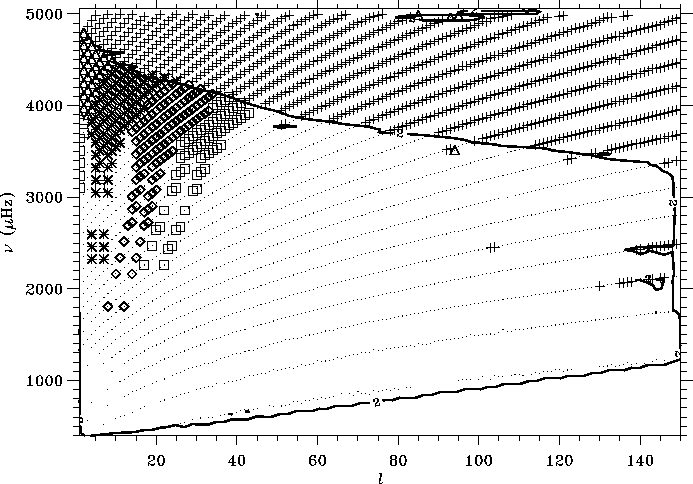 |
Figure 9:
An diagram illustrating the regions where n-leaks are
a potential problem.
The different symbols show modes affected
by leaks within  for various for various  :
for crosses, :
for crosses,  for triangles, for triangles,
 for stars, for stars,  for diamonds and for diamonds and  for squares.
The curve shows the for squares.
The curve shows the  contour contour |
Contours of  are
shown in Fig. 8. We anticipate particular difficulty in fitting peaks
independently when this ratio is less than 2. This occurs at high
frequency (around
are
shown in Fig. 8. We anticipate particular difficulty in fitting peaks
independently when this ratio is less than 2. This occurs at high
frequency (around  Hz), because the linewidths become large,
and also at high degree
(
Hz), because the linewidths become large,
and also at high degree
( )
where
)
where  becomes small. The latter
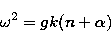
tendency can be seen from the approximate formula for medium and high l,
becomes small. The latter
tendency can be seen from the approximate formula for medium and high l,
 |
(7) |
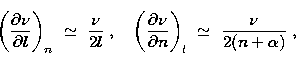
 is a constant of order unity. From this formula,
 |
(8) |
, the
spacing decreases with l. (In fact the
effective gravitational acceleration increases with decreasing turning
point radius for modes of medium and high degree
- because going down through the convection zone the interior mass
decreases more slowly than r-2 increases
- so the above formulae
overestimate and underestimate
 , though they are good for order-of-magnitude
and qualitative behaviour.)
The above approximation implies
, though they are good for order-of-magnitude
and qualitative behaviour.)
The above approximation implies
 Since is of order unity, it follows that at moderate and high
degree (where
Since is of order unity, it follows that at moderate and high
degree (where  ) the frequency spacing between neighbouring n's
is much greater than between neighbouring l's.
The ratio decreases
however as l decreases, so that at low degree it is necessary to
be concerned also with nearby leaks from modes of different order n.
At the lowest degrees, a more appropriate approximation for the
frequencies is the
Tassoul formula
) the frequency spacing between neighbouring n's
is much greater than between neighbouring l's.
The ratio decreases
however as l decreases, so that at low degree it is necessary to
be concerned also with nearby leaks from modes of different order n.
At the lowest degrees, a more appropriate approximation for the
frequencies is the
Tassoul formula
 where
where  Hz and
  are constants,
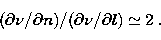
whence it can be seen that
are constants,
whence it can be seen that
 |
(9) |
 (
( ), one needs to be aware of the possibility of
"n-leaks'' - neighbouring modes with different
radial order n - for
), one needs to be aware of the possibility of
"n-leaks'' - neighbouring modes with different
radial order n - for  . Where
 is very close to
 , leaks with
  will be particularly
problematic.
In Fig. 9 we show the modes whose nearest neighbour is within two
linewidths: different symbols are used to show the modes affected
by particular leaks. In addition to all the modes with
will be particularly
problematic.
In Fig. 9 we show the modes whose nearest neighbour is within two
linewidths: different symbols are used to show the modes affected
by particular leaks. In addition to all the modes with
 (crosses), for which the nearest significant
leak generally has l differing from the target degree by one,
this figure indicates that there are difficulties at
moderately low degree due to leakage from modes with different n
(and hence - to have similar frequency to the target mode - with
degrees l differing from the target degree by more than one).
Note that the leakage decreases fairly quickly with
(crosses), for which the nearest significant
leak generally has l differing from the target degree by one,
this figure indicates that there are difficulties at
moderately low degree due to leakage from modes with different n
(and hence - to have similar frequency to the target mode - with
degrees l differing from the target degree by more than one).
Note that the leakage decreases fairly quickly with  , and
is typically less than one per cent of the mode power at
, and
is typically less than one per cent of the mode power at  .Thus leaks from modes with substantially different values of l are
not a principal concern.
.Thus leaks from modes with substantially different values of l are
not a principal concern.
Copyright The European Southern Observatory (ESO)