

Our abundance results are presented in Table 11 (click here) and relative abundances are plotted in Figs. 8 (click here), 9 (click here), 13 and 6 (click here). Below, we shall compare our results with model calculations for the galactic chemical evolution. Sometimes, we shall also quote results of other studies, in particular that of Edvardsson et al. (1993a) (which is grossly compatible in terms of calibration and methods with the present one), but also with others, in particular for Population II dwarf stars.
Table 11: Elemental abundances our programme stars. For each star and
each ion the derived elemental abundance, the line-to-line scatter
(the error in the mean = line-to-line scatter/ )
and the number of lines used in the analysis are given. The table is
continued on the following pages. This table is only published electronically
)
and the number of lines used in the analysis are given. The table is
continued on the following pages. This table is only published electronically
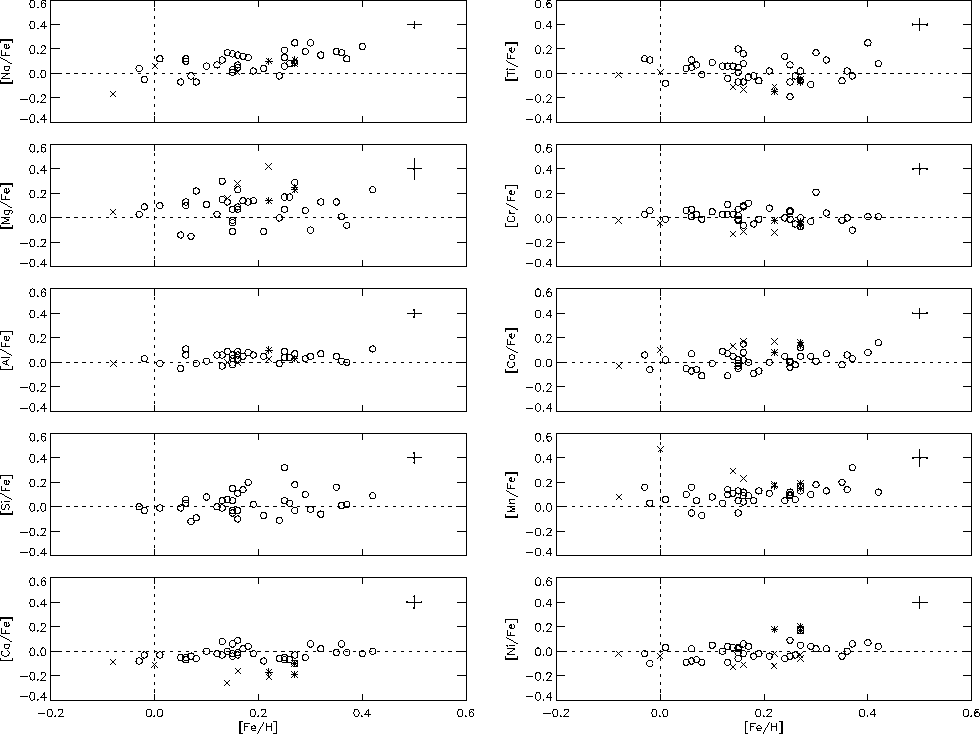
Figure 8: Our abundances relative to Fe.
 symbols denote the five K
dwarf stars while
symbols denote the five K
dwarf stars while  symbols denote the stars from
Barbuy & Grenon (1990)
symbols denote the stars from
Barbuy & Grenon (1990)
Comparison of stellar abundance results from different studies may not always be straightforward. There are many inconsistencies that may confuse the interpretation of such comparisons. The usage of different lines for the abundance analysis, different stellar parameters, different model atmospheres, and, if the study is differential to the Sun, different solar model atmospheres; all of these may lead to offsets and may cause the compiled data to show trends which are unreal. Nevertheless, below we shall compare our abundances with results from other studies to put our results into a broader picture of the galactic chemical evolution.
In observational studies of galactic chemical evolution iron is often used as the reference element. The reason for this is twofold; iron is believed, but this is debated, to be a fair chronometer for the nucleosynthesis in the Galaxy, and the spectra of dwarf stars show many iron lines, easy to measure. The evolutionary picture for iron is complicated by the fact that iron is produced in both core collapse and type Ia supernovae. From this point of view oxygen, which is only produced in core-collapse supernovae, may be preferable as reference element. However, as we will discuss in Sect. 6.2 (click here), oxygen abundances are not trivial to derive. We will therefore conform with common practise and use iron as reference element.
Our resulting iron abundances are well determined with a line-to-line
scatter in [Fe/H] of typically 0.09 dex and a formal error in the
mean iron abundance of typically less than 0.02 dex for each star. We
find that [Fe/H] does not vary with  , i.e.
  ,
Fig. 9. This is an important observation when we consider
other elemental abundances relative to Fe later,
cf. Sect. 6.3 (click here), and a first indication that the mixing of gas
over the
,
Fig. 9. This is an important observation when we consider
other elemental abundances relative to Fe later,
cf. Sect. 6.3 (click here), and a first indication that the mixing of gas
over the  spanned has been quite efficient. The five
K dwarf stars show a similar behaviour as the rest of the sample.
spanned has been quite efficient. The five
K dwarf stars show a similar behaviour as the rest of the sample.
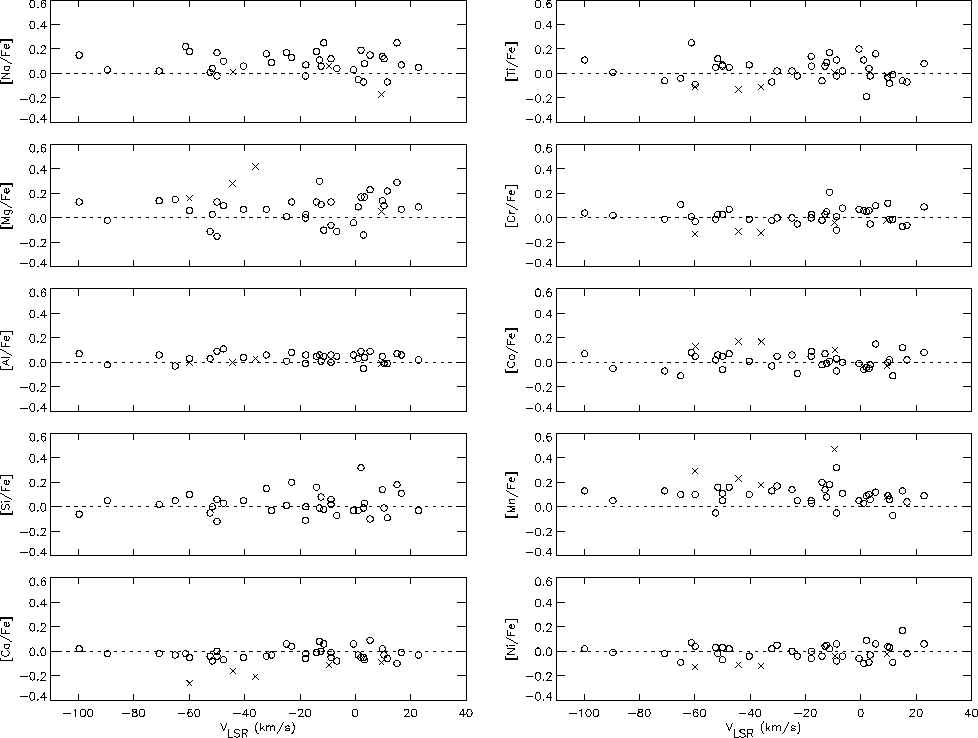
Figure 9: Our abundances relative to . symbols
denote the five K
dwarf stars
Oxygen is the third most abundant element in stars and therefore plays a significant role for stellar opacities and energy generation. Therefore, determination of stellar ages depends strongly on the assumed initial oxygen abundance in the star, see e.g. VandenBerg (1992). Oxygen abundances also affect the determination of time-scales in the galactic chemical evolution and star-formation rates. Thus, it is important to know the amount of oxygen throughout the history of the Galaxy.
We have studied three oxygen criteria; the forbidden line at 6300 Å, the 6158 Å line and the 7774 Å triplet. These criteria are commonly used; however, discrepancies between the abundances derived from the different criteria for the Sun, as well as for other late-type stars, have prevailed in spite of much work (cf. e.g. Eriksson & Toft (1979) and Kiselman (1993) and references therein). Non-LTE and granulation are two proposed sources of the discrepancy between abundances derived from the [OI] line and from the triplet lines.
The formation of the [OI] line is expected not to be subject to departures from LTE. The lower level of the transition is the ground level of the atom and the majority of the oxygen should be found in the ground state of the atom under solar photospheric conditions. There are, however, suspicions that the analysis of the line might be subject to systematic errors due to the adoption of plane parallel stellar atmosphere models since granulation effects are not taken into account in these models, Kiselman & Nordlund (1995).
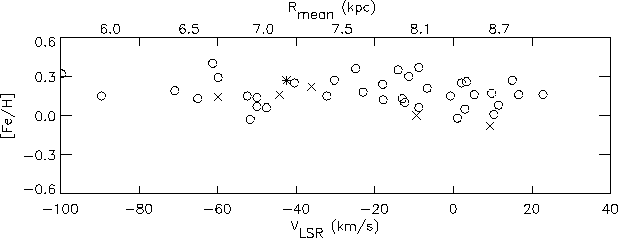
Figure 10: Iron abundances relative hydrogen vs. .
signs denote the five K dwarf stars and HD 87007 is denoted by
a sign
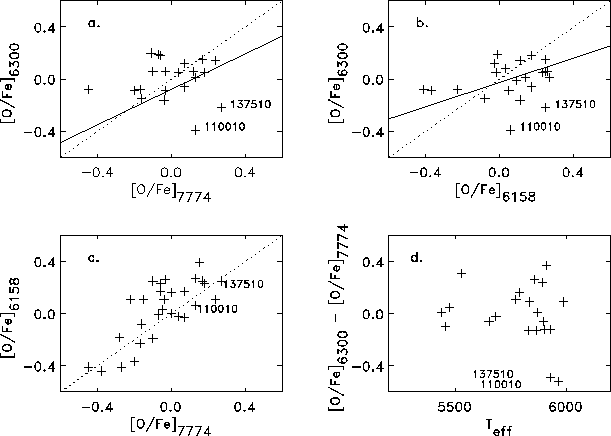
Figure 11: Oxygen abundances derived from different abundance criteria
are compared, panel a), b) and c) On each axis is
the wavelength of the criterion indicated. The 7774 Å oxygen
abundance represents the mean of the results for the three triplet
lines. The one-to-one relations are indicated by dotted lines and the
relations found by Edvardsson et al. (1993a) by solid lines. In panel
d) we show the difference between abundances derived from
6300 Å and the triplet lines as a function of effective temperature
Edvardsson et al. (1993a) found a correlation between oxygen abundances derived from the [OI] line and the abundances derived from the triplet lines as well as a correlation with the abundance derived from the 6158 Å line. These relations are shown, together with our data, in Fig. 11. We do not find a clear correlation between abundances derived from [OI] and the abundances derived from the 7774 Å triplet and 6158 Å lines for our stars. This circumstance, and the fact that the [OI] line is not expected to be affected by departures from LTE, lead us to use only the abundance derived from the [OI] line in our analysis.
When comparing our results with those of Nissen & Edvardsson (1992) we find in general a higher oxygen abundance. This discrepancy can be understood: Nissen & Edvardsson (1992) have used an oscillator strength of -9.75 (Lambert 1978) while ours is -9.84. This means that our abundances should be scaled down by 0.09 dex to be put on the same scale as the Nissen & Edvardsson (1992) abundances.
Three of our stars, HD 37986, HD 77338 and HD 87007, have previously been
studied by Barbuy & Grenon (1990). These authors derive oxygen
abundances and metallicities for a group of 11 dwarf stars. The stars
were selected on the basis of their kinematics and claimed to
represent the "local bulge population''. The stars fell clearly above
the oxygen trend expected from simple models of galactic chemical
evolution (their Fig. 1). The results were interpreted as possible
evidence for a rapid, and probably early, enrichment of the gas in the
galactic Bulge. For most of the 11 stars in their study,
Barbuy & Grenon (1990) derived the same abundance from the forbidden line as
from the triplet lines. This is not the case for the majority of the
stars in our study, see Fig. 11. As shown in Table
12 (click here), for the three stars in common with
Barbuy & Grenon (1990), we find that our iron abundances are lower by 0.2 dex as
compared to their results, while the oxygen abundances derived from
the triplet lines stay the same relative to iron. The largest
discrepancy in derived oxygen abundance is found for the forbidden
line in HD 87007. Unfortunately, the error in our determination of this
abundance is rather large. The spectrum is one of our poorer, with a
S/N of only  80. The estimated error in [O/H] from noise might
then be as large as 0.5 dex. Thus, it is possible that the high
abundance derived by us from the forbidden line for HD 87007 is due to
errors. For the two other stars the forbidden oxygen line was,
unfortunately, heavily obscured by telluric lines and could not be
used.
80. The estimated error in [O/H] from noise might
then be as large as 0.5 dex. Thus, it is possible that the high
abundance derived by us from the forbidden line for HD 87007 is due to
errors. For the two other stars the forbidden oxygen line was,
unfortunately, heavily obscured by telluric lines and could not be
used.
| ID | HD 37986 | HD 77338 | HD 87007 | ||||||
| [Fe/H] | 0.27 | 0.22 | 0.27 | ||||||
| [M/H] | 0.47 | 0.45 | 0.43 | ||||||
[O/Fe] | 0.54 | ||||||||
| 0.15 | 0.20 | 0.00 | |||||||
[O/Fe] | 0.15 | 0.29 | 0.27 | ||||||
| 0.23 | 0.20 | 0.20 | |||||||
[O/Fe] | 0.39 | -0.04 | 0.27 | ||||||
|
|
was not measured by them
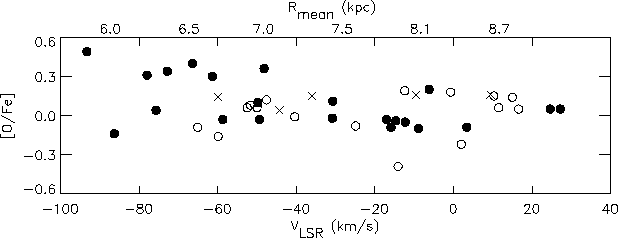
Figure 12: Oxygen abundances,  and this work and
 Nissen & Edvardsson (1992), as
function of .
At the top of
the figure is the mean galactocentric distance,
Nissen & Edvardsson (1992), as
function of .
At the top of
the figure is the mean galactocentric distance,  2 kpc, indicated for different
velocities. The relation between and is
taken from Fig. 1 in Edvardsson et al. (1993b). The star with the lowest
oxygen to iron abundance ratio is HD 110010
2 kpc, indicated for different
velocities. The relation between and is
taken from Fig. 1 in Edvardsson et al. (1993b). The star with the lowest
oxygen to iron abundance ratio is HD 110010
We only have access to velocity data for one of the stars, HD 87007
(Barbuy, private communication). It has a velocity of
-42.5 km s-1 which means that it would not satisfy the velocity
criteria of our high-velocity sample designed to represent the inner
part of the disk. The high  velocity (radial velocity in
the galactic plane of symmetry) of the star, however, gives a total
spatial velocity which fulfils the requirement of membership in our
high velocity sample. Castro et al. (1997) have studied 9 other
high velocity stars from the work by Grenon (1989). Their
results support our results. It is, however, difficult to make a
clear comparison since velocity data for these stars have not been
published.
velocity (radial velocity in
the galactic plane of symmetry) of the star, however, gives a total
spatial velocity which fulfils the requirement of membership in our
high velocity sample. Castro et al. (1997) have studied 9 other
high velocity stars from the work by Grenon (1989). Their
results support our results. It is, however, difficult to make a
clear comparison since velocity data for these stars have not been
published.
In Fig. 12 we plot [O/Fe] vs. for our stars as
well as the, generally, more metal-poor disk stars in the sample of
Nissen & Edvardsson (1992). For the combined sample one may trace a
tendency for [O/Fe] to decrease with increasing , but
this is not shown by our sample alone. From Fig. 13 (click here) we
conclude that the oxygen abundance in general keeps declining relative
to the iron abundance also for  0.1 dex. This is not
inconsistent with what Nissen & Edvardsson (1992) found in this
metallicity range.
0.1 dex. This is not
inconsistent with what Nissen & Edvardsson (1992) found in this
metallicity range.
Oxygen is produced in massive stars exploding as supernovae of types
II, Ib and Ic, Woosley & Weaver (1995) and
Thielemann et al. (1996).
Therefore, oxygen is expected to rapidly build up at early times in
the Galaxy or in any region which has experienced substantial star
formation "lately''. [O/Fe] starts to decline once the iron
producing supernovae start contributing more significantly to the
enrichment of the interstellar gas. This decline starts at
[Fe/H] dex in the galactic disk, or at even lower metallicities.
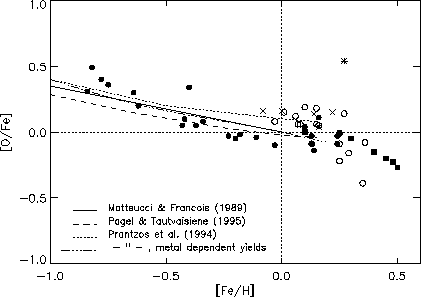
Figure 13: Oxygen abundances from this work, symbols, and from
Nissen & Edvardsson (1992), symbols. symbols
denote our five K dwarf stars, symbol HD 87007 and the
filled boxes data from Castro et al. (1997). The star with lowest [O/Fe] is HD 110010
In Fig. 13 (click here) we compare our data with three different theoretical models of the galactic chemical evolution. The model by Matteucci & François (1989) clearly shows the envisaged decline in [O/Fe] after [Fe/H] = -1.0 dex, i.e. when supernovae type Ia start to contribute to the enrichment of the gas. This can be compared with a more recent model, taking the effects of metallicity dependent supernova yields into account, by Prantzos & Aubert (1995). The difference between the two models by Prantzos & Aubert (1995) is not large for lower metallicities but from around solar metallicity there is an increasing discrepancy between their two models. If this suggested trend continues to higher [Fe/H] the model using metallicity dependent yields would be favoured by our data. The model by Pagel & Tautvaisiene (1995) is a simple analytic model, which assumes supernovae type Ia to give their yields after a fixed time delay. In spite of its simplicity it fits the data remarkably well and may suggest that the basic understanding of the processes involved is correct.
Tsujimoto et al. (1995) studied the abundance gradients in the galactic disk by means of a viscous disk model of galactic chemical evolution. As can be seen in their Fig. 8 differences in oxygen abundances as a function of radial distance from the galactic centre are predicted to be so small that it would hardly be possible to resolve this in a study as ours where such a small part of the radius is spanned. This is compatible with our results in Fig. 13. We note that their model predicts (their Figs. 7 and 8) [O/Fe] vs. [Fe/H] to flatten out at solar metallicities. If this suggested trend is continued when the models are further evolved, it would be difficult to reconcile them with our data, and with the results by Castro et al. (1997).
One of the aims with our study was to determine whether or not the upturn of [Na/Fe] vs. [Fe/H] found by Edvardsson et al. (1993a) is real and if so, if it is an effect of a mixture of stars from different populations, cf Figs. 8 (click here), 9 (click here), 14 (click here) and 15. We confirm that the upturn is real. However, the upturn is less steep in our study than what one could trace from the scattered diagram of Edvardsson et al. (1993a).
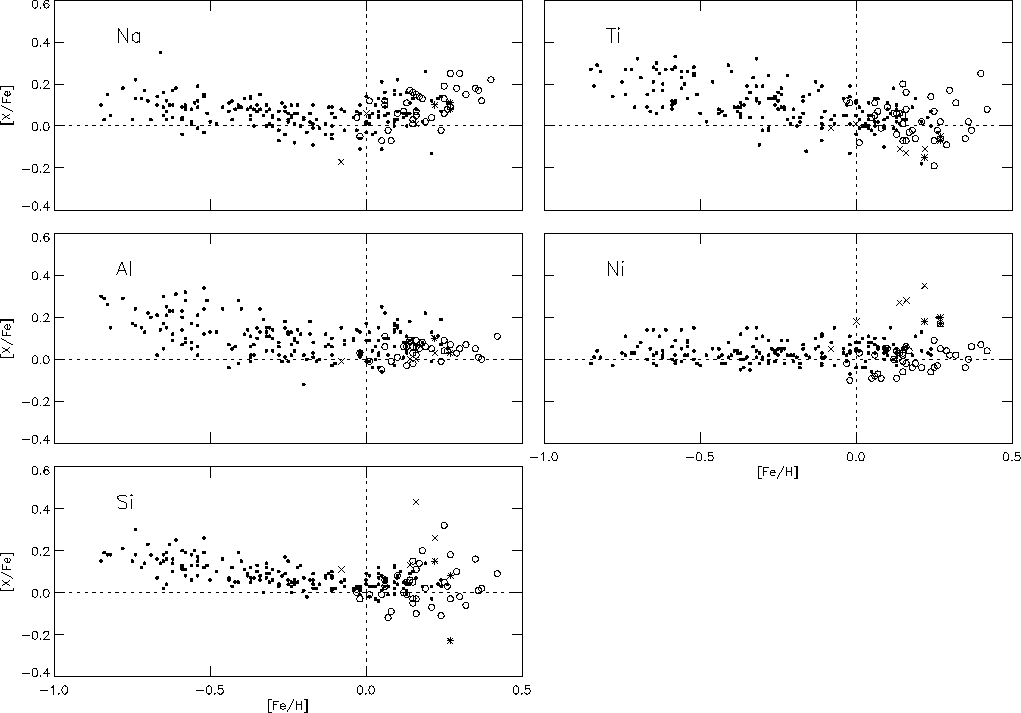
Figure 14: Abundances from this study compared with results from
Edvardsson et al. (1993a). On the vertical axes we give [X/Fe] where X
is the element indicated in the upper left corner of each
panel. symbols denote our results except the five K dwarf stars which
are denoted by symbols and the three stars from
Barbuy & Grenon (1990) which are denoted by symbols. Results from Edvardsson
et al. are
denoted by  symbols
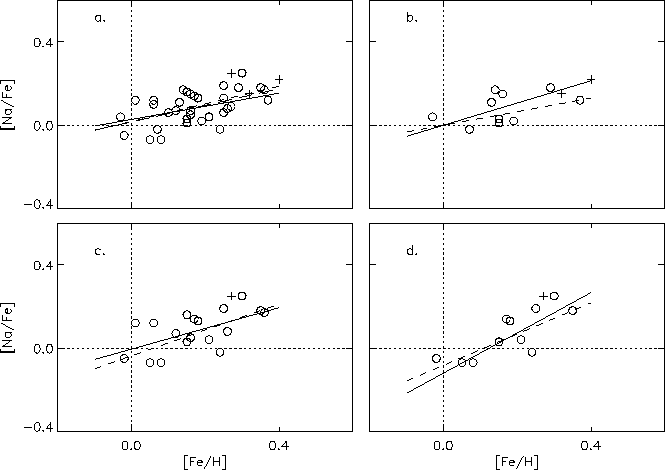
Figure 15: In this figure we explore the different velocity samples as
indicators of differences in galactic chemical evolution in adjacent
parts of the galactic disk. The five K dwarf stars and the stars from
Barbuy & Grenon (1990) are excluded from this discussion. In panel
a) we show [Na/Fe] for all stars. Error-bars are smaller than the
symbols. In panel b) are the stars with  km s-1 and/or
 km s-1 shown. In panel c) stars with
  km s-1 and in panel d) stars with
  km s-1. Solid
lines show the result of a weighted linear least square fit to the
data and the dashed lines show least distance fits to the same
data. Stars denotes by + symbols have sodium abundance determined from
one line only, and are not used in the error weighted fits
km s-1. Solid
lines show the result of a weighted linear least square fit to the
data and the dashed lines show least distance fits to the same
data. Stars denotes by + symbols have sodium abundance determined from
one line only, and are not used in the error weighted fits
In Fig. 15 we have divided our sample into stars
representing the disk interior to the solar orbit and the solar orbit
and made linear least-square fits to the data. In panel a. we show all
47 stars and a least-square fit with the K dwarf stars and the stars
from Barbuy & Grenon (1990) excluded. In panel b. we show the stars
that represent the disk interior to the solar orbit. There is no
appreciable difference found between this sample and the whole
sample. In panel c. and d. we have defined the solar orbit sample in
two different ways. In c. it contains all stars with  km s-1 and in d. with
  km s-1. The sample in panel
c. also has a behaviour indistinguible from that of panel a. However,
the km s-1 seem to show a somewhat steeper trend.
km s-1. The sample in panel
c. also has a behaviour indistinguible from that of panel a. However,
the km s-1 seem to show a somewhat steeper trend.
An interesting question is now what difference in
[Na/Fe] one would
have reason to expect for stars formed at different . Using
the data of Edvardsson et al. (1993a)
we estimate that the minimum
value of  is about 0.05 dex/kpc. Extrapolating
this to the metal-rich stars and to
is about 0.05 dex/kpc. Extrapolating
this to the metal-rich stars and to  kpc one finds at
the most a difference of 0.1 dex between our two samples. Implicit in
this assumption is then that the population of metal-rich stars at 6
kpc, which is very sparsely represented in the sample of
Edvardsson et al. (1993a), is not qualitatively different from that in the solar
neighbourhood. The results obtained in the present study supports this
and indicate that the difference in [Na/Fe] is, in fact, at the most 0.05
dex.
kpc one finds at
the most a difference of 0.1 dex between our two samples. Implicit in
this assumption is then that the population of metal-rich stars at 6
kpc, which is very sparsely represented in the sample of
Edvardsson et al. (1993a), is not qualitatively different from that in the solar
neighbourhood. The results obtained in the present study supports this
and indicate that the difference in [Na/Fe] is, in fact, at the most 0.05
dex.
In this connection, one should also note that orbital diffusion may
well mask the possible differences between stars formed at 6 kpc and 8
kpc. E.g., stars of solar age in an orbit with  kpc
may have migrated from an orbit with
kpc
may have migrated from an orbit with  kpc (cf. Wielen
et al. 1996). The mixture of stars with different original orbits, in
combination with a radial galactic gradient of [Fe/H], was proposed by
Wielen et al. (1996) to explain the unexpectedly high scatter in [Fe/H] of
0.2 dex for solar type stars, with similar age and similar present
, found by Edvardsson et al. (1993a).
From the work of
Wielen et al. (1996) we estimate that two samples of stars with
kpc (cf. Wielen
et al. 1996). The mixture of stars with different original orbits, in
combination with a radial galactic gradient of [Fe/H], was proposed by
Wielen et al. (1996) to explain the unexpectedly high scatter in [Fe/H] of
0.2 dex for solar type stars, with similar age and similar present
, found by Edvardsson et al. (1993a).
From the work of
Wielen et al. (1996) we estimate that two samples of stars with  and 6.5 kpc, respectively, would then be mixed by orbital diffusion
so much that the population effects in abundances only would show up
to about half the expected size as compared with the situation if
orbital diffusion is not present. Although the reason for the great
inhomogeneities in the gravitational potential, needed to account for the
orbital diffusion of this magnitude, is not known, we conclude that the
effects looked for by dividing the total sample of stars according to
the velocity criteria used here, might be diminished considerably by
this phenomenon.
and 6.5 kpc, respectively, would then be mixed by orbital diffusion
so much that the population effects in abundances only would show up
to about half the expected size as compared with the situation if
orbital diffusion is not present. Although the reason for the great
inhomogeneities in the gravitational potential, needed to account for the
orbital diffusion of this magnitude, is not known, we conclude that the
effects looked for by dividing the total sample of stars according to
the velocity criteria used here, might be diminished considerably by
this phenomenon.
Aluminium is produced in heavy single stars, with  .
The scatter, as well as the internal line-to-line scatter, in our
data is considerably smaller than in Edvardsson et al. (1993a).
The upturn
in [Al/Fe] vs. [Fe/H] indicated in their data is not obviously present
in ours, see Fig. 14 (click here). The two studies use different lines for
the abundance analysis. The small scatter in [Al/Fe] for [Fe/H] >
0.0 dex is also evident in Morell (1994). The lines used by
Morell (1994) and us, 6696.03 Å and 6698.66 Å, are situated
in a part of the stellar spectrum which is clean. Thus, we expect no
problems with continuum fitting and blends and errors arising
from measurements
of the line strengths should be negligible. The trend in
Fig. 14 (click here) and its similarity with, e.g., that of Ca
(Fig. 18 (click here)) suggests a similar origin in core-collapse supernovae.
.
The scatter, as well as the internal line-to-line scatter, in our
data is considerably smaller than in Edvardsson et al. (1993a).
The upturn
in [Al/Fe] vs. [Fe/H] indicated in their data is not obviously present
in ours, see Fig. 14 (click here). The two studies use different lines for
the abundance analysis. The small scatter in [Al/Fe] for [Fe/H] >
0.0 dex is also evident in Morell (1994). The lines used by
Morell (1994) and us, 6696.03 Å and 6698.66 Å, are situated
in a part of the stellar spectrum which is clean. Thus, we expect no
problems with continuum fitting and blends and errors arising
from measurements
of the line strengths should be negligible. The trend in
Fig. 14 (click here) and its similarity with, e.g., that of Ca
(Fig. 18 (click here)) suggests a similar origin in core-collapse supernovae.
Due to the large line-to-line scatter in our magnesium data it is not possible to determine here if the large scatter found by Edvardsson et et al. (1993a) is real or not. We note, however, that we get roughly the same amount of scatter as they do, Fig. 16 (click here). There is no evidence in our data for a correlation between kinematics and [Mg/Fe] ratios of the stars, Fig. 9 (click here).
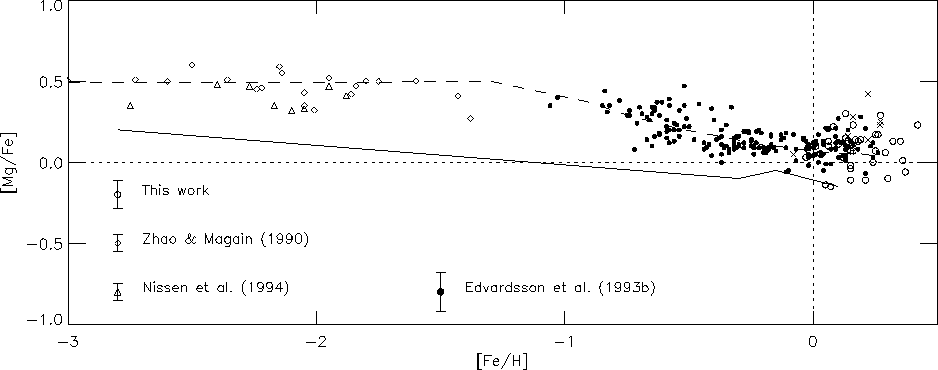
Figure 16: Magnesium vs. iron abundances from several studies, as given
in the figure, as well as model calculations of the galactic chemical
evolution from Pagel & Tautvaisiene (1995) (dashed line) and
Timmes et al. (1995) (solid line). signs denote the K dwarf
stars in our sample. Indicated error bars refer to the error in the
mean
Magnesium is, like oxygen, usually assumed to be formed only in core-collapse supernovae through hydrostatic carbon burning. Timmes et al. (1995) are not so successful in describing the over-all evolution of magnesium abundances in the Galaxy. This may suggest that the production of Mg is not fully understood at present. The simple-minded model with the delayed yield formalism is more successful in this respect, Pagel & Tautvaisiene (1995).
We only use two lines to determine silicon abundances while Edvardsson et al. (1993a) used eight lines. We find a much larger scatter in our data than they do, Fig. 14 (click here). It has not been possible, from our data, to determine the origin of neither the line-to-line scatter nor the star-to-star scatter. When inspecting the lines one by one no line seems to stand out in terms of derived abundances. Nor do we find any signs of the scatter to be an effect of different stellar populations mixing, see e.g. Fig. 9 (click here).
Comparison of our calcium abundances with those of Edvardsson et al. (1993a), in Fig. 17 (click here), confirms their finding that the [Ca/Fe] flattens out towards higher metallicities. Also, there is no obvious difference between stars with different galacto-centric mean distances, Fig. 9 (click here).
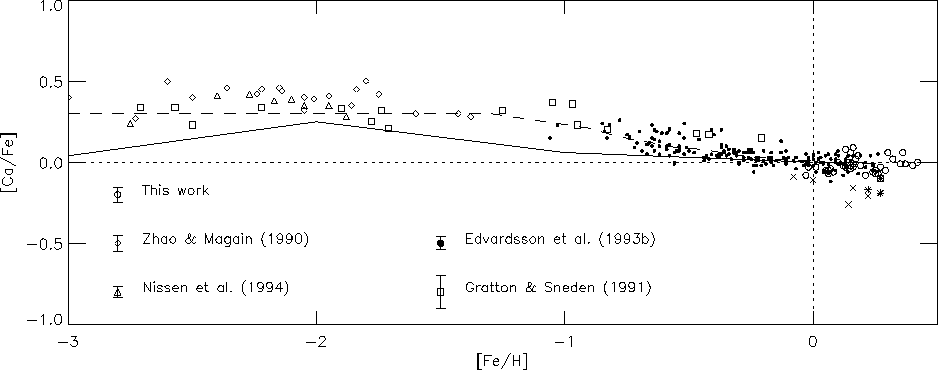
Figure 17: Calcium abundances from several studies, as given in the
figure, as well as model calculations of the galactic chemical
evolution from Pagel & Tautvaisiene (1995) (dashed line) and
Timmes et al. (1995) (solid line). Typical error bars are indicated
for each study. symbols denote K dwarf stars and the stars in common with
Barbuy & Grenon (1990)
As is evident from Figs. 8 (click here) and 18 (click here) the K
dwarf stars exhibit a behaviour which is very different from the
rest of the sample. They seem to have a mean calcium relative to
iron abundance  dex lower than the mean abundance for the
rest of the stars. When plotting [Ca/Fe] as a function of effective
temperature we see that the stars with low Ca abundances have the
lowest effective temperatures, cf. Fig. 18 (click here).
dex lower than the mean abundance for the
rest of the stars. When plotting [Ca/Fe] as a function of effective
temperature we see that the stars with low Ca abundances have the
lowest effective temperatures, cf. Fig. 18 (click here).
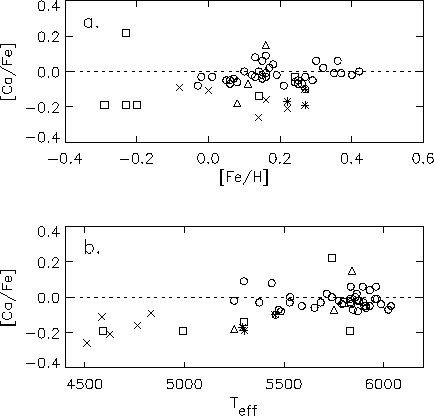
Figure 18: Calcium abundances for our stars, except the K dwarf stars,
symbols. The K dwarf stars are denoted by symbols. Abundances for
solar-type stars from Abia et al. (1988),  symbols,
and Gratton & Sneden (1987),
symbols,
and Gratton & Sneden (1987),
 symbols, and the stars from Barbuy & Grenon (1990),
symbols
symbols, and the stars from Barbuy & Grenon (1990),
symbols
In a high resolution, high signal-to-noise abundance study of dwarfs and giants in the disk by Abia et al. (1988), there are six dwarf stars in the same metal and effective temperature range as our K dwarf stars. In Fig. 4a in Abia et al. (1988) the same features as in Fig. 18 (click here) can be seen, i.e. cool, metal-rich stars show up as underabundant in calcium. In another study, Gratton & Sneden (1987), of light elements in field disk and halo stars we also find support for such a behaviour of calcium in cool dwarf stars.
The key to these low [Ca/Fe] measures may lie in overionization. Drake (1991) performed non-LTE calculations for calcium for a range of stellar parameters. He showed that the difference between an abundance derived under non-LTE and LTE conditions varies strongly with effective temperature and surface gravity, and less strongly with metallicity. Drake (1991) finds that the non-LTE effect on abundances of Ca in G and K dwarf stars increase considerably with decreasing effective temperature. From his Figs. 4, 7 and 8, we estimate the correction factor for weak lines in a dwarf star of at least solar metallicity with an effective temperature of 4500 K to be on the order of 0.3 dex. Such an adjustment would indeed put the K dwarf stars right on the line, [Ca/Fe] = 0.0 dex. This suggests that the calcium abundance may vary in lockstep with the iron abundance also for metal-rich K dwarf stars.
[Ti/Fe] was shown by Edvardsson et al. (1993a) to be a slowly decreasing function of [Fe/H]. The decline may continue also for higher iron abundances. We use 10 - 12 lines to derive titanium abundances for our stars, while Edvardsson et al. (1993a) used four. In spite of our, presumably, smaller random errors in the abundance determination for each star, as is shown in Fig. 14 (click here) we still find the same and comparatively large scatter in the abundances found by Edvardsson et al. (1993a).
Inspection of derived stellar abundances as a function of excitation
energy for the lower level in the transition for each line indicated
no presence of non-LTE effects or blends. However, also for titanium
we found no evidence that the large star-to-star scatter should be a
result of a mixing of stars with different mean-perigalactic
distances, i.e. different velocities, see
Fig. 9 (click here).
Abundances derived from ScI lines are unreliable and we therefore only present abundances determined from ScII lines, Fig. 19 (click here). Scandium exhibits some scatter but seems to vary in lockstep with iron.
For vanadium the atom is represented by two lines and the ion by one. We present the data derived from lines of the atom. Also vanadium appears to vary in lockstep with iron over the metallicity range studied.
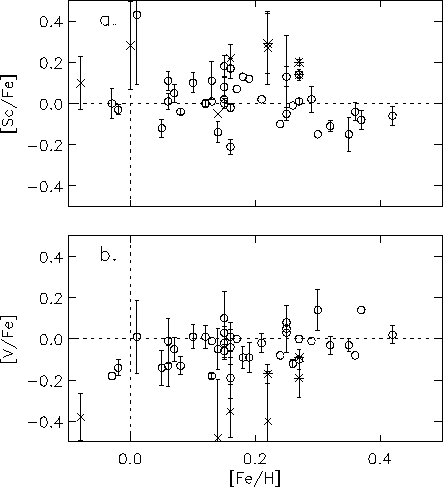
Figure 19: Scandium abundances from ScII and vanadium abundances
from VI. Error bars indicate the error in the mean. Stars with no
error bar means that the abundance was derived from a single
line. symbols denote K dwarf stars and symbols the stars from
Barbuy & Grenon (1990)
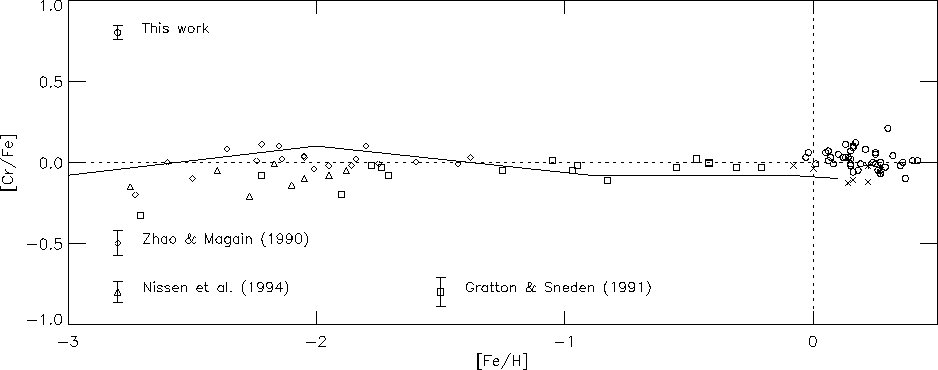
Figure 20: Chromium data from several sources, as given in the figure,
showing the galactic chemical evolution of chromium. The
solid line is from Timmes et al. (1995). The chromium rich star in
our sample is HD 87646. The error bars indicate the error in the mean.
symbols denote our K dwarf stars and the stars in common with
Barbuy & Grenon (1990). Chromium was not
studied by Edvardsson et al. (1993a)
For the most metal-rich stars chromium, as well as other iron peak elements, varies in lockstep with iron, Fig. 8 (click here). The overall evolution of [Cr/Fe] seems to be well described by Timmes et al. (1995) using the supernova yields by Woosley & Weaver (1995), Fig. 20 (click here). The flatness of the relation between [Cr/Fe] and [Fe/H] can be understood as a consequence of that massive stars with solar initial metallicities produce enough chromium to balance the iron production by SNIa, cf. Timmes et al. (1995).
Few studies of stellar abundances have been made for these elements. Manganese abundances were measured by Gratton (1989) for 25 metal-poor giants and dwarfs. Cobalt abundances were obtained by Gratton & Sneden (1991) for 17 metal-poor (mostly) giant and dwarf stars and by Ryan et al. (1991) for 19 dwarf and giant stars.
Five lines of the manganese atom were used for determination of
abundances, three weak and two stronger lines. [Mn/Fe] scales with
[Fe/H], but with a tendency to increase for  dex, Fig. 21. This increase seems to continue beyond
  dex.
We use seven lines arising from the atom to determine cobalt
abundances. From our data cobalt seems to vary in lock-step with iron
for
dex.
We use seven lines arising from the atom to determine cobalt
abundances. From our data cobalt seems to vary in lock-step with iron
for  dex.
dex.
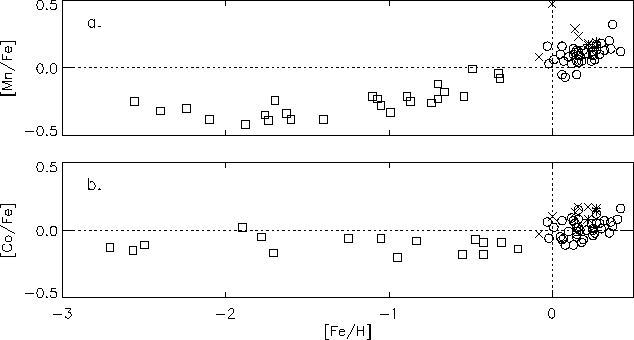
Figure 21: Manganese, panel a), and cobalt, panel b),
abundances from this work, , , and symbols, and
from Gratton (1989) (manganese) and
Gratton & Sneden (1991)
(cobalt), symbols
Manganese and cobalt belong to the group of iron-peak elements. These elements are thought to be formed during explosive silicon burning in supernova explosions and nuclear statistical equilibrium (Woosley & Weaver 1995).
Timmes et al. (1995) find that the rise in [Mn/Fe] vs. [Fe/H] from
[Fe/H] dex is due to the over-production of manganese in
supernovae type Ia and in heavy stars with solar metallicity, as
compared with the iron production, while for cobalt the production of
iron in supernovae type Ia is balanced by production of cobalt in
supernovae resulting from massive stars with initially solar
metallicity.
We have used 12 lines from the nickel atom to obtain abundances; Edvardsson et al. (1993a) used 20 lines. Like Edvardsson et al. (1993a) we find that nickel varies in lock-step with iron, and this continues also for higher metallicities, Fig. 14. For the stars in common between the studies the nickel abundances derived are in excellent agreement, although our study does not show the slight offset found by Edvardsson et al. (1993a).
Here, we also note an interesting behaviour of the K dwarf stars, namely that they show larger nickel abundances than the rest of the sample. The large number of lines together with the fact that the lower excitation energies for the lines span a range of values (1.9-5.3 eV) and that the formal error for each star is small makes departures from excitation equilibrium an unlikely explanation for this effect.
Overionization, for most stars but less for the cool ones, or blends are possible but neither very probable explanations. The phenomenon needs further systematic study.
Most of the heavy elements (A>70) are formed through the r- and s-processes. For some of them one of the processes contributes much more than the other. The s-process contributes most, for the solar system composition, to Y (73%) and Zr (79%) while Eu is to 90% formed in the r-process, according to Anders & Grevesse (1989). Eu is one of the few r-process elements with clean lines observable in the visual part of stellar spectra. Therefore, it is well suited for studies of the sites for the r-process. The relative abundances of s-elements produced in thermally pulsing asymptotic giant branch stars are set by the degree of the exposure to neutrons. Heavier neutron flux enhances the abundances of the heavier elements (Ba, Nd, Hf) relative to the lighter ones (Y, Zr, Mo). Molybdenum is formed by a mixture of processes (p- , r- and s-processes), see Anders & Grevesse (1989).
From this knowledge one would expect the r-process elements to have high abundances in old stars and show a declining trend when compared to iron. This is indeed seen for europium, see figures and discussions in Mathews et al. (1992) and Woolf et al. (1995). For the s-process elements, on the other hand, one would expect old stars to have low s-element abundances while the more recently formed stars would show an increase in their s-element abundance, due to the long time scales for the evolution of the s-process sites. Such a tendency was also traced by Edvardsson et al. (1993a).
Results
Our stellar spectra contain few lines of these heavy elements that are accessible in the visual and may be securely used as abundance criteria.
We have derived abundances for a number of s- and r-process elements, using a small number of YII lines of suitable strength, one line each for ZrI and MoI, two for LaII and one each for NdII, {EuII and HfII. We find that the metal-rich stars have roughly solar abundances of these elements relative to iron, however, with some possible departing trends.
Up to [Fe/H] 0.2 dex we confirm the result by
Edvardsson et al. (1993a)
that Y varies in lock-step with iron. For the more metal-rich stars,
however, there may be a decline in [Y/Fe] (see Fig. 22 (click here)).
The results may, however, be due to possible effects of overionization
in yttrium.
As is clear from Fig. 22 (click here) that for Zr there is probably a systematic trend with effective temperature, resulting in a large scatter (or even a division of stars into groups) and unreliable abundances. Blends may may also contribute to this scatter. The results for our stars do generally indicate lower Nd abundances than those of Edvardsson et al. (1993a) and again a decrease of [Nd/Fe] with increasing [Fe/H].
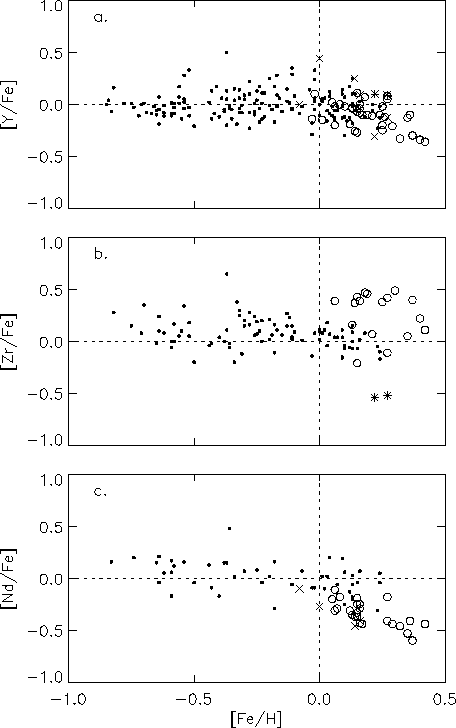
Figure 22: Comparison of data from this study and
from Edvardsson et al. (1993a) for three elements, yttrium, zirconium
and neodymium. symbols denote our abundances, symbols
denote the K dwarf stars, symbols the stars from Barbuy &
Grenon (1990) and symbols denote abundances from
Edvardsson et al. (1993a)
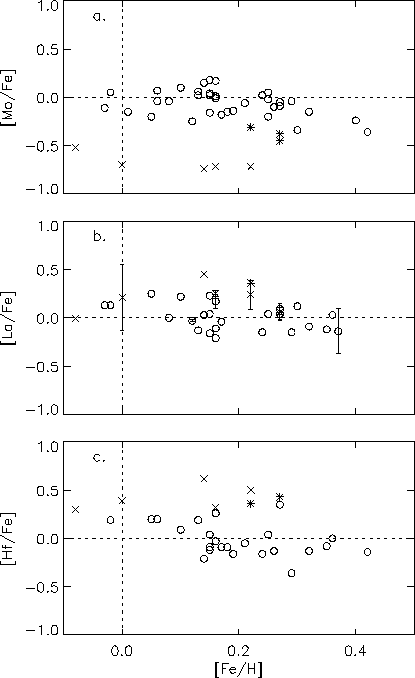
Figure 23: Molybdium, lanthanum and hafnium abundances relative to
iron. symbols denote K dwarf stars and symbols the
stars from Barbuy & Grenon (1990)
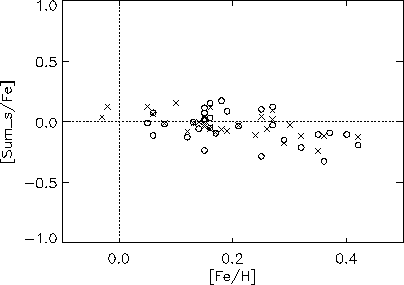
Figure 24: The sums of light and heavy s-process elements are
shown. The sums has been weighted as follows 
 . Only stars with at least two
of the elements in the sum measured are shown. symbols denote the sum
of the light s-process elements and symbols denote the heavy elements
. Only stars with at least two
of the elements in the sum measured are shown. symbols denote the sum
of the light s-process elements and symbols denote the heavy elements
For molybdenum, lanthanum and hafnium we have no studies to compare with and can therefore not say very much about the general evolution. The molybdenum abundances are derived from one MoI line. Mo and Hf, and probably also La, however, show the familiar pattern, ascribed to overionization in the K dwarf stars.
In conclusion, the abundances of Mo, La, and Hf seem to roughly vary in lock-step with Fe, however, with some indications that the abundance ratios decrease with increasing [Fe/H].
In order to improve the statistics we have derived two quantities,
 , and
, and  . The weights in these expressions reflect the
number of spectral lines measured of each element. The results are
plotted vs. [Fe/H] in
. The weights in these expressions reflect the
number of spectral lines measured of each element. The results are
plotted vs. [Fe/H] in
Fig. 24 (click here), where the K dwarfs have
been excluded. A downward slope of roughly the same magnitude for the
"light'' and the "heavy'' elements is seen. This trend is in fact also
present in most of the corresponding diagrams for the individual
elements, although the scatter in larger, see Figs. 22 (click here) and
23 (click here). A slope of this magnitude can also be traced for the
s-elements in Edvardsson et al. (1993a), Fig. 22 (click here).
A tendency of this type may, if true, indicate that s-elements enrichment occurs less frequently in metal-rich AGB stars. One may speculate that this might be because mass loss could finish their evolution earlier than for more metal-poor stars.
In some studies the iron abundance derived from FeII lines are preferred as reference element for europium rather than abundances derived from FeI lines. From our data this does not seem to be an obvious choice. Particularly, this is not so for the K dwarf stars, since europium with its low ionization energy, 5.7 eV, will remain highly ionized for all our stars irrespective of the effective temperature while almost all iron will be in the neutral state in the cool stars. Thus abundances derived from FeII for these stars would be vulnerable to departures from LTE in the ionization equilibrium. In our study we derive iron abundances from, in general, more than 30 lines from FeI and from four or three lines from FeII. Thus, also statistically we could expect the atomic abundance to be better determined.
In Fig. 25 (click here) data from Woolf et al. (1995) and our data are plotted with iron abundances derived from FeI and FeII as reference, respectively. Europium shows a declining trend with metallicity from [Fe/H] = -1.0 to 0.0 dex and this trend now seems to continue unchanged for [Fe/H] > 0.0 dex.
Europium is well-correlated with oxygen as well as with the
 -elements, Fig. 26 (click here). This supports the idea that
europium, oxygen and the -elements are all formed in the same
type of events, supernovae type II.
-elements, Fig. 26 (click here). This supports the idea that
europium, oxygen and the -elements are all formed in the same
type of events, supernovae type II.
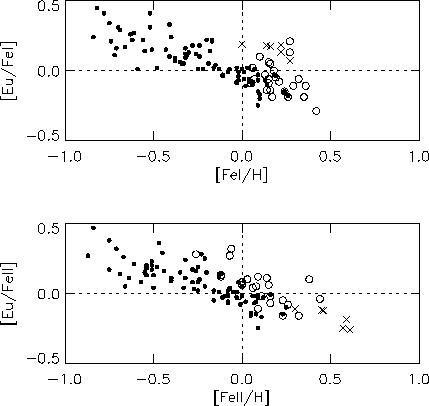
Figure 25: Europium abundances. symbols
this work, symbols K dwarf stars this work, symbols
Woolf et al. (1995). Iron abundances are derived from FeI and
FeII, in the two panels respectively
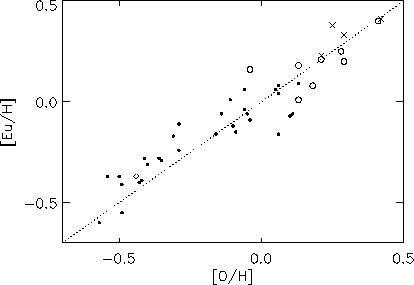
Figure 26: Europium abundances and oxygen
abundances compared. this work (excluding the K dwarf stars),
K dwarf stars, Woolf et al. (1995). The line with slope
+1 is indicated by a dotted line. Oxygen abundances are in our work
derived from the [OI] line at 6300 Å while the oxygen
abundances used together with the europium data from Woolf et al. (1995)
are from Edvardsson et al. (1993a) and are derived (mostly) from the triplet
lines at 7774 Å, scaled to the [OI] abundances using
results from Nissen & Edvardsson (1992)
It should finally be mentioned that the abundance trends (or lack of
trends) discussed here are consistent with the results obtained for 9
solar-type dwarf stars in the interval  dex by
Tomkin et al. (1997). One exception from this, however, is Eu for
which the latter results sooner suggest a slight increase in the
[Eu/Fe] with increasing [Fe/H] on the basis of measurements of the
same Eu lines as used here.
dex by
Tomkin et al. (1997). One exception from this, however, is Eu for
which the latter results sooner suggest a slight increase in the
[Eu/Fe] with increasing [Fe/H] on the basis of measurements of the
same Eu lines as used here.