

The main characteristics for the PLANCK satellite mission as
given by Bersanelli et al. (1996) is a spin
stabilized
spacecraft with a payload consisting mainly of a telescope, a focal plane
assembly and passive and active cooling devices. The telescope is a 1.5 m off-axis
Gregorian system with
the line-of-sight inclined  with respect to the spin axis.
The main characteristics for the payload are listed in Table 1 (click here).
with respect to the spin axis.
The main characteristics for the payload are listed in Table 1 (click here).
| Instrument | Low Frequency (LFI) | High Frequency (HFI) | |||||||
Center frequency,  [GHz] [GHz] | 31.5 | 53 | 90 | 125 | 150 | 217 | 353 | 545 | 857 |
| Detector type | HEMT Radiometers | Bolometers | |||||||
| Number of detectors | 4 | 14 | 26 | 12 | 8 | 12 | 12 | 12 | 12 |
| Angular resolution [arcmin] | 30 | 18 | 12 | 12 | 10.3 | 7.1 | 4.4 | 4.4 | 4.4 |
Bandwidth ( ) ) | 0.15 | 0.15 | 0.15 | 0.15 | 0.37 | 0.37 | 0.37 | 0.37 | 0.37 |
1 sensitivities per pixel for a 2 yr mission
with a 30' beam sensitivities per pixel for a 2 yr mission
with a 30' beam | |||||||||
 (Thermodynamic) [10-6] (Thermodynamic) [10-6] | 5.9 | 3.4 | 4.4 | 10.7 | 0.3 | 0.4 | 1.3 | 8.4 | 465.3 |
| Intensity | 0.48 | 0.75 | 2.43 | 9.52 | 0.33 | 0.48 | 1.07 | 1.31 | 1.83 |
As can be seen from Table 1 (click here), the instrumental sensitivities of the
frequency bands centered on the peak of
the CMBR are in the order of  . This is
also indicated in Figs. 1 (click here) and 2 (click here).
. This is
also indicated in Figs. 1 (click here) and 2 (click here).
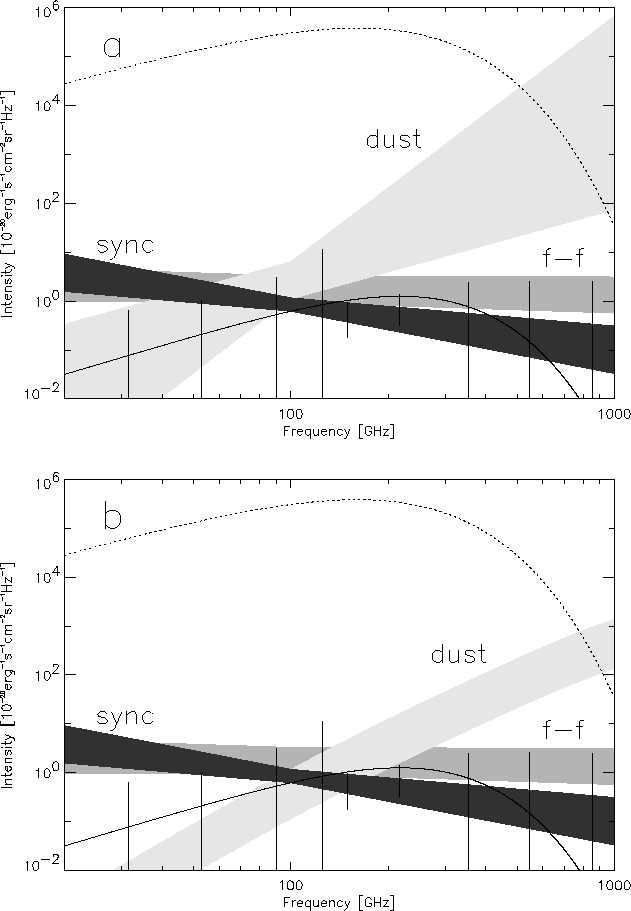
Figure 1: The range of foregrounds given the parameter ranges covered by
the model calculations.
For both plots the dashed line is the 2.728 K black-body, the solid line
corresponds to a  of 10-6, the darkest grayshaded
region is the synchrotron radiation (marked "sync''), the intermediate grayshaded region is the
free-free emission (marked "f-f'') and finally the lightest grayshaded region is the
dust component (marked "dust''). The solid vertical lines illustrate
PLANCK instrument noise levels given in Table 1 (click here).
In a) the parameters for the simulations with the perfect power-law dust
model are shown and in b) the ranges for the two-temperature dust
simulations are displayed
of 10-6, the darkest grayshaded
region is the synchrotron radiation (marked "sync''), the intermediate grayshaded region is the
free-free emission (marked "f-f'') and finally the lightest grayshaded region is the
dust component (marked "dust''). The solid vertical lines illustrate
PLANCK instrument noise levels given in Table 1 (click here).
In a) the parameters for the simulations with the perfect power-law dust
model are shown and in b) the ranges for the two-temperature dust
simulations are displayed
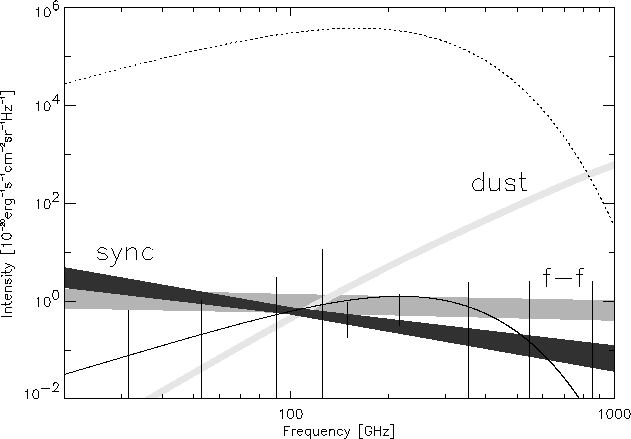
Figure 2: The range of foregrounds used in
the model calculations of Brandt et al. (1994).
The dashed line is the 2.728 K black-body, the solid line corresponds to
a of 10-6, the darkest grayshaded region is
the synchrotron radiation (marked "sync''), the intermediate grayshaded region is the
free-free emission (marked "f-f'') and finally the lightest grayshaded region is the dust component (marked
"dust''). As in Fig. 1 (click here) the PLANCK instrument
noise levels are indicated by vertical lines
The MAP mission as described by
Spergel et al. (1996) is also a spin stabilized
spacecraft with a payload consisting of a dual back-to-back optical system
providing COBE-like differential symmetry and passively
cooled HEMT based detectors. The two telescopes are also 1.5 m off-axis
Gregorian systems with the line-of-sight inclined  with respect
to the spin axis. MAP is expected to reach a sensitivity
of
with respect
to the spin axis. MAP is expected to reach a sensitivity
of  per
per  degree2 pixel
(Spergel et al. 1996) so it is clear, that it is not the intention for
MAP to reach the same sensitivity as the PLANCK mission.
An overview of the main payload characteristics is given in Table 2 (click here).
degree2 pixel
(Spergel et al. 1996) so it is clear, that it is not the intention for
MAP to reach the same sensitivity as the PLANCK mission.
An overview of the main payload characteristics is given in Table 2 (click here).
|
Center frequency, [GHz] | 22 | 30 | 40 | 60 | 90 |
| Detector type | HEMT Radiometers | ||||
| Number of detectors | 4 | 4 | 8 | 8 | 16 |
| Angular resolution [arcmin] | 54 | 39 | 31.8 | 23.4 | 17.4 |
| Bandwidth () | 0.18 | 0.17 | 0.28 | 0.18 | 0.19 |
| 1 sensitivities per pixel for a 1 yr mission
with a 18' beam | |||||
| (Thermodynamic) [10-6] | 9.3 | 9.4 | 9.6 | 10.1 | 11.3 |
| Intensity | 0.37 | 0.69 | 1.23 | 2.77 | 6.23 |
and intensity assuming a noise temperature,  , of
25
, of
25  K per degree2 pixel per frequency band.
The sensitivties given as intensity
are in units of 10-20 erg s-1 cm-2 Hz-1 sr-1
K per degree2 pixel per frequency band.
The sensitivties given as intensity
are in units of 10-20 erg s-1 cm-2 Hz-1 sr-1