

We ran the growth curve fitting program only for the galaxies
cross-identified in LEDA. Out of them the
photometric type (see Sect. 4 (click here)) was determined for 3262 galaxies.
Figure 4 (click here) shows the histogram of  for the whole sample and for
galaxies of quality
for the whole sample and for
galaxies of quality  .
.
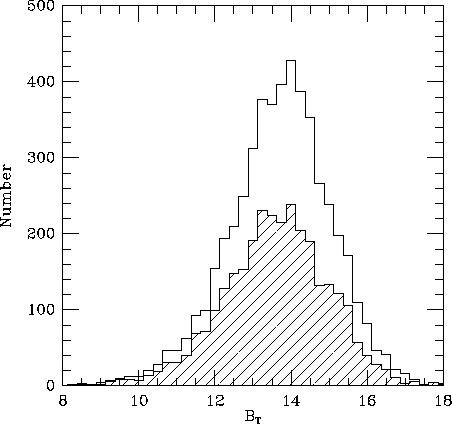
Figure 4: Histogram of total B-magnitude, , for the whole sample and for
galaxies with a quality (hatched)
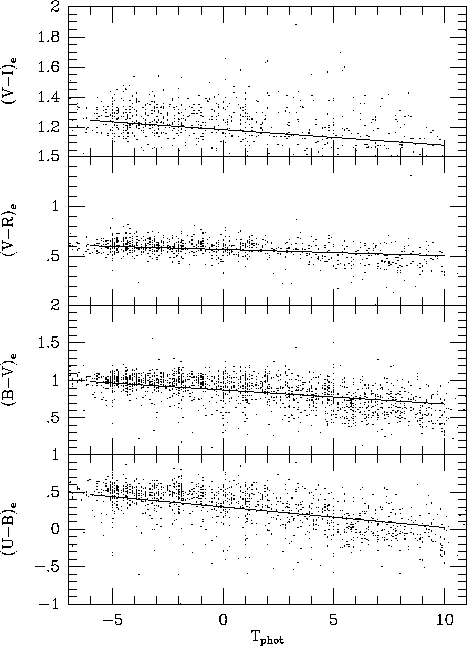
Figure 5: Relation between the effective colour indices and the
photometric type.
The continuous lines are the least square fitted solution adopted
for reducing the data to the B-band when no direct calibration
were available (See Sect. 5.2)

Figure 6: Relation between the colour gradients (in ordinates)
and the photometric type.
The points are the average gradients (in  computed in bins of width
 . The error bars are the uncertainty on this mean gradient,
i.e.,
. The error bars are the uncertainty on this mean gradient,
i.e., 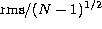 , where rms is the dispersion within a given box and
N the number of galaxies in this box. Typically,
, where rms is the dispersion within a given box and
N the number of galaxies in this box. Typically,  and
and
 .
The continuous lines are the least square fitted solution adopted
for reducing the data to the B-band when no direct determination
of the colour gradients were possible
.
The continuous lines are the least square fitted solution adopted
for reducing the data to the B-band when no direct determination
of the colour gradients were possible
| Colour |  |  |  |  |
| U-B | 0.300 | -0.027 | -0.084 | -0.002 |
| B-V | 0.870 | -0.019 | -0.071 | -0.004 |
| V-R | 0.570 | -0.006 | -0.030 | -0.002 |
| V-I | 1.179 | -0.011 | -0.059 | -0.006 |
, ) and colour gradients (, ) with  . Coefficients u
are the ordinates for
. Coefficients u
are the ordinates for  and v the slopes.
(See Figs. 5 (click here) and 6 (click here))
and v the slopes.
(See Figs. 5 (click here) and 6 (click here))
| Q | Nb of gal |
| 0 | 2191 |
| 1 | 751 |
| 2 | 2253 |
| 3 | 751 |
| 4 | 823 |
| 5 | 152 |
| 6 | 371 |
| Quantity | N | Mean difference | rms |
| PH - RC3 | |||
| 1648 | -0.057 | 0.242 |
 | 1509 | 0.159 | 0.485 |
 | 1172 | -0.006 | 0.083 |
 | 1501 | 0.003 | 0.045 |
 | 376 | 0.009 | 0.050 |
 | 374 | 0.007 | 0.090 |
and error on  ). The units
mag/arcsec2 for
). The units
mag/arcsec2 for  and mag for the other quantities
The derived parameters are summarized in Table 4 for the 5169 galaxies for which a growth curve could be fitted (2229 were rejected because only one aperture or two apertures from different references were available).

Figure 7: Comparison between total magnitudes from RC3,  (in ordinate), and from this study,
  (abscissa).
The comparison is done for 1403 galaxies having the quality flag: .
The straight line corresponds to
(abscissa).
The comparison is done for 1403 galaxies having the quality flag: .
The straight line corresponds to 
Figure 7 (click here) compares the total B magnitudes from RC3 and this study,
respectively (RC3) and (PH), and Table 7 (click here) summarizes
the results of the comparison of different derived parameters.
The comparisons were restricted to the galaxies with and with
an error on BT(RC3) smaller than 0.4.
The systematic differences are significant. In average, our determinations
are  more luminous,
and
more luminous,
and  less bright than
those in RC3. The differences in colours are consequences of those
on and , taking the colour gradients into consideration.
These differences are due to the choice of the set of growth curve, as
when using the RC3 set of growth curves our determinations are consistent
with RC3 to within 0.01 mag on .
less bright than
those in RC3. The differences in colours are consequences of those
on and , taking the colour gradients into consideration.
These differences are due to the choice of the set of growth curve, as
when using the RC3 set of growth curves our determinations are consistent
with RC3 to within 0.01 mag on .
The few outliers apparent in Fig. 7 (click here) are galaxies for which the RC3 fit was based on very few apertures. They are: IC 5273 and NGC 4603 4679 5085 5398 7649
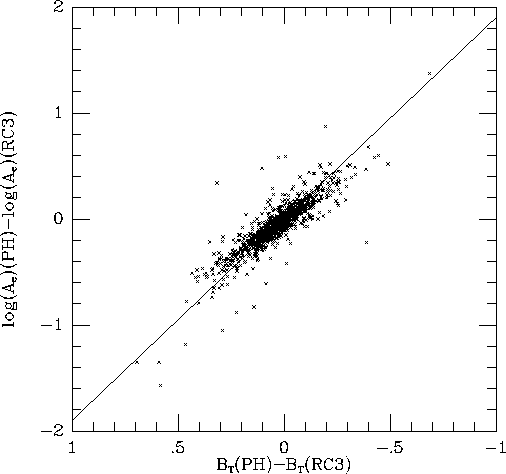
Figure 8: Correlation of the errors on and  .
Abscissa: Difference between the total magnitude ()
from INTERP growth curves and from RC3 (in mag).
Ordinate: Difference between the mean surface brightness within
.
Abscissa: Difference between the total magnitude ()
from INTERP growth curves and from RC3 (in mag).
Ordinate: Difference between the mean surface brightness within  from INTERP growth curves and RC3 in
  .
The comparison is done for 1389 galaxies having the quality flag:
.
The comparison is done for 1389 galaxies having the quality flag:
Figure 8 (click here) shows the error correlation between and ,
the line is the correlation observed for internal errors (see Fig. 1 (click here)).
As already noticed by, e.g., Hamabe & Kormendy (1987), this correlation
is important. It may significantly biases physical relations, in particular
those used as distance indicator.
As illustrated by the comparisons with RC3, the external errors on and
are much larger than those derived from the formal errors on our
fitting parameters. If we a priori suppose that the errors on both
determinations are comparable, the external errors are 0.15 mag on
and  on .
The comparisons between the results obtained
with the three sets of growth curves (INTERP, Sérsic, and RC3) give
comparable rms differences. This shows that the intrinsic deviations
from any set of growth curves for individual galaxies is the dominant
source of error.
on .
The comparisons between the results obtained
with the three sets of growth curves (INTERP, Sérsic, and RC3) give
comparable rms differences. This shows that the intrinsic deviations
from any set of growth curves for individual galaxies is the dominant
source of error.
Using a one-parameter family of growth curves can probably not represent
the diversity of the galaxies, and even for well observed galaxies we
do not expect to reach a precision on better than 0.1 mag.