

From the list of sources that are found in the fields of
Table 1 (click here), I selected all sources that are compatible
with a soft, thermal source spectrum. Paper I
showed that HR2 is a better estimator for the
softness of a source spectrum because it suffers less from intervening
absorption. Sources with a black body spectrum and a
source temperature of 70eV or less will have a hardness ratio HR2
of -0.8 or less, if they penetrate less than 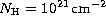 .
Neutron stars accreting from the interstellar medium are not
expected to show harder source spectra (e.g. Blaes & Madau
1993). Some authors, e.g. Zamperi et al. (1995), have argued that
the emergent spectrum of accreting neutron stars might have
a hard component but the bulk of the emission (
.
Neutron stars accreting from the interstellar medium are not
expected to show harder source spectra (e.g. Blaes & Madau
1993). Some authors, e.g. Zamperi et al. (1995), have argued that
the emergent spectrum of accreting neutron stars might have
a hard component but the bulk of the emission ( ) is still
equivalent to a soft thermal spectrum.
) is still
equivalent to a soft thermal spectrum.
A conservative selection criterion for soft sources would require that
the hardness ratio plus its error is less than some threshold,  . However, this criterion is too
stringent for my sample. Soft sources that are only detected in the
soft band and are not detected in the hard band are assigned by the
standard processing an artificially large error in the hardness
ratio. Applying the above selection criterion would exclude all these
sources. Instead, I define a filter based on source brightness. I have
selected all sources with a rate
. However, this criterion is too
stringent for my sample. Soft sources that are only detected in the
soft band and are not detected in the hard band are assigned by the
standard processing an artificially large error in the hardness
ratio. Applying the above selection criterion would exclude all these
sources. Instead, I define a filter based on source brightness. I have
selected all sources with a rate  and at least 20
detected counts. A minimum of 20 counts gives a reasonable confidence
in the accuracy of the hardness ratio, and the count rate limit
guarantees an area coverage of better than 92%.
and at least 20
detected counts. A minimum of 20 counts gives a reasonable confidence
in the accuracy of the hardness ratio, and the count rate limit
guarantees an area coverage of better than 92%.
| X-ray Coordinates | Rate | Cnts | HR1 | HR2 | ID | Type | mV | |||||||||||
| Name |  |  |  | |||||||||||||||
| RX J0550.6+0005 | 05 | : | 50 | : | 37.7 | +00 | : | 05 | : | 56 | 0.866 | 430 | -0.98 | -1.00 | GD 257 | DA1 | 15.10 | |
| RX J0605.0-0707 | 06 | : | 04 | : | 58.8 | -07 | : | 07 | : | 06 | 0.038 | 20 | 0.79 | -1.00 | spec | AGN, z=0.233 | ||
| RX J0614.0-0714 | 06 | : | 13 | : | 58.1 | -07 | : | 14 | : | 50 | 0.092 | 24 | 0.06 | -1.00 | HD43066 | B9 | 6.7 | |
| RX J0620.2-0904 | 06 | : | 20 | : | 11.5 | -09 | : | 04 | : | 26 | 0.096 | 29 | -0.01 | -1.00 | spec | dMe | ||
| RX J0629.6+0829 | 06 | : | 29 | : | 37.0 | +08 | : | 29 | : | 29 | 0.110 | 51 | -0.25 | -1.00 | HD45759 | F8 | 7.5 | |
| RX J1156.0-7700 | 11 | : | 55 | : | 57.7 | -77 | : | 00 | : | 40 | 0.065 | 21 | -0.67 | -1.00 | HD103673 | G5V | 8.6 | |
| RX J1623.9-3312 | 16 | : | 23 | : | 54.7 | -33 | : | 12 | : | 28 | 0.060 | 23 | -0.09 | -0.82 | HR6097 | A0V+ | 7.0 | |
| RX J1856.6-3754 | 18 | : | 56 | : | 34.4 | -37 | : | 54 | : | 26 | 3.456 | 567 | -0.73 | -0.92 | NS candidate | |||
| RX J1917.7+2226 | 19 | : | 17 | : | 39.3 | +22 | : | 26 | : | 28 | 0.034 | 21 | 0.89 | -1.00 | HD180939 | B5V+ | 6.9 | |
| RX J1920.9+1903 | 19 | : | 20 | : | 51.4 | +19 | : | 03 | : | 44 | 0.070 | 40 | -0.27 | -1.00 | 1E1918.7+1857 | dMe | ||
| RX J1922.7+0950 | 19 | : | 22 | : | 40.7 | +09 | : | 50 | : | 55 | 0.202 | 43 | 1.00 | -1.00 | spec | G star | ||
| RX J1947.4+3045 | 19 | : | 47 | : | 23.3 | +30 | : | 45 | : | 58 | 0.873 | 197 | -0.95 | -1.00 | spec | hot white dwarf? | ||
| RX J1958.6+7218 | 19 | : | 58 | : | 34.1 | +72 | : | 18 | : | 24 | 0.062 | 52 | -0.03 | -0.85 | probably stellar | |||
| RX J2011.5+3824 | 20 | : | 11 | : | 28.3 | +38 | : | 24 | : | 12 | 0.087 | 33 | -0.02 | -1.00 | HD192020 | G8V | 7.93 | |
| RX J2019.6+4048 | 20 | : | 19 | : | 38.8 | +40 | : | 48 | : | 25 | 0.230 | 63 | 0.85 | -1.00 | faint red object | |||
| RX J2114.6+4607 | 21 | : | 14 | : | 33.6 | +46 | : | 07 | : | 44 | 0.135 | 39 | 0.96 | -0.86 | faint red object | |||
Out of 2270 source in my dark cloud sample only 16 sources pass this selection filter. Table 2 (click here) lists all 16 sources with their ROSAT name, coordinates and their X-ray parameters. I have approximated the boundaries of the dark clouds with a wide rectangle. Therefore some of the sources in this areas might not be in front of a cloud and extragalactic objects might shine through gaps between individual cloudlets. A reduced stellar density close to the source position is a good indicator for the presence of a dark cloud.
I have used the digitized sky-survey to create finding charts for each of the 16 sources, Fig. 3 (click here). A circle with a radius of 30'' is centered in each figure at the X-ray position. Because most sources in the sample are faint, their uncertainty in the X-ray position is dominated by systematics. 30'' is generally considered a conservative choice and supported by recent identification programs (see Paper I for more details). For some fields capital letters identify objects that have been further studied with optical spectroscopy.
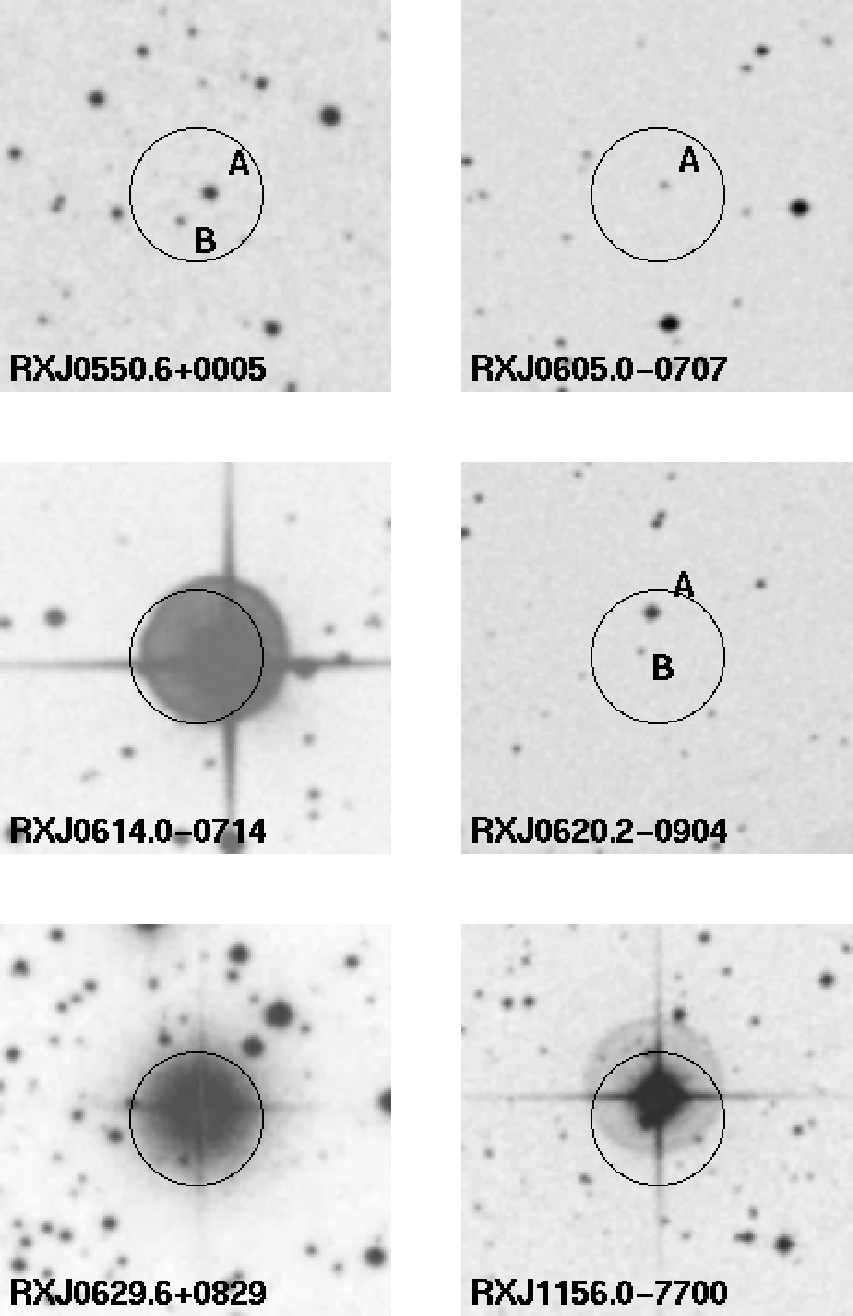
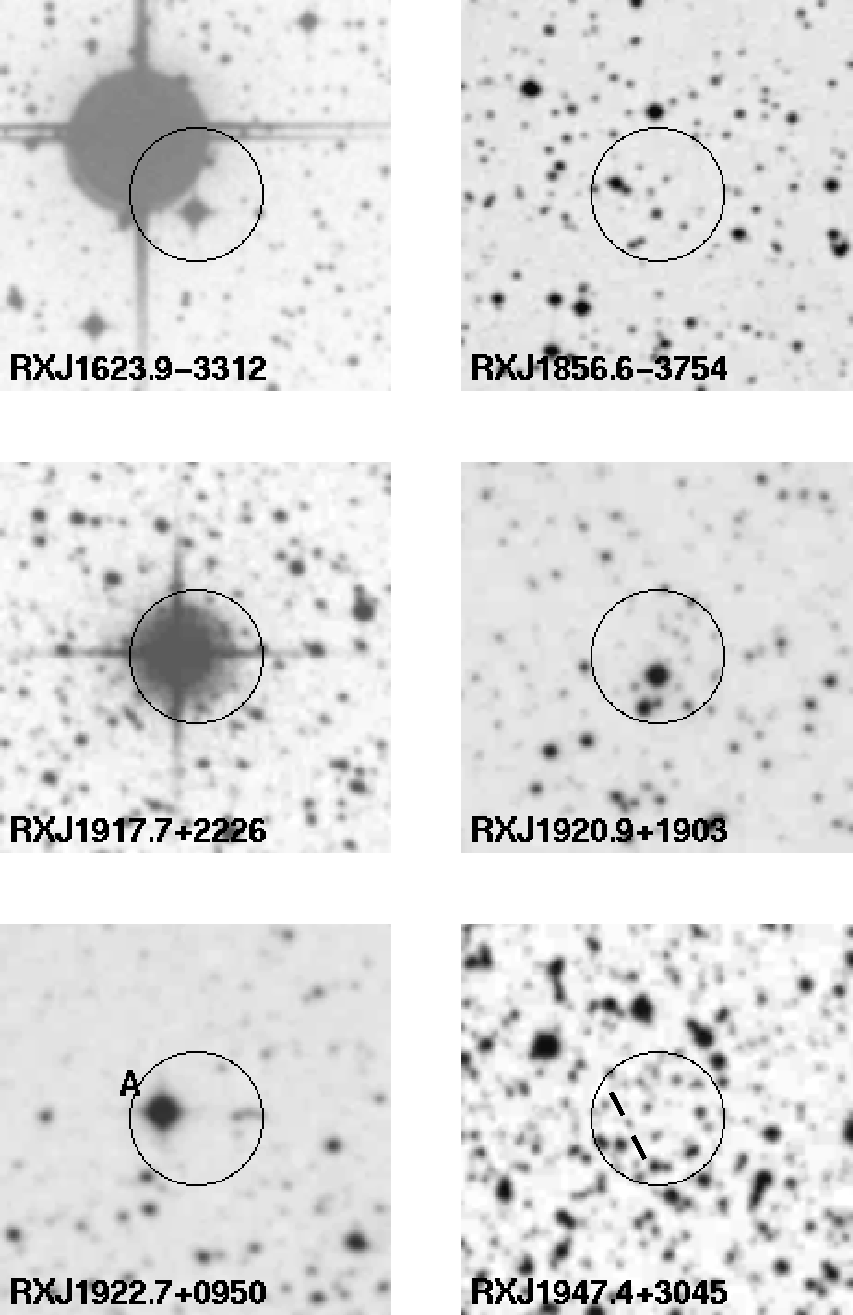
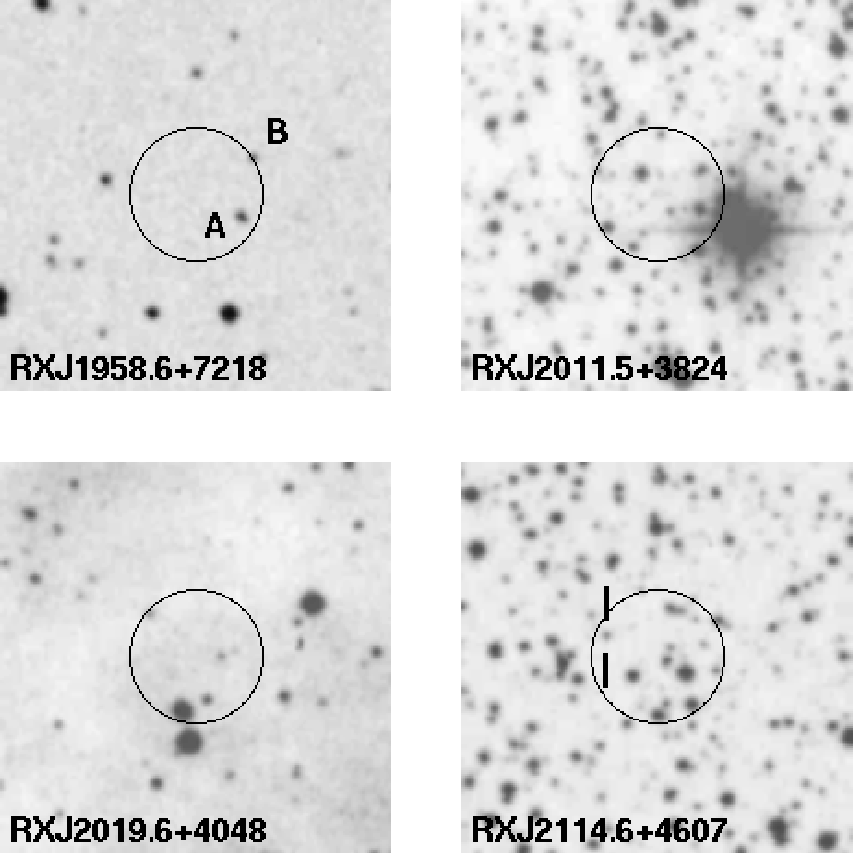
Figure 3: Finding charts for soft sources. The charts have
been produced from the digitized Palomar Sky-Survey.
The circles are centered at the X-ray position and
have a radius of 30 arcseconds. North is up and
East to the left. Capital letters identify the
brightest objects next to them
All source positions were searched in the SIMBAD and NED catalogs for known counterparts. The result of this search is summarized in Table 2 (click here). Eight sources are identified with bright stars. For four additional fields, I conducted optical spectroscopy at the Palomar 60-inch and the Palomar 200-inch telescope. Low resolution spectra of candidates are shown in Fig. 4 (click here).
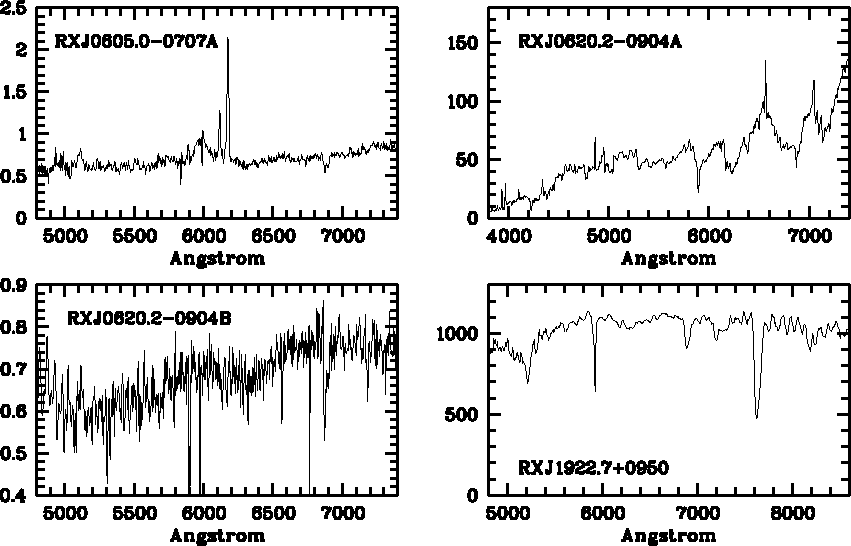
Figure 4: Identification spectra for 4 objects.
RX  : M dwarf with
  emission.
RX
emission.
RX  : faint stellar object
RX
: faint stellar object
RX  : AGN with [OIII] and broad
 emission at
z=0.2.
RX
emission at
z=0.2.
RX  : G star.
The X-axes are in Angstrom and the Y-Axes in
arbitrary units
: G star.
The X-axes are in Angstrom and the Y-Axes in
arbitrary units
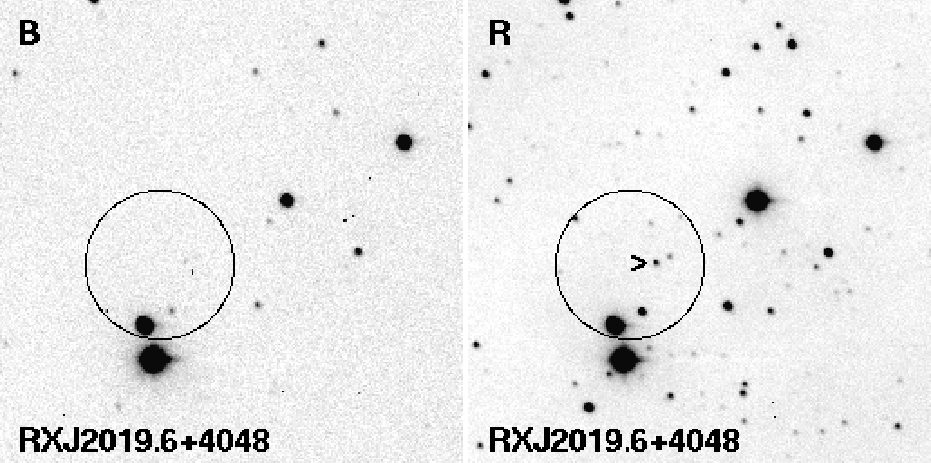
Figure 5: CCD frames of the field of RX J2019.6+4048.
The images were taken with 60 seconds integration time
at the Palomar 60-inch telescope. The images are in
the blue Kron-Cousin B (left) and R filter (right).
An arrow in the read image marks a faint red object,
probably an extragalactic object. The circles are
centered at the X-ray source position and have a
radius of 30 arcseconds. North is up and East to
the left
RX is an AGN with a redshift of 0.233.
RX is a M dwarf star with emission;
the second object within the error circle RX
shows a stellar spectrum without emission lines. I therefore
suggest the M dwarf to be the source of RX  .
RX is identified as G star.
No spectroscopic data is available for RX
.
RX is identified as G star.
No spectroscopic data is available for RX  .
However, Fig. 5 (click here) shows CCD frames in the Kron-Cousin B and R
filter of this field. In the R image, a faint red object close to the
X-ray position is apparent.
An inspection of the R and B plate of the second generation of
the Palomar Sky Survey (POSSII) yielded another red object coincident
with RX J2114.6+4607, see mark on finding chart in Fig.3 (click here).
Pending identification through
spectroscopy, I suggest that those two red objects are the likely extragalactic
counterparts to RX J2019.6+4048 and RX J2114.6+4607.
.
However, Fig. 5 (click here) shows CCD frames in the Kron-Cousin B and R
filter of this field. In the R image, a faint red object close to the
X-ray position is apparent.
An inspection of the R and B plate of the second generation of
the Palomar Sky Survey (POSSII) yielded another red object coincident
with RX J2114.6+4607, see mark on finding chart in Fig.3 (click here).
Pending identification through
spectroscopy, I suggest that those two red objects are the likely extragalactic
counterparts to RX J2019.6+4048 and RX J2114.6+4607.
Unfortunately there is no spectroscopic data available for
RX J1958.6+7218. However, due to the moderately hard spectrum,
the low count rate of  and the presence of object
A inside the error circle I expect this source to be due to
coronal emission from A.
and the presence of object
A inside the error circle I expect this source to be due to
coronal emission from A.
The three brightest sources in the sub-sample, RX J0550.6+0005,
RX J1856.6-3754 and RX J1947.4+3045, are also the sources with the
softest HR1 values.
This indicates that they are affected very little by
absorption. The brightest source RX J1856.6-3754 with  has been indeed suggested by Fred Walter et al. (1996)
to be a nearby isolated neutron star, accreting from the
interstellar medium. RX J0550.6+0005 is the known hot white
dwarf star GD257 (Bergeron et al. 1994) with an effective
surface temperature of
has been indeed suggested by Fred Walter et al. (1996)
to be a nearby isolated neutron star, accreting from the
interstellar medium. RX J0550.6+0005 is the known hot white
dwarf star GD257 (Bergeron et al. 1994) with an effective
surface temperature of  also visible as EUV source
(Marsh et al. 1997).
also visible as EUV source
(Marsh et al. 1997).
This left the intriguing case of RX J1947.4+3045 with very similar X-ray properties as GD257 but a much fainter optical counterpart (mV>19 compared to mV=15.1 for GD257). A comparison of the B and I plate of POSSII showed a very blue object within the X-ray error circle, see mark on finding chart in Fig.3 (click here). I was able to obtain a spectrum of the source taken with the Palomar Hale telescope and the double spectrograph in June 1997, see Fig. 6 (click here). The spectrum is similar to that of a hot white dwarf star. It shows a hot continuum, no emission lines, very weak Balmer lines in absorption and broad absorption bands that resemble Swan C2 bands, due to molecular carbon. The hot continuum and the molecular bands give conflicting informations on the source temperature, demanding high and low surface temperatures simultaneously. This suggests that we are either looking at a binary system or absorption from circumstellar material. None of the models is particular conclusive. I am therefore not yet able to describe all features in the spectrum with a consistent model. This interesting object will be discussed in detail in a forthcoming letter.
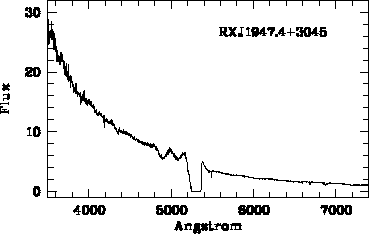
Figure 6:
Spectrum of the blue object inside the error
box of RX J1947.4+3045.
The gap in the spectrum around 5300 Å is caused
by the lack of overlap between the red and the
blue side of the spectrograph. The spectrum immediately
next to the gap is heavily affected by effects of
the dichroic that can not be calibrated.
The Y-Axis has arbitrary units