

I have reported on the statistical analysis of all sources in
the ROSAT All-Sky Survey that are in areas
identified by Dame et al. (1987) as Galactic dark clouds.
Optical identifications for all sources with  that
meet a brightness limit, are presented.
The majority coincide with bright, nearby stars.
All but one source, have likely optical identifications.
The source without plausible optical identification is also the
brightest X-ray source.
This source has been suggested earlier to be due
to an nearby isolated neutron star accreting from the interstellar
medium (Walter et al. 1996).
The source stands out prominently among its peers
and is easily rediscovered. I conclude that there is no similar
source found in the sample. The dark cloud sample covered more than
that
meet a brightness limit, are presented.
The majority coincide with bright, nearby stars.
All but one source, have likely optical identifications.
The source without plausible optical identification is also the
brightest X-ray source.
This source has been suggested earlier to be due
to an nearby isolated neutron star accreting from the interstellar
medium (Walter et al. 1996).
The source stands out prominently among its peers
and is easily rediscovered. I conclude that there is no similar
source found in the sample. The dark cloud sample covered more than
 on the sky down to a limiting count rate of
 . One such source per
corresponds to
. One such source per
corresponds to 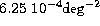 or
or  at a count rate
  .
The detection limit in the All-Sky Survey is
significantly lower than the cut-off chosen here. The statistical
analysis shows no evidence of an increase of soft sources at lower
count rates. I take this as further evidence that the derived
limit is conservative and may be in fact much lower.
An in depth analysis of this survey and Paper I
will be published as Paper III.
.
The detection limit in the All-Sky Survey is
significantly lower than the cut-off chosen here. The statistical
analysis shows no evidence of an increase of soft sources at lower
count rates. I take this as further evidence that the derived
limit is conservative and may be in fact much lower.
An in depth analysis of this survey and Paper I
will be published as Paper III.
Acknowledgements
This article is based on research conducted during my three year visit to the California Institute of Technology. I want to thank Prof. S.R. Kulkarni for his hospitality, support and countless discussions during this time. I am indebt to J. Trümper for his support of this project and many fruitful suggestions. I thank Chris Clemens and Angela Putney for help with understanding the blue spectrum. The ROSAT project is supported by the German Bundesministerium für Bildung und Wissenschaft (BMBW/DARA) and the Max-Planck-Society. This research has made use of the NASA/IPAC extragalactic database NED) which is operated by the Jet Propulsion Laboratory, Caltech, under contract with the National Aeronautics and Space Administration, and of the SIMBAD database, operated at CDS, Strasbourg, France. The Digitized Sky Survey (DSS) was produced at the Space Telescope Science Institute under U.S. Government grant NAG W-2166.