

Large intensity variations over very short time scales are present in many
black-hole candidates and in some neutron star systems. In the neutron star
systems if the magnetic field is weak, the inner radius of the
accretion disk can be very close to the neutron star surface resulting in
flux variation at the Keplerian frequencies, or at the
beat frequencies between the Keplerian frequency and spin of the
neutron star. In the case of black-hole sources, the disk can extend upto the
lowest stable orbit (3 times the Schwartzchild radius) for a
non-rotating black hole, or even closer to the compact object for a
maximally rotating compact object. The fast variations observed in
GRS 1915+105 indicate size of the emission region  0.1 light second,
large for the inner disk of a few stellar mass black-hole.
0.1 light second,
large for the inner disk of a few stellar mass black-hole.
The hard X-rays are found to be delayed compared to the soft X-rays
indicating that the soft and hard
X-ray emitting regions are not the
same and the variations in luminosity of the two regions are not
simultaneous, as it is expected to be for physically separated regions.
The hard X-ray emissions from black hole candidates are usually thought
to be reprocessed emission of underlying soft photons from an inner disk.
In such cases multiple inverse Compton scattering by the energetic
electrons in the corona, which is responsible for the increase in energy
of the photons, may introduce some delay between the soft and hard X-ray
spectrum. Our observation of hard X-ray delay in the source, which is
overlying on the QPOs as shown in Fig. 4 (click here), indicates that the soft X-rays
(most of them of energy < 6 keV) from the inner disk are up-scattered
by a plasma of size of a fraction of a light-second.
Quasi-periodic oscillations of many different frequencies are observed
in GRS 1915+105 (Morgan et al. 1997). During the bright state, low frequency
QPOs were observed with harmonics. QPOs of two or more different
frequencies were also observed. The QPO frequency in the flaring
state varied erratically between 0.0016 Hz and
0.16 Hz with a higher
frequency QPO of 7.6 Hz observed on May 14. In the two flaring
states the QPO frequency is relatively high, 1.5 Hz to 8 Hz
varying erratically with a low frequency QPO of 0.003 Hz observed
on June 16. The 67 Hz QPOs are observed during the bright and
flaring state. The QPOs frequency variations during the low-hard
state, seems to have some definite pattern in it. The QPO frequency
was 2.3 Hz at the beginning of the low-hard state, decreased
slowly to a lowest frequency of 0.62 Hz on July 25, and again
increased slowly to 2.0 Hz towards the end of the low-hard
state. The QPO frequency history of GRS 1915+105 during its
low state inferred from published data is shown in
Fig. 6 (click here).
The rms/mean of 6 days observations of ASM around each data
point is plotted along with the QPO frequency.
Crossed circles are PPC observations, the dotted circles represent
PCA observations (Morgan et al. 1997) and the stars are the rms/mean
obtained from ASM archival data.
We notice that the QPO frequency
decreased to a minimum during our observations and
then increased again. Erratic changes in the QPO frequency between
segments of observations on the same day are present. An overall
trend of a smooth decrease followed by increase in the QPO frequency
is clearly observed. The rms deviation of the X-ray intensity shows
dramatic change when the source makes transition from flaring to low state
and again back to the flaring state. The QPO frequency appears to be
very strongly related to the rms/mean intensity of the source.
The hardness ratio between the  keV flux and
  keV flux
increased during the low-hard state and decreased again as the source
went to the flaring state again.
keV flux
increased during the low-hard state and decreased again as the source
went to the flaring state again.
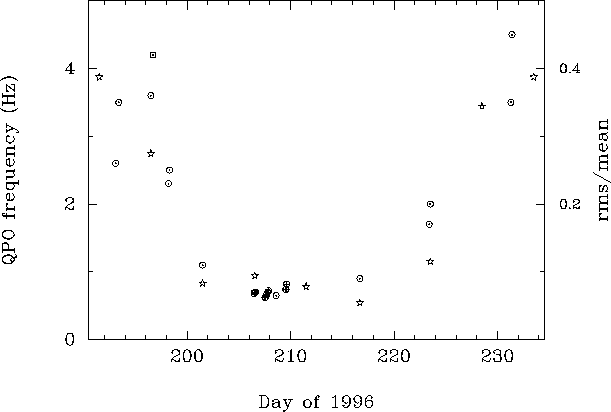
Figure 6: The QPO frequency (left scale) and rms variation (right scale)
history of GRS 1915+105
during the low-hard state. The crossed circles are PPC observations and
dotted circles are PCA observations. The stars represent the rms/mean during
a 6 days period in the ASM light curve around each point
The quasi-periodic oscillations detected during our observations are
stable, narrow and strong. It may represent the Keplerian
motion of blobs of hot material in the disk. Stability of the QPO
frequency in the range 0.62 to
0.82
Hz during 5 days of observations, during which the
overall intensity of the source is also nearly constant, indicates that
the QPO production region is narrow in the radial direction and is
stable when the mass accretion rate is stable. But the force behind
confinement of the hot spots in the radial directions which can produce
narrow QPOs, is not understood.
In a model of disk accretion around black hole sources, in which
the disk passes through a standing shock close to the centrifugal
barrier, a QPO generation mechanism has been developed
(Molteni et al. 1996).
Oscillations around the mean shock location can give rise to
intensity modulations similar to the quasi periodic oscillations
observed in the black hole candidates like GX  ,
GS
,
GS  etc.
The oscillations of the shock surface arise as a balancing act
between the infall of the converging disk material and the outflow
of the hot shockfront. If the cooling time scale of the expanding
postshock halo and the infall time scale of the disk are nearly
the same, a modulation of upto
etc.
The oscillations of the shock surface arise as a balancing act
between the infall of the converging disk material and the outflow
of the hot shockfront. If the cooling time scale of the expanding
postshock halo and the infall time scale of the disk are nearly
the same, a modulation of upto  of the intensity can be
produced. In this model the QPO frequency is predicted to increase
with mass accretion rate. Sustained quasi-periodic oscillations
are possible if the dominant cooling process
is bremsstrahlung. Chakrabarti & Titarchuk (1995) have
shown that for sources emitting near their Eddington luminosity the
post shock region emits mainly by bremsstrahlung. The smooth QPO
frequency variations during the low-hard state can be attributed
to a similar increase in the mass accretion rate. This is in
agreement with the QPO production process mentioned above. In this
model the spectrum becomes harder at lower luminosity. This
fact also has been observed in the ASM data showing a harder
spectrum during the low state (Bradt 1996). For a
of the intensity can be
produced. In this model the QPO frequency is predicted to increase
with mass accretion rate. Sustained quasi-periodic oscillations
are possible if the dominant cooling process
is bremsstrahlung. Chakrabarti & Titarchuk (1995) have
shown that for sources emitting near their Eddington luminosity the
post shock region emits mainly by bremsstrahlung. The smooth QPO
frequency variations during the low-hard state can be attributed
to a similar increase in the mass accretion rate. This is in
agreement with the QPO production process mentioned above. In this
model the spectrum becomes harder at lower luminosity. This
fact also has been observed in the ASM data showing a harder
spectrum during the low state (Bradt 1996). For a  black hole (for a stable 67 Hz QPO observed with PCA to represent
the Keplerian rotation of the innermost stable disk around a
non-rotating black hole) and 0.7 Hz QPO, the average shock
front is at a radius of around
black hole (for a stable 67 Hz QPO observed with PCA to represent
the Keplerian rotation of the innermost stable disk around a
non-rotating black hole) and 0.7 Hz QPO, the average shock
front is at a radius of around  .
.