Background observations were made during August 1-3 in a nearby region
of the sky which is devoid of any known X-ray source. When data in the
good latitude region of  to
to  are taken, the
background count rate fits well with a constant value with reduced
are taken, the
background count rate fits well with a constant value with reduced
 . Background subtracted light curve is generated for
each of the observation slots and the total light curve is shown in
Fig. 1 (click here). Individual light curve of each observation with integration time
of 1 min are plotted in Fig. 1 (click here). The individual observation stretches
are 2 to 19 min long. The date and time of the observations
are shown in the panels. The bottom panel shows the ASM light curve of
GRS 1915+105 in
. Background subtracted light curve is generated for
each of the observation slots and the total light curve is shown in
Fig. 1 (click here). Individual light curve of each observation with integration time
of 1 min are plotted in Fig. 1 (click here). The individual observation stretches
are 2 to 19 min long. The date and time of the observations
are shown in the panels. The bottom panel shows the ASM light curve of
GRS 1915+105 in  keV range during 1996 July 20-29. Each data
point is a result of about 90 seconds observation of ASM with
keV range during 1996 July 20-29. Each data
point is a result of about 90 seconds observation of ASM with  observations every day. The ASM light curve of the source, as shown
in the lower panel of Fig. 1 (click here), is also featureless during the days of
our observations. The intensity decrease as observed on July 27 is not
evident in ASM data, but the PPC and ASM observations are not
exactly simultaneous. Day to day variability in the source intensity
is within 10% of the average value except for the final day of
observation. The rms variability in the 1 minute light curve of
individual observation slots is only about 1.6%, a part of which is
also due to the nonstatistical variation in the background. This small
variation can be compared to the 0.5% rms variation estimated for a
constant intensity light curve of the same intensity with only Poissonian
variations.
observations every day. The ASM light curve of the source, as shown
in the lower panel of Fig. 1 (click here), is also featureless during the days of
our observations. The intensity decrease as observed on July 27 is not
evident in ASM data, but the PPC and ASM observations are not
exactly simultaneous. Day to day variability in the source intensity
is within 10% of the average value except for the final day of
observation. The rms variability in the 1 minute light curve of
individual observation slots is only about 1.6%, a part of which is
also due to the nonstatistical variation in the background. This small
variation can be compared to the 0.5% rms variation estimated for a
constant intensity light curve of the same intensity with only Poissonian
variations.
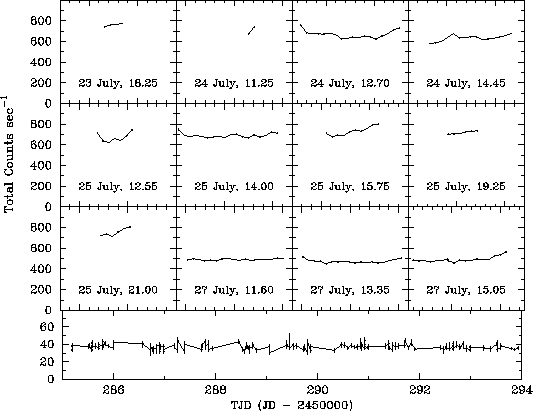
Figure 1: The light curve of GRS 1915+105 observed with the PPCs. Date
and time of observations are shown in the individual sections.
Each section is for 20 minutes duration and data points of bin size
of 1 minute are plotted. The bottom panel shows the ASM light curve
during July 20-29, each data point is about 90 seconds of observations
with about 5-10 observations every day
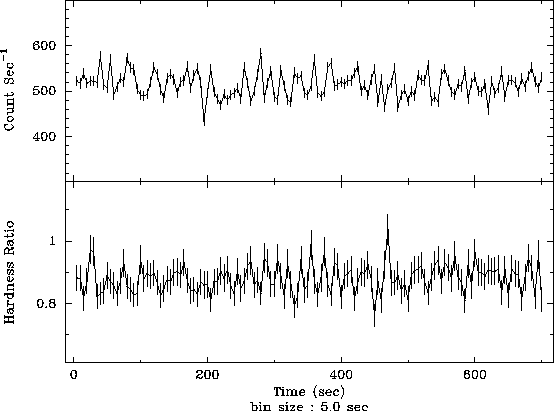
Figure 2: The intensity and hardness ratio are plotted for one of the PPC
observation slots. Data bin size is chosen to be 5 seconds to reduce the
statistical errors
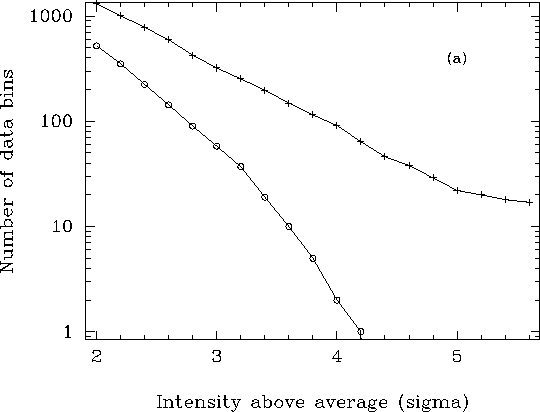
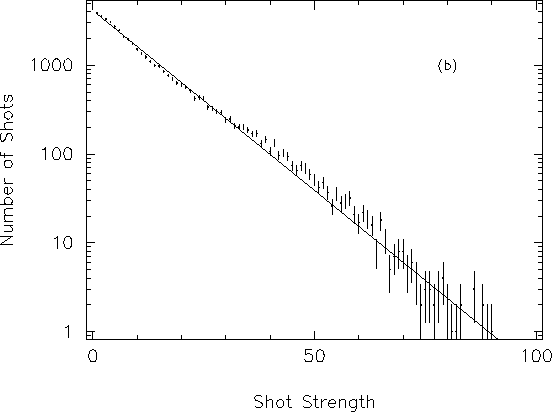
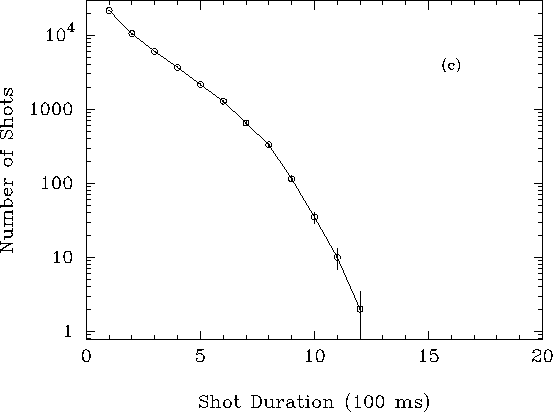
Figure 3: A statistical representation of the intensity variations in GRS 1915+105
observed with the PPCs. The data sets of the three detectors are treated as
independent observations and the results are added.
a). The number of 100 ms data bins exceeding a running
average of 21 data points is plotted as a function of the excess expressed in
 . The lower curve is the expected distribution calculated with a
synthetic light curve with the same running average as in the observed light
curve,
b). the number distribution of the shots as a function of number of
photons in the shots and
c). the number distribution of shots as a function
of shot duration
. The lower curve is the expected distribution calculated with a
synthetic light curve with the same running average as in the observed light
curve,
b). the number distribution of the shots as a function of number of
photons in the shots and
c). the number distribution of shots as a function
of shot duration
The hardness ratio, defined as the ratio of counts rate in the  keV
band and
keV
band and  keV band is
found to decrease gradually with few days time scale in the ASM
observations during the soft-hard state. We observe no noticeable
change in the hardness ratio during individual
observation slots. In Fig. 2 (click here) we have shown a section of the light
curve with the hardness ratio plotted with it. The hardness ratio
is defined as the number of counts in
keV band is
found to decrease gradually with few days time scale in the ASM
observations during the soft-hard state. We observe no noticeable
change in the hardness ratio during individual
observation slots. In Fig. 2 (click here) we have shown a section of the light
curve with the hardness ratio plotted with it. The hardness ratio
is defined as the number of counts in  keV divided by
those in
keV divided by
those in  keV. A bin size of 5 seconds has been used to compute the
hardness ratio to reduce the error bars.
keV. A bin size of 5 seconds has been used to compute the
hardness ratio to reduce the error bars.
A search was made to find intensity variations in the source largely exceeding the photon counting statistics. Each individual time bin was inspected with respect to a running average in the light curve around that bin and intensity variations above the average were classified in terms of its strength. In Fig. 3 (click here)a we have shown the number distribution of data bins exceeding the average, as a function of the excess. The number of data points where large intensity enhancement is detected is much more than that expected in an otherwise constant intensity light curve with Poissonian statistics. This difference is more pronounced for the larger intensity enhancements. We have earlier reported large intensity variations over time scale of 100 ms to few sec in our observation of GRS 1915+105 (Paul et al. 1997). However there is no intensity variation at a longer time scale of a minute or more as can be seen in Fig. 1 (click here) where one minute count rate is plotted.
Time variability in the X-ray intensity of black hole sources
has been proposed to be the result of randomly occurring shots with
exponential rise and/or decay (Terrell 1972). A Large number
of shots in the Cyg  light curve were added and the resultant
profile was found to have nearly symmetric rise and decay
(Negoro et al. 1994). To
quantify the variations in the intensity as sum of shots in the
light curve of GRS 1915+105, we have identified shots and classified
them in terms of the number of photons in them. Every data
bin of the 100 ms light curve is compared to a running average
around it, and successive data bins, when found to be above the
average, a shot is presumed to have occurred. The total excess
counts in the individual shots above the average are calculated
and a number distribution of that is shown in Fig. 3 (click here)b. We find that
the distribution fits very well with an exponential function
(
light curve were added and the resultant
profile was found to have nearly symmetric rise and decay
(Negoro et al. 1994). To
quantify the variations in the intensity as sum of shots in the
light curve of GRS 1915+105, we have identified shots and classified
them in terms of the number of photons in them. Every data
bin of the 100 ms light curve is compared to a running average
around it, and successive data bins, when found to be above the
average, a shot is presumed to have occurred. The total excess
counts in the individual shots above the average are calculated
and a number distribution of that is shown in Fig. 3 (click here)b. We find that
the distribution fits very well with an exponential function
( ; with N = 4140 and C=10.7 ; S is the
strength of the shot in photon counts). The durations of
the shots are shown in Fig. 3 (click here)c which also has an exponential
form with increasing slope above 0.7 seconds. The shape
of the curve in Fig. 3 (click here)c can also be explained as an exponential
distribution of shot duration with a hump around 0.7 s, which
is the width of the pulse profile at the quasi-periodic oscillation
period of 1.4 second.
; with N = 4140 and C=10.7 ; S is the
strength of the shot in photon counts). The durations of
the shots are shown in Fig. 3 (click here)c which also has an exponential
form with increasing slope above 0.7 seconds. The shape
of the curve in Fig. 3 (click here)c can also be explained as an exponential
distribution of shot duration with a hump around 0.7 s, which
is the width of the pulse profile at the quasi-periodic oscillation
period of 1.4 second.
To measure any delay between the hard and soft X-rays, cross
correlations (correlation coefficients with different delays) were
calculated. All observation slots were divided into smaller
segments of 64 data points of 100 ms duration. The cross correlation
function between the keV and keV count rate profiles were
calculated for all of these small data lengths. The resultant
cross correlation functions were added and averaged and are plotted
in Fig. 4 (click here). The peaks in the cross-correlation plot are due to the
strong QPOs at a frequency of 0.7 Hz. The region near 0 is plotted
in the inset and the asymmetry around 0 delay is clearly visible. One
possible explanation for this asymmetry in the cross correlation function
is a time lag between the soft and hard X-ray oscillations.
The difference between the right and left hand side of the cross
correlation function is maximum at around  s indicating a
delay of 0.2 to 0.4 s for the hard X-rays compared to
the soft X-rays in our observations. Similar asymmetry is observed
in all the observations and in all the three detectors.
s indicating a
delay of 0.2 to 0.4 s for the hard X-rays compared to
the soft X-rays in our observations. Similar asymmetry is observed
in all the observations and in all the three detectors.
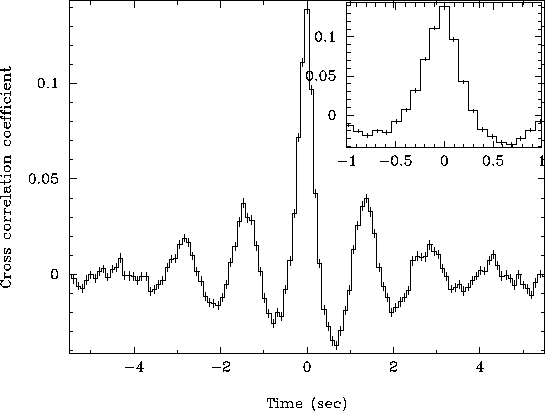
Figure 4: The cross correlation function for different delays between the
soft X-rays ( keV) and hard X-rays ( keV) is plotted here. The
oscillations in the plot is due to the QPOs at a period of 1.4 seconds.
In the inset is shown the cross correlation function near zero,
asymmetry on the two sides of zero is visible
We have discovered quasi-periodic oscillations in GRS 1915+105
with frequency varying between 0.62 to 0.82 Hz
(Agrawal et al. 1996b;
Paul et al. 1997). GRS 1915+105 is the sixth black
hole candidate after GX  , Cyg , LMC ,
GS
, Cyg , LMC ,
GS  and GRO J0422+32,
in which QPOs have been observed. The power density spectrum obtained from
the PPC observations shows
that the QPOs are very narrow (< 0.2 Hz) and strong (rms 9%). The
PDS is flat for frequencies less than the QPO frequency and at
frequencies above this it follows a power law of index -1.5 . There
is no marked difference between the power spectrum of the low and high
energy X-rays. The PDS of GRS 1915+105 as observed
in its low state resembles that of the other black hole candidates in
their very high state.
This type of band limited noise is characteristic of black hole
sources in their very high state (Miyamoto et al. 1992;
van der Klis 1995).
Black hole sources have strong very low frequency intensity
variations when in low-hard state and in high state the
PDS is flat below a break frequency.
and GRO J0422+32,
in which QPOs have been observed. The power density spectrum obtained from
the PPC observations shows
that the QPOs are very narrow (< 0.2 Hz) and strong (rms 9%). The
PDS is flat for frequencies less than the QPO frequency and at
frequencies above this it follows a power law of index -1.5 . There
is no marked difference between the power spectrum of the low and high
energy X-rays. The PDS of GRS 1915+105 as observed
in its low state resembles that of the other black hole candidates in
their very high state.
This type of band limited noise is characteristic of black hole
sources in their very high state (Miyamoto et al. 1992;
van der Klis 1995).
Black hole sources have strong very low frequency intensity
variations when in low-hard state and in high state the
PDS is flat below a break frequency.
The light curve was folded at the observed QPO period and the
resultant profile is found to be nearly sinusoidal with pulse
amplitude of 4% of the total intensity of the source (Fig. 5 (click here)).
There is no noticeable difference in pulse shape in the two energy
ranges, and keV.
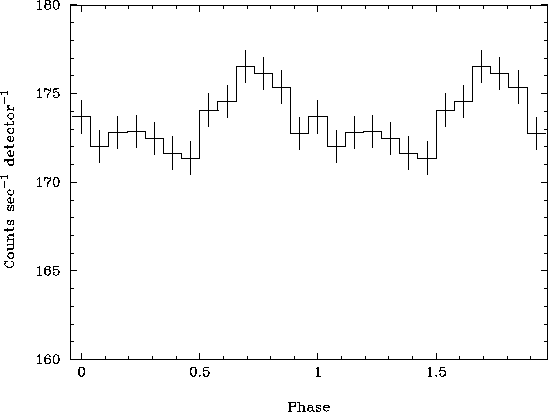
Figure 5: The pulse profile of GRS 1915+105 folded with the mean
QPO period