

The rms (Jy) distribution of the new detections is given in Fig. 2 (click here)a, which
shows a cut-off at  Jy corresponding to the theoretical sensitivity
of our telescope for on-source integration time of one hour.
Jy corresponding to the theoretical sensitivity
of our telescope for on-source integration time of one hour.
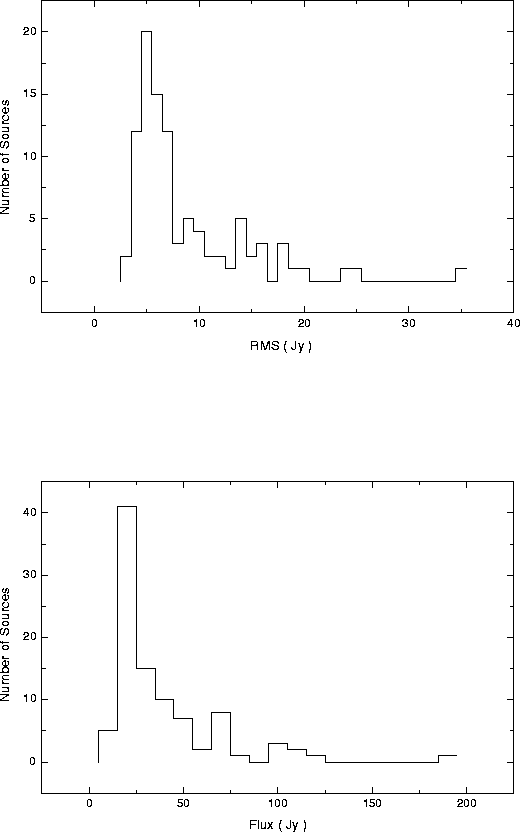
Figure 2: a)
Distribution of 1 rms noise;
b)
Distribution of peak flux density of the new detections
rms noise;
b)
Distribution of peak flux density of the new detections
The peak flux density distribution of the new detections is given in Fig. 2 (click here)b,
which has a cut-off around 15 Jy and a peak around  Jy.
49 of the new detections are tentatively classified as Star Formation
Region, and others are classified as Star (Palagi et al. 1993).
Almost all of
our newly-detected sources are associated with IRAS sources. In terms of the
logarithm of the IRAS fluxes (
Jy.
49 of the new detections are tentatively classified as Star Formation
Region, and others are classified as Star (Palagi et al. 1993).
Almost all of
our newly-detected sources are associated with IRAS sources. In terms of the
logarithm of the IRAS fluxes ( , with
  ),
Wouterloot & Walmsley (1986) proposed the criteria for the H2O maser in
star formation regions:
),
Wouterloot & Walmsley (1986) proposed the criteria for the H2O maser in
star formation regions:  . 87%
of the newly-detected sources classified as SFR are inside this boundary.
The distribution in the infrared color-color diagram of our newly-detected
stellar masers is also in accordance with that of the 274 known stellar
maser sources listed in the catalogues of the H2O maser sources compiled
by the Arcetri group.
. 87%
of the newly-detected sources classified as SFR are inside this boundary.
The distribution in the infrared color-color diagram of our newly-detected
stellar masers is also in accordance with that of the 274 known stellar
maser sources listed in the catalogues of the H2O maser sources compiled
by the Arcetri group.
Among our new detections listed in Table 1, a few evolved stars with IRAS low resolution infrared spectral class 4n and even a few standard carbon stars are included. These results may appear in contrast with current models of C-rich stars. It is well-known that the chemical classes of evolved stars are usually classified as O-rich, C-rich, and S-type, and the composition of the atmosphere and circumstellar envelope of these objects depends strongly on the chemical class to which they belong. Usually, oxygen-bearing molecules other than CO are relatively rare in the atmospheres and the circumstellar envelopes of C-rich stars, and the detection of OH, H2 O, or SiO maser emission is considered to be the indicator of O-richness of these stars. In fact, until now the dominant chemistry of many objects is not well-known, and the discrimination of the chemical properties of their circumstellar envelopes is by far not straightforward. For examples, detections of OH or H2O masers from some J-type carbon stars are reported (Little-Marenin 1986; Willems & de Jong 1988; Barnbaum et al. 1991; Nakada et al. 1991; Engels 1994), and generally explained by the existence of O-rich envelopes surrounding C-rich stars. Wood et al. (1983) found that the infrared properties of two LPV(long period variable) carbon stars in SMC switch between the O-rich and carbon star groups as they vary.
However, the detection of an H2O maser from a standard carbon star is unusual and is worthy to be investigated, although the signal to noise ratio in some of our detections is not very high and more sensitive observations are needed for further confirmation.
Acknowledgements
We would like to thank senior engineer F.Q. Huang and the technical staff of Qinghai Station, Purple Mountain Observatory for their invaluable assistance during the observations. Thanks to Prof. D. Xiang and Prof. H. J. Su for their very good comments of the text. This work has been supported by Joint Radio Astronomy Laboratory, Chinese Academy of Sciences.