

We have divided this section into two parts; in the first part we present
our newly discovered and confirmed  Bootis stars and in the second part we
discuss certain candidate Bootis stars. The latter have a relatively high
probability of being either bona-fide Bootis or related stars, but
follow-up observations (e.g. with higher resolution and/or higher S/N
spectroscopy) are required to confirm their spectral types.
Bootis stars and in the second part we
discuss certain candidate Bootis stars. The latter have a relatively high
probability of being either bona-fide Bootis or related stars, but
follow-up observations (e.g. with higher resolution and/or higher S/N
spectroscopy) are required to confirm their spectral types.
Bootis stars
Based on our observational data we are able to identify six new Bootis stars
and confirm the membership of six stars
(see Table 1 (click here) in Paunzen et al. 1997).
Table 2 (click here) lists all stars with
a description of their spectra. Furthermore, we have listed
Strömgren
photometric indices from Hauck & Mermilliod (1990) as well as
 values from Uesugi & Fukuda (1982) and Abt &
Morrell (1995). In the column (C) we give the classification of the
hydrogen lines (normal or peculiar) according to
Gray (1988). Classifications in parentheses - e.g.
(Boo) indicate stars in which the Bootis characteristics are mild.
The last column (Status) indicates if a star is newly discovered (N) or
confirmed (C) as Bootis type.
values from Uesugi & Fukuda (1982) and Abt &
Morrell (1995). In the column (C) we give the classification of the
hydrogen lines (normal or peculiar) according to
Gray (1988). Classifications in parentheses - e.g.
(Boo) indicate stars in which the Bootis characteristics are mild.
The last column (Status) indicates if a star is newly discovered (N) or
confirmed (C) as Bootis type.
| HD | HR | ADS | Spectral Type | V | b-y | m1 | c1 |  | | C | Status |
| 23392 | A0Va- (Boo) | 8.70 | 0.014 | 0.154 | 0.975 | 2.917 | NHL | N | |||
| 36726 | 4156 | kA0hA5mA0V Boo | 8.81 | 0.043 | 0.164 | 0.975 | 2.922 | NHL | N | ||
| 64491 | 3083 | kA3hF0mA3V Boo | 6.23 | 0.196 | 0.132 | 0.669 | 2.734 | 751 | (PHL) | C | |
| 152 | |||||||||||
| 74873 | 3481 | kA0.5hA5mA0.5V Boo | 5.87 | 0.064 | 0.188 | 0.934 | 2.890 | 851 | NHL | N | |
| 102 | |||||||||||
| 90821 | kA2hA7mA2Vn Boo | 9.20 | 0.068 | 0.176 | 1.092 | 2.865 | NHL | N | |||
| 91130 | 4124 | 7813 | A0Va- Boo | 5.93 | 0.073 | 0.158 | 1.035 | 2.854 | 1301 | (PHL) | C |
| 1902 | |||||||||||
| 105058 | kA1hA7mA1V Boo | 8.88 | 0.129 | 0.124 | 0.993 | 1301 | (PHL) | C | |||
| 120500 | kA1.5hA5mA1.5V (Boo) | 6.59 | 0.069 | 0.171 | 1.060 | 2.871 | NHL | N | |||
| 170680 | 6944 | 11411 | A0Van (Boo) | 5.14 | 0.006 | 0.140 | 1.052 | 2.892 | 3051 | NHL | C |
| 2002 | |||||||||||
| 171948 | 11498 | A0Vb Boo | 6.71 | NHL | C | ||||||
| 290492 | 4211 | A0.5Vb (Boo) | 9.27D | 0.084 | 0.133 | 0.931 | 2.851 | NHL | N | ||
| 294253 | B9.5Va (Boo) | 9.69 | 0.023 | 0.133 | 0.926 | 2.904 | NHL | C |
: 1 Uesugi & Fukuda (1982),
2 Abt & Morrell (1995). Bootis star,
hydrogen lines show broad wings. Bootis star similar to
HD142703
with peculiar hydrogen lines, classified as
A9Vp(Boo)
by Abt & Morrell (1995). Boo) by
Abt & Morrell (1995). Boo)
by Slettebak et al. (1968). Observations
in the UV confirmed the Bootis character
(Faraggiana et al. 1990).
Spectrum shows a very weak 4481Å
line with slightly peculiar hydrogen
lines. Bootis star. Bootis stars in
the UV by
Baschek & Slettebak (1988). Boo)
by Abt (1985). Bootis character,
star belongs to the
Orion OB1 belt (Guetter 1981), classified
therein as A0V. Close binary system
( ,
d=2
,
d=2 ) which was resolved without any
contamination. Bootis star
by Levato et al.
(1994), member of the Orion OB1 association. Bootis star. Bootis stars
) which was resolved without any
contamination. Bootis star
by Levato et al.
(1994), member of the Orion OB1 association. Bootis star. Bootis stars
Besides the above confirmed
Bootis and "normal" type stars, we have also found some interesting
stars which could not be classified as Bootis stars at first sight.
Further observations are needed
to unambiguously establish their spectral type and to avoid a misclassification.
As a first step, a detailed abundance analysis is presently being carried out
for three
stars (HD84123, HD84948 and HD101108A). The italicized spectral types
are derived from our spectra.
HD23258: A0Vb (sl wk metals), classified as
A0Vp
( Boo) by Abt & Morrell (1995).
This star is a borderline case: the metallic line spectrum is only marginally
weak, the hydrogen lines are very broad.
HD39421: A1Va (wk 4481), classified as A2Vp
(wk 4481) by Abt & Morrell (1995).
HD66684: B9.5Va (sl wk metals), classified as
B9.5Vp ( Boo) by Abt &
Morrell (1995). Again a borderline case: SiII 4128-30 is present
and of normal strength, MgII 4481 is only slightly weak.
HD74911: A2IV (wk 4481)
HD84123 and HD84948: Both stars show a very similar spectrum:
kA6hF1mA6V and are perhaps field horizontal branch stars.
HD84123 was found as a photometric candidate by
Hauck (1986) and HD84948 was classified as
F0Vwl(Boo) by Abt (1984a).
HD101108A: Classified as A5pec(Boo)
by Slettebak et al. (1968)
in the optical
and was confirmed in the UV by Faraggiana et al. (1990).
Our spectrum, on the other hand,
result in: A3IV- (wk 4481), very similar to the MK
standard Eridani.
HD105199: kA0.5hF0mA3V Boo:, classified as
A2V by Oblak et al. (1976). This would be the first Bootis star
where the K-line type is in gross disagreement with the metallic-line
spectrum.
HD149303A: A3IV-V (wk 4481), this star is classified as
A2Vp(Boo) by Abt (1985).
Beside these galactic field stars, we have also observed stars in young open
clusters. Observations in NGC2232 and NGC2301 yielded a null result.
Two stars of NGC2264 turned out to be good candidates for membership in
the Bootis group. Both stars are members of NGC2264 according to Walker
(1956).
NGC2264#87W: A1.5IV (wk 4481), hydrogen line cores are
shallow, maybe due to rotation.
NGC2264#138W: A0.5V (wk 4481), confirmed member of
NGC2264 according to Vasilevskis et al. (1965).
Figures 1 (click here) and 2 (click here) show the location of all known Bootis stars in
the `standard' Strömgren diagrams. Well established Bootis stars were taken
from Paunzen et al. (1997), normal type stars are from
Gray & Garrison (1987, 1989a,b).
Although m1 is not a good indicator of the metallicity for
stars hotter than A2, the overlap (at the main sequence
band, b-y<0.1) of the Bootis distribution with the normal
stars might be taken to suggest that there exists a continuous transition
from the normal stars to the Bootis stars (Fig. 1 (click here)). On the other hand,
it should be noted that this diagram is essentially degenerate in this
region, in that even quite extreme Bootis stars (such as Bootis itself)
are found amongst the normal A-type stars. No difference between
normal dwarf and Bootis stars shows up for the surface gravity in these
photometric diagrams (Fig. 2 (click here)).
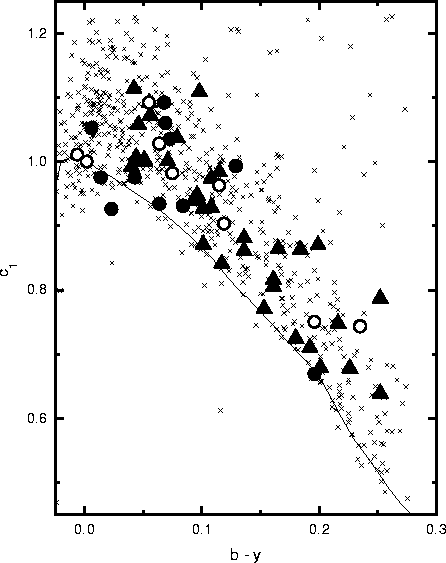
Figure 2: c1 versus b-y.
Symbols are the same as in Fig. 1 (click here).
Standard line is taken from Philip & Egret (1980)