

When we started this project, there was considerable confusion
in the literature over which stars should
be considered as members of the  Bootis group. A small sample of twenty well
established members (Gray & Corbally 1993) gave a general
indication of the region the Bootis stars occupied in the various photometric
diagrams, but the boundaries of these regions were ill-defined.
Since these stars are quite rare (they comprise
about 1% of the field A-type stars), the main problem was to define
photometric boxes which would allow the detection of Bootis stars with a high
probability. These boxes had to be
large enough to include the whole range of possible Bootis stars, but also small
enough to make a spectroscopic survey feasible. We finally adopted
the relations given in Table 1 (click here) as our "search box"
to select candidates from their colours in the
Strömgren photometric system. We have found it impractical to use derived
indices such as
Bootis group. A small sample of twenty well
established members (Gray & Corbally 1993) gave a general
indication of the region the Bootis stars occupied in the various photometric
diagrams, but the boundaries of these regions were ill-defined.
Since these stars are quite rare (they comprise
about 1% of the field A-type stars), the main problem was to define
photometric boxes which would allow the detection of Bootis stars with a high
probability. These boxes had to be
large enough to include the whole range of possible Bootis stars, but also small
enough to make a spectroscopic survey feasible. We finally adopted
the relations given in Table 1 (click here) as our "search box"
to select candidates from their colours in the
Strömgren photometric system. We have found it impractical to use derived
indices such as  and
and  because of their insensitivity to the characteristics of Bootis stars. This
is especially true for stars in the main sequence band (Fig. 1 (click here)). As
an example we take Bootis itself. The calibrations taken from Hilditch
et al. (1983) give E(b-y)=0 and
because of their insensitivity to the characteristics of Bootis stars. This
is especially true for stars in the main sequence band (Fig. 1 (click here)). As
an example we take Bootis itself. The calibrations taken from Hilditch
et al. (1983) give E(b-y)=0 and 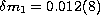 which implies a solar abundance for Bootis, however, Venn & Lambert
(1990) have found
which implies a solar abundance for Bootis, however, Venn & Lambert
(1990) have found  .
The Hauck & Mermilliod (1990) catalogue was used as the
database for our search. To avoid duplication of effort, we have removed
from our candidate list stars already classified in Corbally
(1984) and Gray & Garrison (1987, 1989a,b)
as well as known MK standards. In addition we have searched for possible
candidates in open clusters using the list of North (1993).
Members of these clusters were dereddened and checked for their location in
the photometric boxes. In total a list of 600 possible candidates was
compiled for the northern and southern hemisphere. Up to now about 300 stars
have been observed and 120 have been classified.
.
The Hauck & Mermilliod (1990) catalogue was used as the
database for our search. To avoid duplication of effort, we have removed
from our candidate list stars already classified in Corbally
(1984) and Gray & Garrison (1987, 1989a,b)
as well as known MK standards. In addition we have searched for possible
candidates in open clusters using the list of North (1993).
Members of these clusters were dereddened and checked for their location in
the photometric boxes. In total a list of 600 possible candidates was
compiled for the northern and southern hemisphere. Up to now about 300 stars
have been observed and 120 have been classified.
| -0.025 | < | b-y | < | 0.3 |
| 0.13-0.3(b-y) | < | m1 | < | 0.22-0.3(b-y) |
| c1 | < | 1.4-2(b-y) |
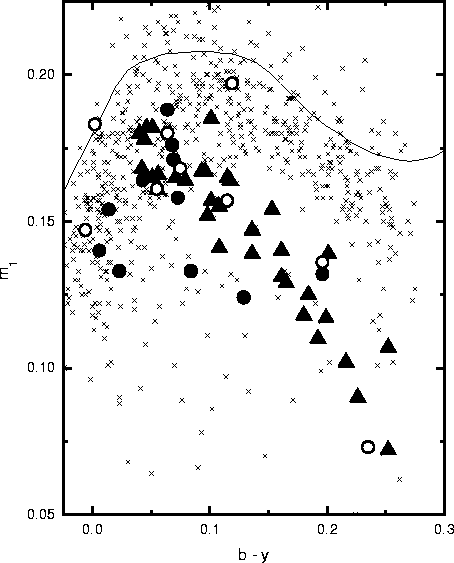
Figure 1: m1 versus b-y.
Crosses are normal stars from Gray &
Garrison (1987, 1989a,b), filled triangles are Bootis stars
from Paunzen et al. (1997), filled circles
are Bootis stars discussed in Sect. 6.1 (click here), open circles are
candidate Bootis stars discussed in Sect. 6.2 (click here). The standard
line is taken from Philip & Egret (1980)