

The corrected spectra have finally been composed into the unified
library shown in Fig. 19 (click here). In this library, model spectra are given
for a parameter grid which is uniformly sampled in  ,
,  , and [M/H], each spectrum being available for the same wavelength
grid, (
, and [M/H], each spectrum being available for the same wavelength
grid, ( ), with a
medium resolution of
), with a
medium resolution of  .
.

Figure 16: Bolometric correction, BCV, as a function of effective
temperature, for corrected K-library
solar-metallicity dwarf model spectra. The solid line
represents the empirical calibration given by
Schmidt-Kaler (1982)
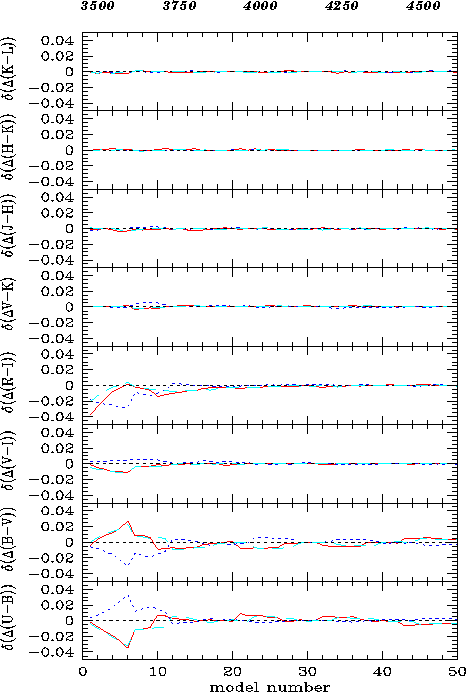
Figure 17: Residuals between differential colors obtained from original
and corrected library spectra for models of the same effective
temperatures and surface gravities but different
metallicities. The abscissa represents the monotonic increase
in temperature (as indicated along the top of the panel) and
surface gravity in a similar way as Table 2 (click here).
Residuals are for the coolest models from the K-library  and for metallicities [M/H]=-3.0 (solid
line), [M/H]=-2.0 (long-dashed line), and [M/H]=+1.0 (dotted
line)
and for metallicities [M/H]=-3.0 (solid
line), [M/H]=-2.0 (long-dashed line), and [M/H]=+1.0 (dotted
line)
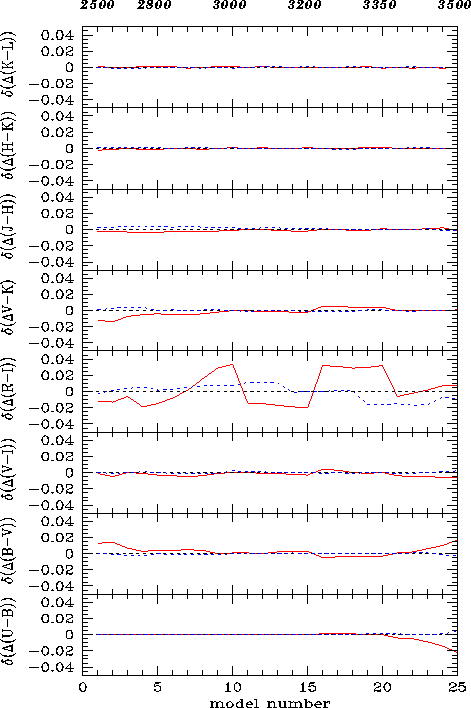
Figure 18: Same as Fig. 17 (click here), but for the M-giant models
from the  -library
  and for
metallicities [M/H]=-1.0 (solid line) and [M/H]=+0.5 (dotted
line). The zero residuals for U-B are due to the fact that in this
wavelength range, -library spectra are available for
solar metallicity only
and for
metallicities [M/H]=-1.0 (solid line) and [M/H]=+0.5 (dotted
line). The zero residuals for U-B are due to the fact that in this
wavelength range, -library spectra are available for
solar metallicity only
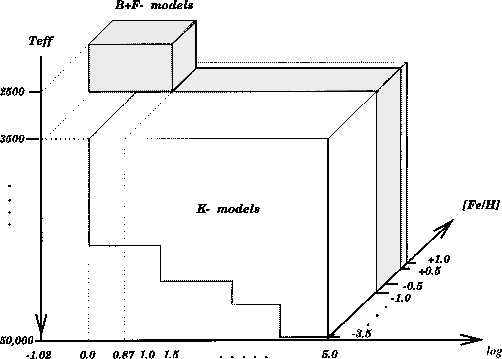
Figure 19: The (, , [M/H]) parameter space covered
by the present unified library. Solid lines delineate approximate
boundaries of available models.  -models for M-giants
are confined to the metallicity range
-models for M-giants
are confined to the metallicity range  (grey part)
The main body consists of the K-library, which provides the most
extensive coverage of parameter space (cf. Table 1 (click here)) down
to  , and which has therefore been fully implemented
to this limit. The extensions to lower temperatures,
, and which has therefore been fully implemented
to this limit. The extensions to lower temperatures,  , and associated lower surface gravities,
  , are provided by the M-giant spectra from
the
, are provided by the M-giant spectra from
the  -library, which, however, covers only the limited
metallicity range
-library, which, however, covers only the limited
metallicity range  .
.
This unified library is available (in electronic form) at the CDS,
Strasbourg, France, where it can be obtained in either of two
versions, with the corrected or the original
uncorrected spectra from the K- and -libraries.