

In order to assess the reliability of the synthetic spectra, we now compare them to empirical temperature-color calibrations. Depending on the availability and the quality of calibration data, two basic calibration sequences will be used for the cooler giants and for the hotter main sequence stars, respectively.
Ridgway et al. (1980) derived an empirical
temperature-(V-K) relation for cool giant stars. This relation is
based on stellar diameter and flux measurements, and therefore on the
definition of the effective temperature:

where  is the apparent bolometric flux,
  is
Boltzmann's constant, and
is
Boltzmann's constant, and  is the angular diameter. Hence
is almost entirely empirical.
is the angular diameter. Hence
is almost entirely empirical.
Over the range  , the Ridgway et al.
calibration was adopted as the effective temperature scale for the
V-K colors. We derived the color-temperature relations for V-I,
J-H, H-K, J-K and K-L using the infrared two-color calibrations
given by Bessell
& Brett (1988) (hereafter referred to as BB88). For the U-B and
B-V colors, we used the color-color relations established by
Johnson (1966), and Bessell's (1979)
calibration was adopted for the
, the Ridgway et al.
calibration was adopted as the effective temperature scale for the
V-K colors. We derived the color-temperature relations for V-I,
J-H, H-K, J-K and K-L using the infrared two-color calibrations
given by Bessell
& Brett (1988) (hereafter referred to as BB88). For the U-B and
B-V colors, we used the color-color relations established by
Johnson (1966), and Bessell's (1979)
calibration was adopted for the  relation.
Because existing calibrations do not go below  , we
have used both observations and theoretical results published by Fluks
et al. (1994) in order to construct semi-empirical
, we
have used both observations and theoretical results published by Fluks
et al. (1994) in order to construct semi-empirical
 -color calibrations down to the range
  . Synthetic V-K colors computed from their sequence of photospheric
model spectra provide a very good match to the calibration by Ridgway
et al., which could thus be extended to the range (
. Synthetic V-K colors computed from their sequence of photospheric
model spectra provide a very good match to the calibration by Ridgway
et al., which could thus be extended to the range ( ) by adopting the theoretical
  relation from Fluks et al.
 . We then
used Fluks et al.'s compilation of
. We then
used Fluks et al.'s compilation of
 observations of a large
sample of bright M-giant stars in the solar neighbourhood to
establish the mean intrinsic colors and standard deviations from their
estimates of interstellar extinction within each photometric band.
Finally, with these results, we derived mean intrinsic color-color
relations - (V-I)-(V-K), (U-B)-(V-I), (R-I)-(V-K) and
(B-V)-(R-I) -, which allowed us to translate to all these other
colors the basic relation adopted above for red
giants within the temperature range .
observations of a large
sample of bright M-giant stars in the solar neighbourhood to
establish the mean intrinsic colors and standard deviations from their
estimates of interstellar extinction within each photometric band.
Finally, with these results, we derived mean intrinsic color-color
relations - (V-I)-(V-K), (U-B)-(V-I), (R-I)-(V-K) and
(B-V)-(R-I) -, which allowed us to translate to all these other
colors the basic relation adopted above for red
giants within the temperature range .
Examples of the adopted fits for the (V-I)-(V-K) and the (U-B)-(V-I) sequences are shown in Figs. 3 (click here) and 4 (click here).
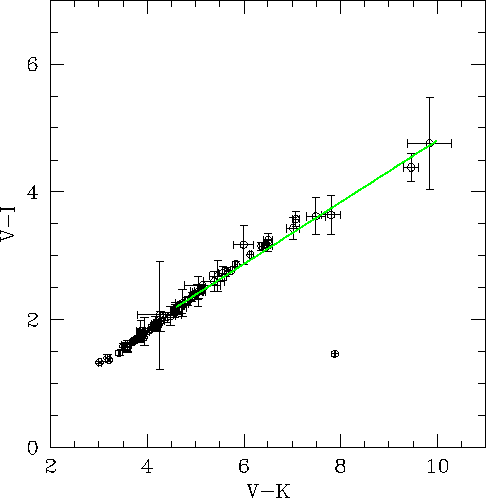
Figure 3: Adopted (V-I)-(V-K) two-color calibration sequence for cool
giants. Symbols represent mean values derived from
observations given by Fluks et al. (1994).
The solid line is a linear least-squares fit to the data for 
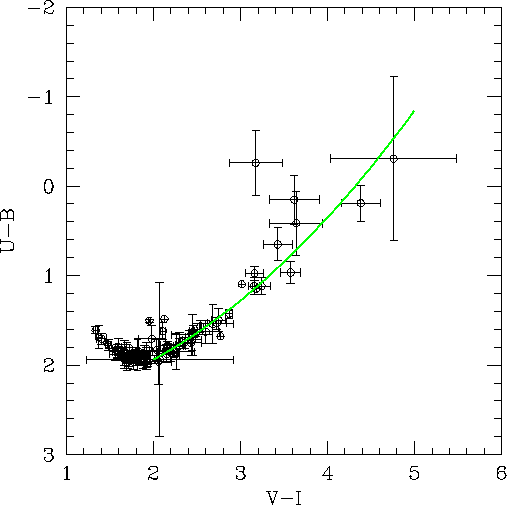
Figure 4: Adopted (U-B)-(V-I) two-color calibration sequence for cool
giants. Symbols represent the same as in
Fig. 3 (click here). The solid line is a quadratic fit to the
data for 
For the infrared colors, the photometric data given by Fluks et
al. are defined on the  filter system, which is
different from the filter system defined by BB88. Using the color
equations relating the two systems and derived by BB88, transformed
JHKL colors from the Fluks et al. data were computed. The
resulting (V-K)-(V-J), (V-K)-(V-H), (V-L)-(V-J) and
(V-H)-(V-J) sequences are well approximated by linear extrapolations
of the two-color relations given by BB88. Furthermore, the model
colors derived from the Fluks et al. synthetic spectra and the
filter responses defined by BB88 also agree very well with these
extrapolated relations (Fig. 5 (click here)). We therefore chose this method
to derive the J-H, H-K, J-K and K-L colors over the range . However, the uncertainty implied by the extrapolation
to the reddest giants is of the order of
filter system, which is
different from the filter system defined by BB88. Using the color
equations relating the two systems and derived by BB88, transformed
JHKL colors from the Fluks et al. data were computed. The
resulting (V-K)-(V-J), (V-K)-(V-H), (V-L)-(V-J) and
(V-H)-(V-J) sequences are well approximated by linear extrapolations
of the two-color relations given by BB88. Furthermore, the model
colors derived from the Fluks et al. synthetic spectra and the
filter responses defined by BB88 also agree very well with these
extrapolated relations (Fig. 5 (click here)). We therefore chose this method
to derive the J-H, H-K, J-K and K-L colors over the range . However, the uncertainty implied by the extrapolation
to the reddest giants is of the order of  ,
indicating that for the coolest temperatures near 2500 K the resulting
empirical calibration of the J-H, H-K, J-K, and K-L colors should
be improved by future observations.
,
indicating that for the coolest temperatures near 2500 K the resulting
empirical calibration of the J-H, H-K, J-K, and K-L colors should
be improved by future observations.
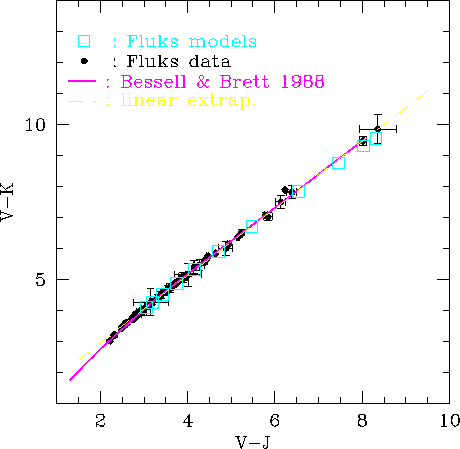
Figure 5: Adopted extrapolation of the (V-K)-(V-J) relation for cool
giants (dashed line). Model colors (open squares) and observed data
(crosses) from Fluks et al. (1994) are
compared to the empirical sequence adopted. (See text for explanations)
Table 2 (click here) presents the final adopted temperature-color calibrations
for red giants, which was supplemented by a  sequence related to
the effective temperature via an evolutionary track (
sequence related to
the effective temperature via an evolutionary track ( )
calculated by Schaller et al. (1992).
)
calculated by Schaller et al. (1992).
|
| U-B | B-V | V-I | V-K | R-I | J-H | H-K | J-K | K-L | |
| 4593 | 1.0175 | 1.0945 | 1.0801 | 2.5001 | 0.4876 | 0.5801 | 0.1001 | 0.6801 | 0.0801 | 2.85 |
| 4436 | 1.1875 | 1.1735 | 1.1701 | 2.7001 | 0.5306 | 0.6301 | 0.1151 | 0.7401 | 0.0901 | 2.50 |
| 4245 | 1.3995 | 1.2815 | 1.3601 | 3.0001 | 0.6026 | 0.6801 | 0.1401 | 0.8201 | 0.1001 | 2.12 |
| 4095 | 1.5665 | 1.3645 | 1.4791 | 3.2601 | 0.6726 | 0.7301 | 0.1501 | 0.8801 | 0.1101 | 1.82 |
| 3954 | 1.7145 | 1.4435 | 1.6341 | 3.6001 | 0.7736 | 0.7901 | 0.1651 | 0.9501 | 0.1201 | 1.55 |
| 3870 | 1.7845 | 1.4895 | 1.7681 | 3.8501 | 0.8596 | 0.8301 | 0.1901 | 1.0101 | 0.1201 | 1.39 |
| 3801 | 1.8155 | 1.5245 | 1.8991 | 4.0501 | 0.9486 | 0.8501 | 0.2051 | 1.0501 | 0.1301 | 1.25 |
| 3730 | 1.8125 | 1.5525 | 2.0531 | 4.3001 | 1.0586 | 0.8701 | 0.2151 | 1.0801 | 0.1501 | 1.15 |
| 3640 | 1.7505 | 1.5775 | 2.2691 | 4.6401 | 1.2286 | 0.9001 | 0.2351 | 1.1301 | 0.1701 | 0.98 |
| 3560 | 1.6515 | 1.5905 | 2.4721 | 5.1001 | 1.5684 | 0.9301 | 0.2451 | 1.1701 | 0.1801 | 0.83 |
| 3420 | 1.4125 | 1.5895 | 2.8281 | 5.9601 | 1.8994 | 0.9501 | 0.2851 | 1.2301 | 0.2001 | 0.56 |
| 3250 | 1.0194 | 1.5274 | 3.3094 | 6.8401 | 2.1704 | 0.9601 | 0.3001 | 1.2601 | 0.2561 | 0.21 |
| 3126 | 0.6454 | 1.4994 | 3.7094 | 7.8303 | 2.3914 | 0.9502 | 0.3702 | 1.3202 | 0.3102 | -0.05 |
| 2890 | 0.0964 | 1.5124 | 4.2344 | 8.7603 | 2.5194 | 0.9202 | 0.4002 | 1.3202 | 0.4202 | -0.57 |
| 2667 | -0.1464 | 1.5074 | 4.4394 | 9.3103 | 2.5584 | 0.9002 | 0.4102 | 1.3102 | 0.5102 | -1.09 |
| 2500 | -0.3284 | 1.5104 | 4.5934 | 9.5603 | 2.5674 | 0.8802 | 0.4202 | 1.3002 | 0.5502 | -1.52 |
1 Bessell & Brett (1988) two-color relation
with Ridgway et al. (1980) to relate to
V-K.
2 Extrapolation of two-color relations from Bessell & Brett
(1988).
3 Synthetic color indices from Fluks et al. (1994)
models.
4 From mean two-color relations derived from the Fluks et
al. (1994) observed data.
5 Empirical calibration from Johnson (1966).
6 Empirical calibration from Bessell (1979).
To construct empirical -color sequences from 12000 K to
3600 K for the main sequence stars, we used different calibrations:
Schmidt-Kaler (1982) was chosen to relate to U-B,
B-V or R-I, and the two-color relations established by
FitzGerald (1970), Bessell (1979), and BB88
were then used to derive the temperature scales for the remaining
colors. This procedure should provide color-temperature calibrations
with uncertainties of  in color or
  in
temperature (Buser & Kurucz 1992).
in
temperature (Buser & Kurucz 1992).
In order to compare the models to the above color-temperature
relations for red giants, model spectra were first interpolated in the
theoretical libraries for appropriate values of surface gravity given
by the  relation defined by the evolutionary track from Schaller et al.
(1992). Synthetic colors computed from these model spectra are
then directly compared to the empirical color-temperature relations, as
illustrated in Fig. 6 (click here).
relation defined by the evolutionary track from Schaller et al.
(1992). Synthetic colors computed from these model spectra are
then directly compared to the empirical color-temperature relations, as
illustrated in Fig. 6 (click here).
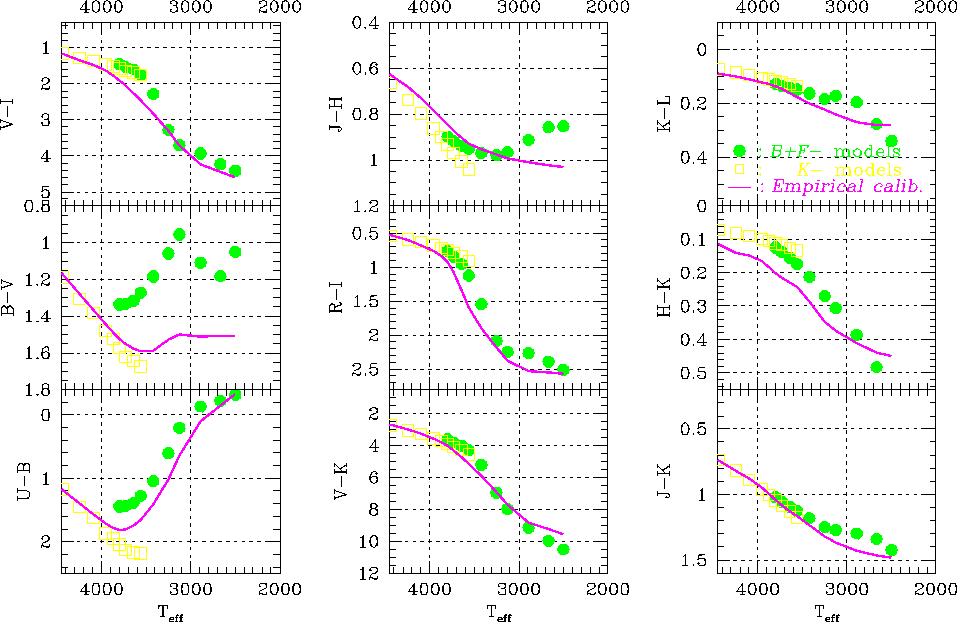
Figure 6: Empirical color-effective temperature calibrations for
solar-metallicity red giant stars (solid lines, according to
Table 2 (click here)) compared to the corresponding theoretical
relations calculated from original synthetic library spectra
(symbols, according to key in insert). Note that different scales
have been used for the different colors
It is evident that the color differences between equivalent models
from the K- and the  -libraries can be as high as 0.4
mag, while those between the theoretical library spectra and the empirical
calibrations may be even larger, up to 1 mag.
-libraries can be as high as 0.4
mag, while those between the theoretical library spectra and the empirical
calibrations may be even larger, up to 1 mag.
Such differences - both between the original libraries and between these and the empirical calibrations - make it clear that direct use of these original theoretical data in population and evolutionary synthesis is bound to generate a great deal of confusion in the interpretation of results. In particular, applications to the integrated light of galaxies at faint magnitude levels, where effects of cosmological redshift may come into play as well, will provide rather limited physical insight unless the basic building blocks of the evolutionary synthesis - i.e., the stellar spectra - are systematically consistent with the best available observational evidence. Thus, our work is driven by the systematic consistency of theoretical stellar colors and empirical calibrations as a minimum requirement for the (future) standard library. As a viable operational step in this direction, a suitable correction procedure for the theoretical spectra will be developed in the following section.
The same procedure as for the giants was applied for the main sequence
stars, except that a zero-age main sequence isochrone (ZAMS) compiled
by Bruzual (1995) was used in the appropriate interpolation
for the surface gravity . Again, synthetic photometry results
obtained from the theoretical library (Kurucz) are compared to the
empirical color-temperature relations in Fig. 7 (click here).
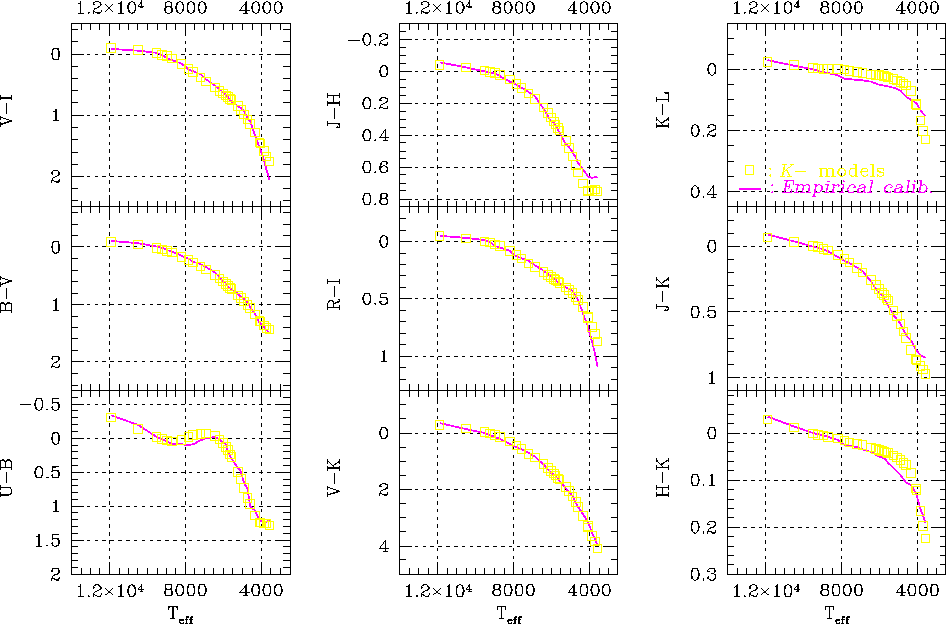
Figure 7: Empirical color-effective temperature calibrations for
solar-metallicity dwarf stars (solid lines, see text for
sources) compared to the corresponding theoretical relations
calculated from original synthetic K-library spectra
(symbols). Note that different scales have been used for the
different colors
Note that the differences between the theoretical and the empirical
colors are significantly smaller than those for the giants given in
Fig. 6 (click here): for the hotter temperatures, they do not exceed 0.1
mag, while at cooler temperatures ( ) differences of up
to 0.3 mag in V-I between models and observations again indicate that
the coolest K-library spectra still carry large uncertainties and should,
therefore, be used with caution (e.g., Buser & Kurucz
1992). Thus, application of the same correction procedure as for
the giant models appears warranted for the dwarf models as well.
) differences of up
to 0.3 mag in V-I between models and observations again indicate that
the coolest K-library spectra still carry large uncertainties and should,
therefore, be used with caution (e.g., Buser & Kurucz
1992). Thus, application of the same correction procedure as for
the giant models appears warranted for the dwarf models as well.
Also note that the Kurucz spectra only go down to 3500 K. We are thus missing the low-luminosity, low-temperature main sequence M stars in the present library. However, we anticipate here that in a corollary paper (Lejeune et al. 1997, hereafter Paper II) the necessary extension is being provided from a similar treatment of the comprehensive grid of M-star model spectra published by Allard & Hauschildt (1995).