

The 8 hypergiants that have been observed show that the Ca II line profiles have
a complex structure.
Emission components appear within the absorption profile,
perhaps similar to the ones that are observed in the Ca II H and K profiles of
stars known to have chromospheric activity. However, the rest of the
stars, i.e., the dwarfs, giants and supergiants show only absorption profiles
in the Ca II triplet lines.
Anderson (1974) observed the  8498 line in 28 stars of
spectral types F8-M2 at a resolution of 0.28 Å and found no distinct
emission in any star. Only one star,
8498 line in 28 stars of
spectral types F8-M2 at a resolution of 0.28 Å and found no distinct
emission in any star. Only one star,  Dra showed a central residual
intensity (CRI) larger than in the other stars, possibly due to filling in by chromospheric
emission. This star is the only one with a very active chromosphere in
Anderson's list
(intensity class 3 according to Wilson 1976). Linsky et
al. (1979) also observed
Dra showed a central residual
intensity (CRI) larger than in the other stars, possibly due to filling in by chromospheric
emission. This star is the only one with a very active chromosphere in
Anderson's list
(intensity class 3 according to Wilson 1976). Linsky et
al. (1979) also observed  8542 profiles at a resolution of
0.14 Å in 49 stars as a probe for chromospheric activity. Their
resolution is twice as high as that of Anderson and is sufficient to
resolve emission features within the absorption profiles of the Ca II
triplet in stars if they are present. No evidence of emission was found even
for the most active chromosphere star.
8542 profiles at a resolution of
0.14 Å in 49 stars as a probe for chromospheric activity. Their
resolution is twice as high as that of Anderson and is sufficient to
resolve emission features within the absorption profiles of the Ca II
triplet in stars if they are present. No evidence of emission was found even
for the most active chromosphere star.
| Star | Spectral | I(CaII K) |  | CRI | EQW | ||||
| type | ( ) ) |  8498 8498 |  8542 8542 |  8662 8662 |  8498 8498 |  8542 8542 |  8662 8662 | ||
| HR 2269 | K3 Ib | - | - | 0.32 | 0.25 | 0.30 | 1.59 | 3.40 | 3.36 |
| 3 Cet | K3 Ib | - | <17 | 0.18 | 0.12 | 0.20 | 2.11 | 4.66 | 3.63 |
| HR 2269 | K3 Ib | - | - | 0.32 | 0.25 | 0.30 | 1 59 | 3.40 | 3.36 |
 Per Per | K3 Ib | 4 |  54 54 | 0.17 | 0.12 | 0.08 | 2.52 | 4.59 | 3.96 |
| 56 Peg | G8 Ib | 4 | <17 | 0.45 | 0.35 | 0.24 | 1.50 | 3.43 | 2.85 |
 Cep Cep | K1.5 Ib | 3 | <17 | 0.16 | 0.11 | 0.10 | 2.60 | 5.17 | 4.51 |
| 56 Peg | G8 Ib | 4 | <17 | 0.45 | 0.35 | 0.24 | 1.50 | 3.43 | 2.85 |
 Gem Gem | G8 Ib | 4 | <17 | 0.19 | 0.15 | 0.11 | 2.62 | 4.71 | 4.02 |
 Dra Dra | G2 Ib-IIa | 3 | 13 | 0.37 | 0.27 | 0.31 | 1.83 | 4.40 | 3.43 |
 Gem Gem | G0 Ib | - |  54 54 | 0.28 | 0.15 | 0.15 | 1.76 | 4.66 | 4.35 |
 Vir Vir | M3 III | 4 | - | 0.33 | 0.20 | 0.17 | 1.59 | 3.37 | 3.05 |
 Gem Gem | M3 III | 5 | - | 0.28 | 0.14 | 0.18 | 1.85 | 3.89 | 3.36 |
 CMa CMa | K4 III | 3 | <19 | 0.30 | 0.17 | 0.16 | 1.49 | 2.94 | 2.62 |
 Tau Tau | K5 III | 3 | <17 | 0.25 | 0.12 | 0.13 | 1.88 | 4.20 | 3.22 |
 Hya Hya | K2 III | 3 | <17 | 0.33 | 0.23 | 0.18 | 1.32 | 3.01 | 2.84 |
 Col Col | K2 III | 2 | - | 0.28 | 0.15 | 0.17 | 1.57 | 3.46 | 2.94 |
 Gem Gem | K1 III | - | 22 | 0.65 | 0.51 | 0.56 | 1.31 | 3.23 | 2.09 |
 Gem Gem | K0 IIIb | 1 | <17 | 0.37 | 0.17 | 0.23 | 1.37 | 3.53 | 2.64 |
 And And | G8 III | 5 | <19 | 0.73 | 0.57 | 0.58 | 0.86 | 2.58 | 1.71 |
 Ori Ori | K0 III | 2 | - | 0.37 | 0.20 | 0.23 | 1.20 | 2.85 | 2.52 |
 Hya Hya | G5 III | - | 19 | 0.5 | 0.33 | 0.36 | 1.15 | 3.04 | 2.35 |
| o UMa | G5 III | 1 | 17 | 0.38 | 0.21 | 0.12 | 1.30 | 3.27 | 2.21 |
 Vir Vir | G2 IV | 3 | 0 | 0.58 | 0.50 | 0.43 | 1.06 | 2.36 | 2.01 |
 Her Her | G5 IV | 0 | 20 | 0.45 | 0.22 | 0.29 | 1.10 | 3.48 | 2.28 |
 Vir Vir | G2 IV | 3 | 0 | 0.58 | 0.50 | 0.43 | 1.06 | 2.36 | 2.01 |
 Her Her | G0 IV | 0 |  10 10 | 0.47 | 0.33 | 0.25 | 1.18 | 2.28 | 2.07 |
 Eri Eri | K2 V | 4 | <17 | 0.58 | 0.44 | 0.47 | 1.16 | 2.96 | 2.06 |
 Eri Eri | K1 V | 2 | - | 0.50 | 0.32 | 0.33 | 1.32 | 3.11 | 2.38 |
 Cet Cet | G8 V | - | 2 | 0.54 | 0.40 | 0.43 | 0.97 | 2.31 | 1.80 |
| 82 Eri | G8 V | - | - | 0.48 | 0.31 | 0.33 | 1.07 | 3.04 | 2.37 |
 Ori Ori | G0 V | 2 | 6 | 0.66 | 0.60 | 0.46 | 0.90 | 1.66 | 1.58 |
 Com Com | G0 V | 1 | 6 | 0.57 | 0.37 | 0.37 | 0.90 | 2.29 | 2.02 |
 Ori Ori | G0 V | 2 | 6 | 0.66 | 0.60 | 0.46 | 0.90 | 1.66 | 1.58 |
 Vir Vir | F9 V | 0 | 3 | 0.50 | 0.35 | 0.33 | 1.10 | 1.88 | 1.83 |
| HR 5317 | F7 V | - | 30 | 0.58 | 0.37 | 0.32 | 1.17 | 3.40 | 2.17 |
 Cap Cap | F8 V | - | 54 | 0.36 | 0.21 | 0.21 | 1.78 | 4.27 | 2.84 |
However, it was found that when the observed spectra of stars are arranged into
groups with similar spectral type and luminosity class, within each group there are stars
for which the line profiles differ in shape near the line center from the rest of the
stars in that group, in the sense that CRI is higher for these stars compared to that of the rest.
Some of the examples cited by Linsky et al. (1979) are 111
Tau- Vir,
Vir,  Boo A-
 Cet,
Cet,  And-
And- Crt,
Crt,
 Ori-
Ori- Com,
Com,  Gem-
Gem- Cet,
Cet,  Aur-
Aur- Crv,
Crv,  Dra-
Dra- Leo, 9 Peg-
 Gem; the first one in each
pair having a higher CRI than the other. These are perhaps the stars whose
absorption profiles show filling in of the
Gem; the first one in each
pair having a higher CRI than the other. These are perhaps the stars whose
absorption profiles show filling in of the  8542 cores by unresolved
chromospheric emission. According to Wilson (1976), most of
these are the active chromosphere stars with an intensity index higher than
3. Following Linsky et al. (1979), we have also grouped all
the observed stars of similar spectral type, luminosity and also metallicity
(within
8542 cores by unresolved
chromospheric emission. According to Wilson (1976), most of
these are the active chromosphere stars with an intensity index higher than
3. Following Linsky et al. (1979), we have also grouped all
the observed stars of similar spectral type, luminosity and also metallicity
(within  [Fe/H] =
  0.2) and have found about 13 pairs that are
tabulated in Table 3 (click here). The first one is with the larger CRI than the
other and is therefore suspected to be chromospherically more active. Listed
in the Cols. 5, 6 and 7 of Table 3 (click here), CRI is systematically higher in
all the 3 lines in the first star of each pair for all pairs. For 4 of the
chromospherically active stars, two examples each of above pairs are cited.
The intensity index according to Wilson & Bappu (1957) and
Wilson (1976) in the more active stars is 3 or higher except
for
0.2) and have found about 13 pairs that are
tabulated in Table 3 (click here). The first one is with the larger CRI than the
other and is therefore suspected to be chromospherically more active. Listed
in the Cols. 5, 6 and 7 of Table 3 (click here), CRI is systematically higher in
all the 3 lines in the first star of each pair for all pairs. For 4 of the
chromospherically active stars, two examples each of above pairs are cited.
The intensity index according to Wilson & Bappu (1957) and
Wilson (1976) in the more active stars is 3 or higher except
for  Ori as seen in Col. 3 of Table 3 (click here). None of these stars
are fast rotators. The quantity
Ori as seen in Col. 3 of Table 3 (click here). None of these stars
are fast rotators. The quantity  taken from the
Bright Star Catalogue is listed in Col. 4. It is less than
taken from the
Bright Star Catalogue is listed in Col. 4. It is less than  for most of the stars. Only
  Cap,
Cap,  Gem and HR 5317
exceed this value. So rotational broadening cannot be affecting the CRI of
the Ca II triplet lines in these stars. Since the latter star (i.e.
Gem and HR 5317
exceed this value. So rotational broadening cannot be affecting the CRI of
the Ca II triplet lines in these stars. Since the latter star (i.e.  Cap) in the pair HR 5317-
 Cap has higher
  , the relatively
higher CRI of HR 5317 cannot be due to rotational broadening. In fact, the
Ca II lines of HR 5317 as seen in Fig. 7 (click here)a seem a bit too weak for
its high +ve [Fe/H]. We suspect that it is due to chromospheric emission
filling in the star.
, the relatively
higher CRI of HR 5317 cannot be due to rotational broadening. In fact, the
Ca II lines of HR 5317 as seen in Fig. 7 (click here)a seem a bit too weak for
its high +ve [Fe/H]. We suspect that it is due to chromospheric emission
filling in the star.  Cet in Fig. 5 (click here)b has a rather low EQW
perhaps again because chromospheric emission has partly filled in its
absorption profile. As Cols. 8, 9 and 10 of Table 3 (click here) show, the
EQWs of all the 3 lines are smaller in the star with the larger CRI than in
the star with the smaller CRI. The amount by which they differ ranges from
10 to 30%. However, this may not be the best way of measuring the
chromospheric emission that fills in the absorption. Following the scheme of
Linsky et al. (1979), we compared the Ca II profiles of each
pair (stars with similar spectral type, luminosity & metallicity) by
dividing the spectrum of one with the larger CRI by that of the other with
the smaller CRI point by point. Figure 9 (click here) shows some of these
divided spectra in
Cet in Fig. 5 (click here)b has a rather low EQW
perhaps again because chromospheric emission has partly filled in its
absorption profile. As Cols. 8, 9 and 10 of Table 3 (click here) show, the
EQWs of all the 3 lines are smaller in the star with the larger CRI than in
the star with the smaller CRI. The amount by which they differ ranges from
10 to 30%. However, this may not be the best way of measuring the
chromospheric emission that fills in the absorption. Following the scheme of
Linsky et al. (1979), we compared the Ca II profiles of each
pair (stars with similar spectral type, luminosity & metallicity) by
dividing the spectrum of one with the larger CRI by that of the other with
the smaller CRI point by point. Figure 9 (click here) shows some of these
divided spectra in  8498, 8542 and
  8662.
8662.
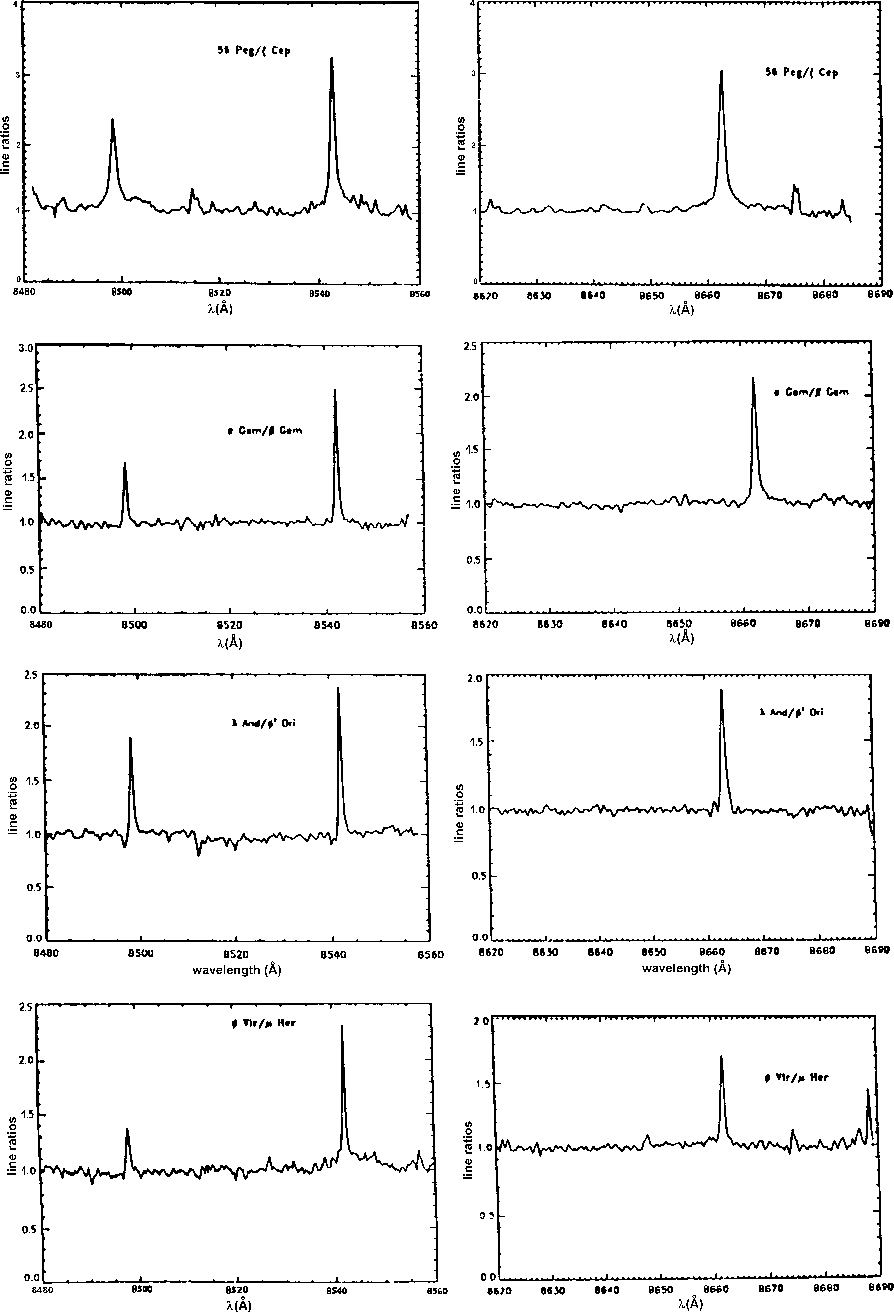
Figure 9: Line ratio spectra of  , 8542, 8662 of a
few sample pairs
, 8542, 8662 of a
few sample pairs
| Ratio | spectra | FWHM(Å) | emission | area of | |||||||
| peak(Å) | emission | ||||||||||
 8498 8498 |  8542 8542 |  8662 8662 |  8498 8498 |  8542 8542 |  8662 8662 |  8498 8498 |  8542 8542 |  8662 8662 | |||
| HR 2269 | / | 3 Cet | 0.84 | 0.78 | 2.14 | 2.45 | 3.25 | 1.67 | 2.06 | 2.54 | 3.58 |
| HR 2269 | / |  Per Per | 1.12 | 1.20 | - | 2.3 | 2.3 | - | 2.58 | 2.75 | - |
| 56 Peg | / |  Cep Cep | 1.50 | 1.15 | 1.23 | 2.36 | 3.25 | 3.05 | 3.54 | 3.74 | 3.74 |
| 56 Peg | / |  Gem Gem | 1.06 | 1.56 | 1.54 | 2.6 | 2.16 | 2.65 | 2.77 | 3.38 | 4.08 |
 Dra Dra | / |  Gem Gem | 1.17 | 0.9 | 1.43 | 1.84 | 1.48 | 1.75 | 2.15 | 1.33 | 2.50 |
 Vir Vir | / |  Gem Gem | 1.10 | 1 20 | 1.05 | 1.23 | 1.46 | 1.25 | 1.35 | 1.75 | 1.31 |
 CMa CMa | / |  Tau Tau | 0.70 | 0.69 | 0.63 | 1.52 | 2.10 | 1.98 | 1.06 | 1.45 | 1.25 |
 Hya Hya | / |  Col Col | 0.84 | 0.65 | - | 1.43 | 2.16 | - | 1.20 | 1.4 | - |
 Gem Gem | / |  Gem Gem | 0.83 | 0.71 | 0.81 | 1.64 | 2.47 | 2.17 | 1.36 | 1.75 | 1.76 |
 And And | / |  Ori Ori | 0.8 | 0.76 | 0.88 | 1.90 | 2.37 | 1.87 | 1.52 | 1.80 | 1.58 |
 Hya Hya | / | o UMa | 0.89 | 0.83 | 0.6 | 1.37 | 1.65 | 3.05 | 1.21 | 1.37 | 1.83 |
 Vir Vir | / |  Her Her | 0.77 | 0.69 | 0.67 | 1.37 | 2.27 | 1.88 | 1.05 | 1.57 | 1.25 |
 Vir Vir | / |  Her Her | - | 0.6 | 0.7 | - | 1.54 | 1.82 | - | 0.92 | 1.27 |
 Eri Eri | / |  Eri Eri | 0.86 | 0.62 | 0.77 | 1.18 | 1.4 | 1.4 | 1.01 | 0.87 | 1.08 |
 Cet Cet | / | 82 Eri | 0.82 | 0.63 | 0.50 | 1.75 | 1.52 | 1.60 | 1.44 | 0.96 | 0.80 |
 Ori Ori | / |  Com Com | 0.92 | 0.64 | 1.05 | 1.27 | 1.71 | 1.4 | 1.17 | 1.09 | 1.47 |
 Ori Ori | / |  Vir Vir | 0.86 | 0.85 | 1.10 | 1.32 | 1.83 | 1.42 | 1.14 | 1.56 | 1.57 |
| HR 5317 | / |  Cap Cap | 1.25 | 1.00 | - | 1.87 | 2.62 | - | 2.34 | 2.62 | - |
These ratio profiles actually show net emission in each of the 3 lines, the
amount that fills in the absorption profile of the star having larger CRI,
i.e., with larger chromospheric activity. They also show the spectral range
over which the chromospheric filling in occurs in the active chromosphere stars.
Columns 2, 3 and 4 of Table 4 (click here) list the FWHM of the ratio profiles
of the 3 lines in the 13 star pairs given in Col. 1. It would be interesting
to see how the FWHM relates to the luminosity of the stars in question. The
ratio plots give FWHM for the 3 lines in supergiants in the range  , in giants from 0.7 Å to 1.1 Å and in dwarfs &
subgiants from 0.6 Å to 0.9 Å. The FWHM does increase with luminosity,
quite in analogy with the behaviour of the Ca II H and K line emission
widths to luminosity. The peak values of the emission profiles of all the 3
lines are displayed in Cols. 5, 6, and 7 of Table 4 (click here). The product of
FWHM and the peak value of emission (which is actually a more direct measure
of the amount of emission) was calculated for all the dwarf, giant and
supergiant pairs and is shown in Cols. 8, 9 and 10. We find that this
quantity is more sensitive to luminosity than FWHM alone. In supergiants, it
lies in the range 2.1 - 4.0 for the 3 lines, in giants between 1.1 - 1.8
and in dwarfs & subgiants between 0.9 - 1.5. Most of the ratio profiles
differ appreciably from unity only in the line core (within
, in giants from 0.7 Å to 1.1 Å and in dwarfs &
subgiants from 0.6 Å to 0.9 Å. The FWHM does increase with luminosity,
quite in analogy with the behaviour of the Ca II H and K line emission
widths to luminosity. The peak values of the emission profiles of all the 3
lines are displayed in Cols. 5, 6, and 7 of Table 4 (click here). The product of
FWHM and the peak value of emission (which is actually a more direct measure
of the amount of emission) was calculated for all the dwarf, giant and
supergiant pairs and is shown in Cols. 8, 9 and 10. We find that this
quantity is more sensitive to luminosity than FWHM alone. In supergiants, it
lies in the range 2.1 - 4.0 for the 3 lines, in giants between 1.1 - 1.8
and in dwarfs & subgiants between 0.9 - 1.5. Most of the ratio profiles
differ appreciably from unity only in the line core (within  of the line core) implying substantial emission in the chromosphere but not
in the photosphere. According to Linsky et al. (1979), a
better way of detecting photospheric emission apart from the chromospheric
emission, is to subtract the profiles of similar stars. Figure 10 (click here)
shows the line difference plots for
of the line core) implying substantial emission in the chromosphere but not
in the photosphere. According to Linsky et al. (1979), a
better way of detecting photospheric emission apart from the chromospheric
emission, is to subtract the profiles of similar stars. Figure 10 (click here)
shows the line difference plots for  8498, 8542 and
 8662 for a few star pairs. The pairs 56 Peg-
 Cep, 56
Peg-
Cep, 56
Peg- Gem, HR 2269-3 Cet, HR 2269-
 Per are much more spread
out (out to more than
Per are much more spread
out (out to more than  of the line core) than the other
pairs, suggesting a strong evidence of emission beyond the line core,
implying it originates in the photosphere.
of the line core) than the other
pairs, suggesting a strong evidence of emission beyond the line core,
implying it originates in the photosphere.
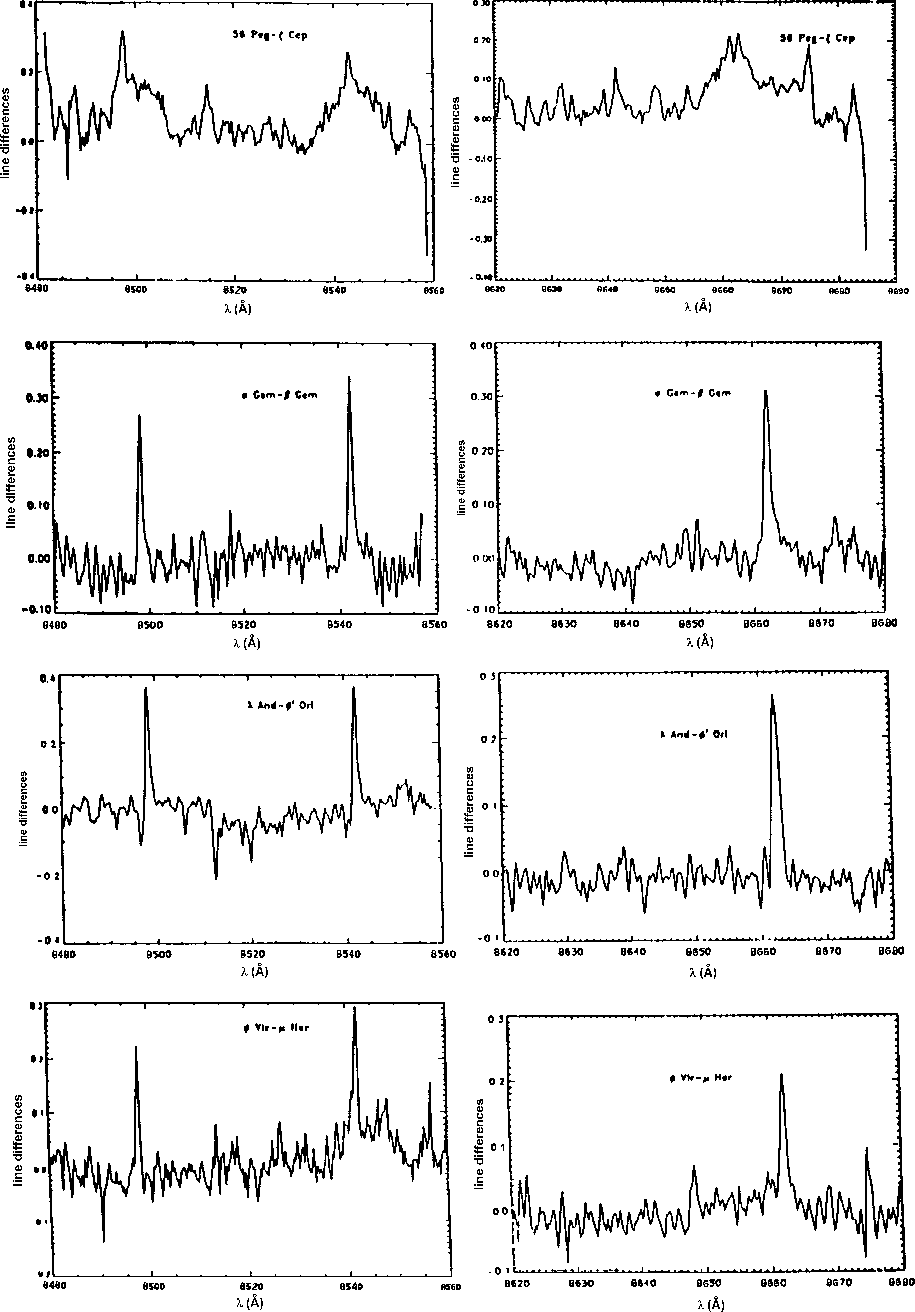
Figure 10: Line difference spectra of  , 8542, 8662
of the same pairs
, 8542, 8662
of the same pairs
Thus, if the CRI of the Ca II triplet lines is not affected
by parameters like rotational broadening, macroturbulence,
microturbulence etc., then the CRI of
especially the 8542 Å and the 8662 Å lines could be viewed as a
diagnostic and a measure of chromospheric activity in stars. The nearly one-to-one correlation
between FWHM/area of the ratio profiles and the Ca II K line emission intensity
index supports the above inference. Linsky et al. (1979) also
strongly support the contention that a direct comparison of  8542
CRIs of stars with similar spectral type and luminosity class should at
least be a qualitative discriminant of chromospheric activity.
The direct spectroscopic diagnostic is the chromospheric radiative loss
rate which is known to be significantly higher in active chromosphere stars than
in quiet chromosphere stars. Linsky et al. (1979) have
estimated the
8542
CRIs of stars with similar spectral type and luminosity class should at
least be a qualitative discriminant of chromospheric activity.
The direct spectroscopic diagnostic is the chromospheric radiative loss
rate which is known to be significantly higher in active chromosphere stars than
in quiet chromosphere stars. Linsky et al. (1979) have
estimated the  8542 chromospheric radiative loss rate in stars they
have observed and find that stars with larger
8542 chromospheric radiative loss rate in stars they
have observed and find that stars with larger  8542 chromospheric
radiative loss rates are also those with larger Ca II K line intensities.
Since the
8542 chromospheric
radiative loss rates are also those with larger Ca II K line intensities.
Since the  8542 CRI's of the stars in each group of stars with
similar spectral and luminosity type have one-to-one correlation with the
K-line index, we contend that
8542 CRI's of the stars in each group of stars with
similar spectral and luminosity type have one-to-one correlation with the
K-line index, we contend that  8542 CRI is a good discriminant of
chromospheric activity. Cayrel de Strobel (1992) has observed
the Ca II
8542 CRI is a good discriminant of
chromospheric activity. Cayrel de Strobel (1992) has observed
the Ca II  8498, 8542 lines in a small sample of F, G and K
dwarfs and slightly evolved subgiants randomly selected from the ``Catalogue
of Nearby Stars" of Gliese (1969). Observed profiles of these
lines in 6 early K dwarfs having about the same effective temperature show
that the shallower the lines are in the spectrum of a star, the more active
the chromosphere of this star is.
8498, 8542 lines in a small sample of F, G and K
dwarfs and slightly evolved subgiants randomly selected from the ``Catalogue
of Nearby Stars" of Gliese (1969). Observed profiles of these
lines in 6 early K dwarfs having about the same effective temperature show
that the shallower the lines are in the spectrum of a star, the more active
the chromosphere of this star is.