A large number of cool stars have been chosen from the Bright Star Catalogue
(Hoffleit 1982) and the [Fe/H] catalogue of Cayrel de
Strobel et al. (1992) brighter than V = +7.0 and ranging in
spectral types from F5 to M4, of all luminosity types. Observations were
carried out at the Vainu Bappu Observatory, Kavalur with the coude echelle
spectrograph at the 102 cm telescope using a  detector, each pixel of
  square size. The spectrograph comprised of
a
square size. The spectrograph comprised of
a  echelle grating blazed at 6746 Å in the 34th order,
a
echelle grating blazed at 6746 Å in the 34th order,
a  cross dispersion grating blazed at 8000 Å in the
1st order and a 25 cm camera. This configuration gave a dispersion of about
cross dispersion grating blazed at 8000 Å in the
1st order and a 25 cm camera. This configuration gave a dispersion of about
 and with the slit width used, a spectral resolution of
about 0.4 Å (
and with the slit width used, a spectral resolution of
about 0.4 Å ( ) in the 26th order
where the Ca II triplet lines lie. The 8498 Å , 8542 Å & 8662 Å
lines have been observed in 146 stars, spanning 5 orders of magnitude in
g, a factor of
) in the 26th order
where the Ca II triplet lines lie. The 8498 Å , 8542 Å & 8662 Å
lines have been observed in 146 stars, spanning 5 orders of magnitude in
g, a factor of  in metallicity, [Fe/H] ranging from -3.0 to
+1.01. But note however that only one star has
in metallicity, [Fe/H] ranging from -3.0 to
+1.01. But note however that only one star has  ; the
rest lie between
; the
rest lie between  and +1.01, spanning a range of
metallicity over a factor of 400.
and +1.01, spanning a range of
metallicity over a factor of 400.
Because of the fairly high spectral resolution, all three lines could not be observed together
in the same spectral interval i.e. in the same order of the echelle
spectrum. A different setting of the grating was required for the  8662
line and hence for each star the coverage required two frames each.
Subject to the sky/seeing conditions,
for stars fainter than V = +5.0, often more than one frame was required
and then the frames were added to obtain a better signal-to-noise ratio. In
most cases, the S/N ratio was of 50 or higher. A Thorium-Argon hollow
cathode lamp was used for line identification and a Xenon lamp was used as a
flat field source. Sufficient number of bias, comparison and flat field
frames were taken each night well spaced out in time in between the star
frames.
8662
line and hence for each star the coverage required two frames each.
Subject to the sky/seeing conditions,
for stars fainter than V = +5.0, often more than one frame was required
and then the frames were added to obtain a better signal-to-noise ratio. In
most cases, the S/N ratio was of 50 or higher. A Thorium-Argon hollow
cathode lamp was used for line identification and a Xenon lamp was used as a
flat field source. Sufficient number of bias, comparison and flat field
frames were taken each night well spaced out in time in between the star
frames.
Table 1 gives the list of the program stars, their spectral types and visual
magnitudes in the first 5 columns. Columns 6, 7, 8 and 9 list the stellar
parameters, namely,  , (R-I),
  and [Fe/H] in that
order, taken from the [Fe/H] Catalogue of Cayrel de Strobel et al.
(1992) and from the Bright Star Catalogue (Hoffleit
1982). (R-I) is a very good indicator of temperature for cool
stars. Here
and [Fe/H] in that
order, taken from the [Fe/H] Catalogue of Cayrel de Strobel et al.
(1992) and from the Bright Star Catalogue (Hoffleit
1982). (R-I) is a very good indicator of temperature for cool
stars. Here 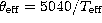 . Since processing of
elements eventually leads to Fe production, [Fe/H] is taken as a metallicity
index. The [Fe/H] catalogue often gives more than one set of values of
. Since processing of
elements eventually leads to Fe production, [Fe/H] is taken as a metallicity
index. The [Fe/H] catalogue often gives more than one set of values of
 ,
,  and [Fe/H] for a given star, based on different
studies done of that star. Care was taken to choose the ones derived from
the best quality data, i.e., data obtained at high resolution and/or in
red/near-infrared and the ones based on fine analysis/spectrum synthesis.
These are more reliable because the red region is less line-crowded than the
blue, thus minimizing the effects of blanketing and allowing a better
location of the continuum. The stars listed in Table 1 include a
distribution of dwarfs, subgiants, giants and supergiants with metallicities
spread over a large enough range. Five stars have [Fe/H] between -1.0 and
-3.0, 22 between -0.5 and -1.0, and 43 between 0.0 and -0.5; 42
stars are metal rich with [Fe/H] between +0.00 and +1.01, while only 5
of them have
and [Fe/H] for a given star, based on different
studies done of that star. Care was taken to choose the ones derived from
the best quality data, i.e., data obtained at high resolution and/or in
red/near-infrared and the ones based on fine analysis/spectrum synthesis.
These are more reliable because the red region is less line-crowded than the
blue, thus minimizing the effects of blanketing and allowing a better
location of the continuum. The stars listed in Table 1 include a
distribution of dwarfs, subgiants, giants and supergiants with metallicities
spread over a large enough range. Five stars have [Fe/H] between -1.0 and
-3.0, 22 between -0.5 and -1.0, and 43 between 0.0 and -0.5; 42
stars are metal rich with [Fe/H] between +0.00 and +1.01, while only 5
of them have  . Because of the restriction of
observations to stars with a magnitude brighter than V = +7.0, not many of
the more metal poor ones (
. Because of the restriction of
observations to stars with a magnitude brighter than V = +7.0, not many of
the more metal poor ones ( ) could be included. Also,
our sample does not contain a large number of metal rich (with
) could be included. Also,
our sample does not contain a large number of metal rich (with  ) G, K and M stars. Since they span all ages, their number is
heavily weighted towards older, metal poor populations. A G, K or M metal
rich star is much rarer than a metal poor one. Similarly, it is more likely
to find an A type (or hotter) star which is metal rich, than a cool star
which is metal rich.
) G, K and M stars. Since they span all ages, their number is
heavily weighted towards older, metal poor populations. A G, K or M metal
rich star is much rarer than a metal poor one. Similarly, it is more likely
to find an A type (or hotter) star which is metal rich, than a cool star
which is metal rich.
There are several stars in Table 1 for which [Fe/H] and  are not yet
available from the literature. Wherever
are not yet
available from the literature. Wherever  is not available, we have
used the statistical values given in Allen (1973) and Zhou
(1991). Table 1 also contains a few superluminous supergiants,
i.e., of luminosity class 0 and 0-Ia, also called hypergiants. Some of
these and several more appear in ``An Atlas of Spectra of the cooler stars"
(Keenan & McNeil 1976). According to this atlas, these stars
are known to have
is not available, we have
used the statistical values given in Allen (1973) and Zhou
(1991). Table 1 also contains a few superluminous supergiants,
i.e., of luminosity class 0 and 0-Ia, also called hypergiants. Some of
these and several more appear in ``An Atlas of Spectra of the cooler stars"
(Keenan & McNeil 1976). According to this atlas, these stars
are known to have  as high as -8.5 to -9.0, comparable to the most
luminous stars in the LMC. Gravities for most of the superluminous
supergiants could not be estimated from Allen (1973) or Zhou
(1991). They were estimated from their basic stellar data in the
following way. The effective temperatures were obtained from the temperature
calibrations of Bohm-Vitense (1972), Flower
(1977), Luck & Bond (1980) and Bell &
Gustaffson (1989). The absolute visual magnitude
as high as -8.5 to -9.0, comparable to the most
luminous stars in the LMC. Gravities for most of the superluminous
supergiants could not be estimated from Allen (1973) or Zhou
(1991). They were estimated from their basic stellar data in the
following way. The effective temperatures were obtained from the temperature
calibrations of Bohm-Vitense (1972), Flower
(1977), Luck & Bond (1980) and Bell &
Gustaffson (1989). The absolute visual magnitude  for these
stars were obtained from the MK-
for these
stars were obtained from the MK- mapping tabulated for various spectral
types and luminosities (Lang 1992). Bolometric corrections
(B.C.) are from Schmidt-Kaler (1982). Once
mapping tabulated for various spectral
types and luminosities (Lang 1992). Bolometric corrections
(B.C.) are from Schmidt-Kaler (1982). Once  and
and
 are known, R, the stellar radius could be calculated:

where 

Once R is known, and the mass M is assumed (from the location of the
star on the HR diagram), g can be calculated:


where M and R are in solar units;  .
.
The values of  listed in Table 1 with asterix are the ones
determined as above.
listed in Table 1 with asterix are the ones
determined as above.
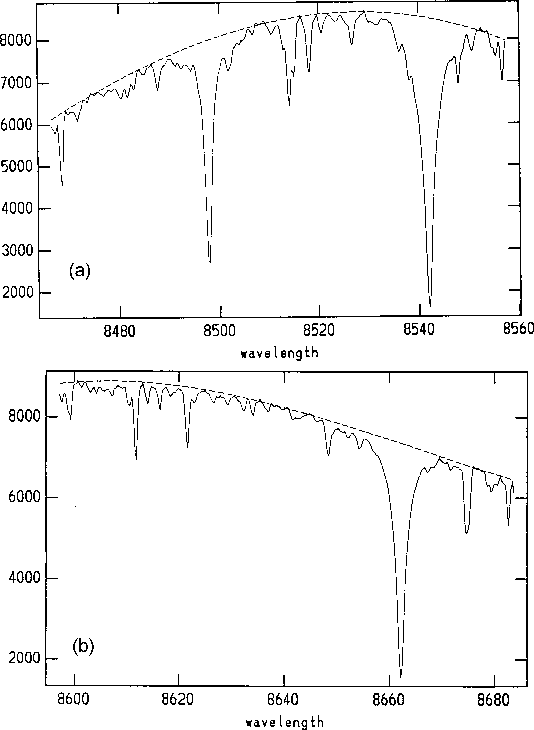
Figure 1: A first order cubic spline fit to the continuum in  Boo:
a)
Boo:
a)  , 8542, b)
A part of the data reduction was carried out with the RESPECT
software package due to Prabhu & Anupama (1991) installed at
the Vax 11/780 system at VBO. Here, the procedure of extracting
one-dimensional spectra from the two dimensional CCD image follows the
optimal extraction algorithm of Horne (1986, 1988). Since for
each star, the  8498, 8542 and the
  8662 spectra were
observed separately, the reduction of their data was done independently for
the two spectra. The reduction procedure involved bias subtraction, flat
field correction, wavelength calibration and normalisation by fitting a
continuum. The bias was subtracted from the raw spectrum, then the spectrum
was divided by the flat field image which accounted both for the pixel to
pixel sensitivity difference of the detector and for the curved nature of
the response function of the echelle spectrograph across each order. The
wavelength scales for the observed spectra were derived using the absorption
lines in the stellar spectrum itself, ensuring that the lines are of
photospheric origin (with lower excitation potential
8662 spectra were
observed separately, the reduction of their data was done independently for
the two spectra. The reduction procedure involved bias subtraction, flat
field correction, wavelength calibration and normalisation by fitting a
continuum. The bias was subtracted from the raw spectrum, then the spectrum
was divided by the flat field image which accounted both for the pixel to
pixel sensitivity difference of the detector and for the curved nature of
the response function of the echelle spectrograph across each order. The
wavelength scales for the observed spectra were derived using the absorption
lines in the stellar spectrum itself, ensuring that the lines are of
photospheric origin (with lower excitation potential  ). The
stellar features chosen in the neighbourhood of
). The
stellar features chosen in the neighbourhood of  , 8542
are Fe I lines at 8468.418 Å, 8471.744 Å, 8514.082 Å, 8515.122 Å\
and 8526.676 Å\
and a Si I line at 8556.797 Å. In the neighbourhood of
, 8542
are Fe I lines at 8468.418 Å, 8471.744 Å, 8514.082 Å, 8515.122 Å\
and 8526.676 Å\
and a Si I line at 8556.797 Å. In the neighbourhood of  are
the Fe I lines at 8610.609 Å, 8611.812 Å, 8613.946 Å, 8616.284 Å,
8621.618 Å, 8674.756 Å and 8688.642 Å and the Si I lines at
8648.472 Å and 8686.368 Å. The analysis of the Ca II triplet lines
requires only the measurement of equivalent widths, so no flux calibration
was done. Instead, each observed spectrum was divided by an estimated
continuum and the EQWs were measured from the normalised spectra thus
obtained. Rest of the data was reduced with the CCD reduction package IRAF
(Image Reduction and Analysis Facility) developed in the UNIX operating
environment and is available on a SUN workstation. Spectra of a few stars
were reduced both with the RESPECT and the IRAF to see how well the EQWs determined in the two ways compare. The correlation was found to be good to within 5 per cent.
are
the Fe I lines at 8610.609 Å, 8611.812 Å, 8613.946 Å, 8616.284 Å,
8621.618 Å, 8674.756 Å and 8688.642 Å and the Si I lines at
8648.472 Å and 8686.368 Å. The analysis of the Ca II triplet lines
requires only the measurement of equivalent widths, so no flux calibration
was done. Instead, each observed spectrum was divided by an estimated
continuum and the EQWs were measured from the normalised spectra thus
obtained. Rest of the data was reduced with the CCD reduction package IRAF
(Image Reduction and Analysis Facility) developed in the UNIX operating
environment and is available on a SUN workstation. Spectra of a few stars
were reduced both with the RESPECT and the IRAF to see how well the EQWs determined in the two ways compare. The correlation was found to be good to within 5 per cent.
The EQW measurement depends most crucially upon the choice of the
continuum. TiO bands appear in the vicinity of the Ca II features stretching
from 8432 Å to 8620 Å. The TiO bands with the triple bandheads at
 8432, 8442 and 8452 become very strong in stars with
spectral types M4 and later, and tend to depress the continuum in the
vicinity of the Ca II triplet lines which thus appear weaker. The
uncertainty in the placement of the continuum, because of the TiO bands, can
therefore give rise to serious uncertainties in the EQW measurements. In
most of the previous studies where the 3 lines were observed simultaneously,
owing to the lower resolution, the practice has been to choose two
wavelength bands over the entire spectral range observed and to define the
continuum by a straight line fit relative to the flux maxima near the chosen
wavelength bands. Fitting a straight line continuum with local maxima at the
bands chosen close to each of the Ca II triplet lines has the effect of
eliminating the contribution from the wings of the Ca II lines which results
in underestimating the EQW. On the other hand, fitting a continuum between
the local maxima at the bands far to the right and left side of the Ca II
line results in an overestimate of the EQW because of the inclusion of TiO
bands especially for the cooler stars. Since the present observations were
obtained at a fairly high spectral resolution and the three lines could not
be observed together, the latter method for choosing the continuum could not
be adopted. Instead, a few points were chosen consistently for spectra of
all the stars, in the regions relatively free of spectral lines across the
order containing the Ca II triplet lines. As a representative sample,
Figs. 1 (click here)a and b show respectively for
8432, 8442 and 8452 become very strong in stars with
spectral types M4 and later, and tend to depress the continuum in the
vicinity of the Ca II triplet lines which thus appear weaker. The
uncertainty in the placement of the continuum, because of the TiO bands, can
therefore give rise to serious uncertainties in the EQW measurements. In
most of the previous studies where the 3 lines were observed simultaneously,
owing to the lower resolution, the practice has been to choose two
wavelength bands over the entire spectral range observed and to define the
continuum by a straight line fit relative to the flux maxima near the chosen
wavelength bands. Fitting a straight line continuum with local maxima at the
bands chosen close to each of the Ca II triplet lines has the effect of
eliminating the contribution from the wings of the Ca II lines which results
in underestimating the EQW. On the other hand, fitting a continuum between
the local maxima at the bands far to the right and left side of the Ca II
line results in an overestimate of the EQW because of the inclusion of TiO
bands especially for the cooler stars. Since the present observations were
obtained at a fairly high spectral resolution and the three lines could not
be observed together, the latter method for choosing the continuum could not
be adopted. Instead, a few points were chosen consistently for spectra of
all the stars, in the regions relatively free of spectral lines across the
order containing the Ca II triplet lines. As a representative sample,
Figs. 1 (click here)a and b show respectively for  8498, 8542
and for
8498, 8542
and for  8662 the continuum fitting obtained by a first order cubic
spline fit over the chosen points. Care has to be taken to define the
continuum relative to the same wavelength regions in stars of all spectral
types so that it provides a consistent method for studying mixed stellar
populations. From the data for stars observed more than once, the error in
the determination of EQWs for each individual observation could be estimated
and this turns out to be less than 10 per cent. M stars would give larger
errors because of the presence of strong TiO bands. We have very few M stars
on our list; in fact none later than M4 are there. However, for the early M
stars where the TiO bands do start showing up, there was some ambiguity in
the location of the continuum. Our experience with EQW measurements from
over 300 spectra revealed that errors in EQWs arise mostly out of
uncertainties in the continuum placing and could amount to
8662 the continuum fitting obtained by a first order cubic
spline fit over the chosen points. Care has to be taken to define the
continuum relative to the same wavelength regions in stars of all spectral
types so that it provides a consistent method for studying mixed stellar
populations. From the data for stars observed more than once, the error in
the determination of EQWs for each individual observation could be estimated
and this turns out to be less than 10 per cent. M stars would give larger
errors because of the presence of strong TiO bands. We have very few M stars
on our list; in fact none later than M4 are there. However, for the early M
stars where the TiO bands do start showing up, there was some ambiguity in
the location of the continuum. Our experience with EQW measurements from
over 300 spectra revealed that errors in EQWs arise mostly out of
uncertainties in the continuum placing and could amount to  .
.
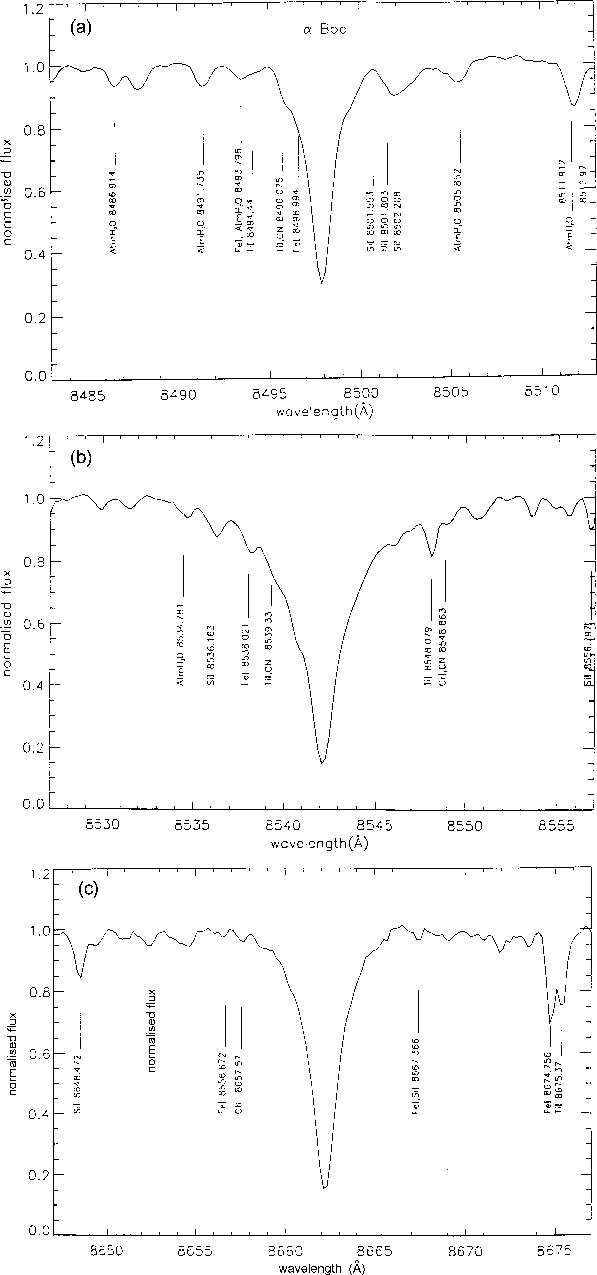
Figure 2: 30 Å normalised (divided by the continuum) spectral
region in  Boo in the neighbourhood of: a)
  ,
b)
,
b)  , c)
, c) 
Columns 4, 5 and 6 of Table 2 list the EQWs of  8498,
8498,  8542 and
 8662 respectively. Column 7 gives the sum of the 3 EQWs designated as
CaT. The observations of DTT (1989), for example, involved the sum of the EQWs of
8662 respectively. Column 7 gives the sum of the 3 EQWs designated as
CaT. The observations of DTT (1989), for example, involved the sum of the EQWs of
 8542 and
  8662 and not of all the three lines of the Ca II triplet.
Theoretical analysis by JCJ (1992) also lists the sum of the two brighter lines.
For comparing the present values with these, we have listed the sum of the observed
EQWs of
8662 and not of all the three lines of the Ca II triplet.
Theoretical analysis by JCJ (1992) also lists the sum of the two brighter lines.
For comparing the present values with these, we have listed the sum of the observed
EQWs of  and
and  , denoted by W in Col. 8. For stars
in common with DTT, the present values are lower roughly by 5 to 20% in 15
of them and
, denoted by W in Col. 8. For stars
in common with DTT, the present values are lower roughly by 5 to 20% in 15
of them and  for 7 of them and for those in common with Zhou
(1991), the present values are lower by an even larger factor. On
the other hand, our
for 7 of them and for those in common with Zhou
(1991), the present values are lower by an even larger factor. On
the other hand, our  8498 measures of 14 stars in common with those
of Anderson (1974) are higher than his and also our
8498 measures of 14 stars in common with those
of Anderson (1974) are higher than his and also our
 8542 measures of 25 stars in common with Linsky et al.
(1979) are higher than theirs. These differences are certainly due
in part to the choice of the line windows for the EQW measurement of the 3
lines which indirectly has to do with the spectral resolution used in each
study. The EQW measurements of the Ca II triplet observed by DTT at a
spectral resolution of 3.5 Å have been based on a choice of a line
window of 30 Å. Zhou's (1991) observations were obtained at
a spectral resolution of 2 Å and the chosen line window was 20 Å. As a
consequence, several features of Ti I, Fe I, Si I, Ni I and CN either
blended with a Ca II triplet line or on either side of it have contributed
to the resultant EQW. Figures 2 (click here)a, b and c show the 30 Å region
around the 3 lines respectively in
8542 measures of 25 stars in common with Linsky et al.
(1979) are higher than theirs. These differences are certainly due
in part to the choice of the line windows for the EQW measurement of the 3
lines which indirectly has to do with the spectral resolution used in each
study. The EQW measurements of the Ca II triplet observed by DTT at a
spectral resolution of 3.5 Å have been based on a choice of a line
window of 30 Å. Zhou's (1991) observations were obtained at
a spectral resolution of 2 Å and the chosen line window was 20 Å. As a
consequence, several features of Ti I, Fe I, Si I, Ni I and CN either
blended with a Ca II triplet line or on either side of it have contributed
to the resultant EQW. Figures 2 (click here)a, b and c show the 30 Å region
around the 3 lines respectively in  Boo as an example, with several
lines identified. About 9 in the vicinity of
Boo as an example, with several
lines identified. About 9 in the vicinity of  8662, 12 around
 8542 and about 13 features in the neighbourhood of
  8498
have added to the measured EQWs. The line windows chosen in the present
observations were much smaller, namely,
8498
have added to the measured EQWs. The line windows chosen in the present
observations were much smaller, namely,  for
for  ;
;  for
for  and
and
 for
for  . These therefore included less blended
features that contribute to the EQWs of the Ca II triplet lines. The window
for
. These therefore included less blended
features that contribute to the EQWs of the Ca II triplet lines. The window
for  8498 includes, besides small contributions of Fe I, Atm
 , Ti I
  , Ti I
  and Fe I
  , the lines of Si I
 , 8502.228 and Ni I
  . The window
chosen for
. The window
chosen for  8542 has Si I
  8536.163, Fe I
  8538.021,
Ti I
8538.021,
Ti I  8548.079 and to a smaller extent CN, Cr I
  8548.863
and that for
8548.863
and that for  8662 contains Fe I
  8656.672, CN
 8657.57 and Fe I, Si I
  8667.366, none of which are strong.
There is less contamination from the neighbourhood of the lines owing to the
smaller windows chosen, hence lower EQWs. The observations of Linsky et al.
(1979) and of Anderson (1974) are at a much higher
spectral resolution (0.14 Å and 0.28 Å respectively) than ours;
perhaps the effect of blending is minimized. For 23 of our program stars in
common with DTT, we re-measured the EQWs choosing the line window to be 30
Å. It turns out that the EQWs are larger, as expected, and closer to the
values of DTT, especially for the
8667.366, none of which are strong.
There is less contamination from the neighbourhood of the lines owing to the
smaller windows chosen, hence lower EQWs. The observations of Linsky et al.
(1979) and of Anderson (1974) are at a much higher
spectral resolution (0.14 Å and 0.28 Å respectively) than ours;
perhaps the effect of blending is minimized. For 23 of our program stars in
common with DTT, we re-measured the EQWs choosing the line window to be 30
Å. It turns out that the EQWs are larger, as expected, and closer to the
values of DTT, especially for the  8542 and the
  8662 lines.
The differences are not that small in the case of the
8662 lines.
The differences are not that small in the case of the  8498 line.
Although the choice of line windows does affect the measured EQWs and
largely accounts for the differences in the
8498 line.
Although the choice of line windows does affect the measured EQWs and
largely accounts for the differences in the  8542, 8662
lines, it must be noted that the reason for part of the discrepancy in the
EQW values (especially those of the
8542, 8662
lines, it must be noted that the reason for part of the discrepancy in the
EQW values (especially those of the  8498) lies in the choice of the
continuum.
8498) lies in the choice of the
continuum.
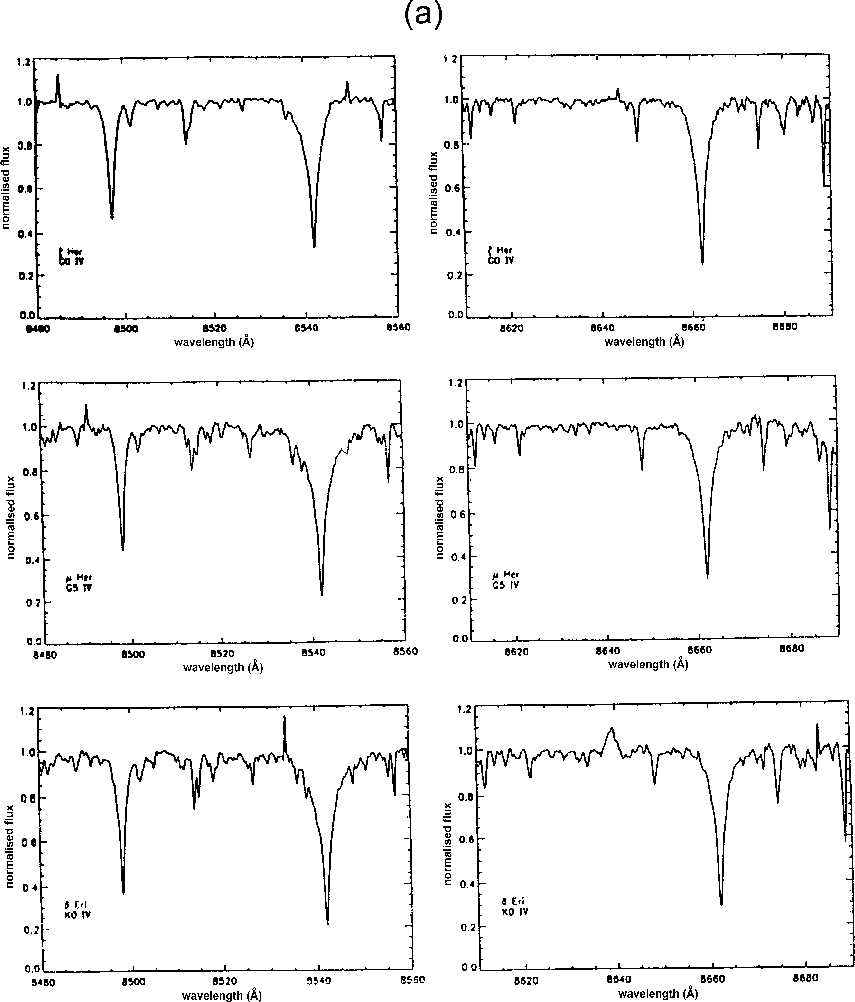
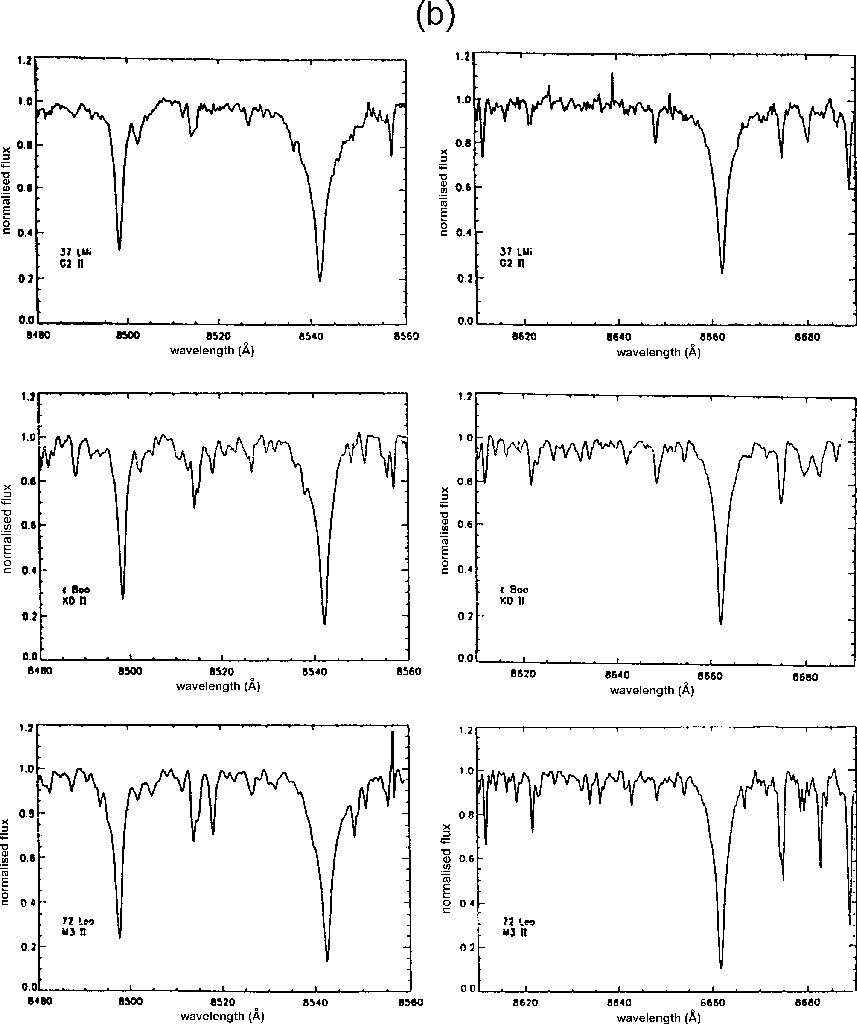
Figure 3: Sample normalised spectra around the  , 8542, 8662 lines
of Ca II for stars of a given luminosity over a range of spectral types:
a) IV, b) II, c) Ib, d) 0-Ia
, 8542, 8662 lines
of Ca II for stars of a given luminosity over a range of spectral types:
a) IV, b) II, c) Ib, d) 0-Ia